
Video Transcript: A few minutes here and I thought I’d just turn on my phone here and do a little YouTube Live, answer some of your questions, get you caught up on some of what’s going on around here.
Thanks everybody for making the Black Friday week so great. I know not everybody loves getting all those emails, but we just had some great deals this year and just want to say thanks to everybody. We are almost done shipping out all of the orders. I have still have four sets of pipes that need to be fully assembled and put together. So, those will be coming out, either shipping those tomorrow or early next week. So, thanks for your patience on that.
Also, if you’re looking to get something for somebody for Christmas, now’s the time. Postage and shipping can be slow this time of year with weather and just with people being busy. So, if you’re looking at getting something for the piper on your Christmas list, now’s the time to get to the BagpipeLessons.com shop and get that ordered. And if you have any questions about the shipping times or anything, just shoot us an email and we’ll get back to you. But, best to order soon and to order, you know, if you can upgrade to the priority shipping that’s and make sure that things get to you on time. Anyway, cool. So that’s that about the sort of the shopping season.
It’s a bit of a sad week for the piping world. We lost a couple of great pipers just in the last week. And first one is Ian McLellan. And Ian’s, you know, a lot of people consider him to be the greatest Pipe Major of all time in terms of competitive pipe bands. And he was Pipe Major of the Strathclyde Police, and their great era was in the 80s into the 90s and winning the Grade One World Pipe Band Championships, like the Super Bowl of bagpipes. There’s nothing that comes close to that important or that sort of magnitude. And they won the Worlds 12 times, including six in a row. And that’s just an unbelievable feat. And Ian was also a great solo player and later was a judge in both pipe bands and solos.
I got to know Ian and got to take lessons with him in the late 90s at the Masters of Scottish Arts Winter School. So I was sort of a young up-and-coming professional piper and the Winter School was here in Seattle and it was the first of its kind. Like a super school for piping and drumming. And I was actually at some of the original planning meetings and this concept of the Masters of Scottish Arts, the vision was a gentleman named John Callahan and he had this idea and he got together some local pipers and were like, “What do you think about this idea?” And it was really an amazing concept.
And the idea was to bring the very best pipers and drummers and Highland dancers to Seattle, which is where I am sitting right now, and to do a school, like a week-long school of lessons and then have a concert at a big huge concert hall. And his vision, I never thought it was going to happen. He said we have to have absolutely the best of the best. And we helped put together a list of what that would be. And I didn’t think it would be possible. So it was Alasdair Gillies, Mike Cusack, Bill Livingston, Ian McLellan, Jack Lee, Willie McCallum, Roddy MacLeod. So really like the very, very best.
And then, you know, on the drumming side, it was Tim Kilpatrick. And I’m leaving people out. But if you don’t know who those names are because you’re not into the, you’re not sort of familiar with the piping and pipe band scene, this would be like saying, “We want to put together a camp, a sports camp, and this is who we want to have teaching there. We want to have Michael Jordan, Wayne Gretzky, Joe Montana, Tom Brady, Gordie Howe, Magic Johnson, Larry Bird.” I mean, you’re getting what I’m saying. And then, oh, and then also we want to have, I don’t know, just think of who the greatest of the great in whatever field and that was John Callahan’s vision of this Winter School.
I didn’t think it was going to happen, but it did end up happening. And it was one of the great thrills of my life as a piper to be at a school and to get to have lessons with all these amazing legends, living legends really. And one of them was Ian McLellan. And I remember some really memorable lessons with him. And one of them was about “how do you get a good sound?” You know, how do you get a good chanter sound? And this is before online shopping was an option. So you’re talking about going to a shop or ordering things through the mail or whatever. And I asked what his secret to a great chanter sound was.
And he said, I’ll never forget this. He said, “I get a box of reeds and I just go through them and I test them until I find one that’s great and that’s it.” And I just had to laugh about that, and I’m still laughing about it now because he was a partner in The Band Room which was a shop and I think before that you know he’s Pipe Major of Strathclye Police. He is a very well-connected person in the piping community in Scotland in the Glasgow area, it’s not that big so you could do that. But to me it just was crazy that that was his secret. And of course, he had other tools in his arsenal as well to get a great sound.
But what that taught me and what I still believe today to be true, and not just a belief on faith, but what I’ve experienced through all these years of playing band, solo, teaching, working with pipers of all levels, is that the very best reeds are born. I mean they’re made, but they’re made by the reed maker. I’m not a reed maker. So those reeds, the really good reeds, they’re going to be good right from the beginning, right? They are good reeds right out of the box. Now, you want to make sure that they’re stored in the right humidity environment so they don’t get too dry. You break them in. There’s of course a tuning process, but there’s no turning a badly made reed or a damaged reed into a good reed. New reeds will come to you and the good ones are good right from the get-go.
So, if you’re looking for a good reed, just a quick aside, check out my Foundation Reed on the website. I’ll put the link below. They’re guaranteed. As far as I know, they’re the only reeds in the world that are personally guaranteed. I select every reed. I pick the strength that you order and I personally guarantee that it’s going to be good or I’ll replace it or give you your money back.
Um, so that was Ian McLellan. The other thing that he did which was kind of unusual, was he played heavy F strikes. So normally a strike these days we tap the single finger so you’re tapping an E. But he played a heavy F strike and I don’t remember the tune. He’s working on some 6/8s and I asked about it and I said, “Oh are you playing a heavy F strike?” and he said, “Yep.” Actually said, “Am I?” and then said, “Oh okay yeah I guess I am.” So I’ve asked some people about these heavy F strikes because we don’t really see them too often. I think Dr. Angus plays them, Dr. Angus MacDonald. Haven’t talked to him about it, but it sounds like he’s playing them on recordings.
There’s also a very famous story, famous to the people who were there. I don’t know if it’s famous broadly, but it kind of became a legendary story. And Alasdair Gillies who was there loved to tell this story about they were talking about the performance that the instructors were going to be putting together at our big concert hall at Benaroya Hall and they were working on I think an MSR or something. Of course Ian being the senior most accomplished pipe band leader would be the Pipe Major of this group, this superstar band. The way the story goes is that Bill Livingston was asking like, “how many beats are we going to do or what’s this break going to be and how are we going to organize this?” You know, “how are we going to conceptualize this break?” And the famous quote from Ian McLellan was something like, “When my foot comes down, you start the next tune.” And there might have been a little bit more colorful language worked in there, but Alasdair loved that story because it just encapsulated Ian McLellan’s really strong leadership, his confidence, and the Strathclyde Police were sort of legendary for that, which is they practiced a lot, they were really tight, and he was the leader. And when that foot comes down, you start the tune.
Anyway, cool. All right. Lots of comments here. Thanks everybody. Give me a second.
So, sadly Ian passed away just about a week ago and he was really, really well respected. I’d see him at the big competitions in Scotland and always had a smile and a twinkle in his eye and he told me after I’d had some success at the very highest level over there in Scotland, he came up to me and he said that he was proud of me. And I was kind of surprised by that and he said that he remembered teaching me all those years before and that he was always kind of pulling for me and he was really pleased that I had had the success on the international stage competing at that high level. So, that was really sweet to have someone who’s just absolutely a living legend, to feel like they’re on your side. So, we miss him a lot.
All right, what’s going on here? Lots of comments on that. And then I just saw a couple days ago that another great piper has died and that’s Jamie Troy, James W. Troy or Jamie Senior. And I knew Jamie since I was 13 years old. And he was one of my teachers at the Coeur d’Alene Piping School in Coeur d’Alene, Idaho. And back in the 70s and 80s and into the early 90s, that was the place. There’s a lot of these piping schools around now, but at that point, that was like the school where people went and people from Oregon, Washington, all across this area. I made lifelong friends at that camp from all across Canada.
And my first year there, I could barely play my pipes. I was just a little kid and I hadn’t been playing that long and I was struggling to play the pipes. And the Troy family sort of seemed like celebrities or like some kind of piping royalty because there was Jamie Senior who’s a Pipe Major to the City of Victoria Pipe Band and then his son Jamie Jr., we’re about the same age but Jamie’s a little bit younger than me. And when you’re 12 or 13, being a year younger seems like a lot. And he was already a superb piper. I think that year he might have been a Grade Two level piper, which is a high amateur level, and a Grade One side drummer. And then Jackie, the younger sister, she’s a really, really good drummer. So, they were this kind of amazing, super talented family, and playing together. And I just have these really strong memories even all these years later of Jamie Senior playing with Jamie Jr. and just thinking that was the coolest thing, you know, to have a kid piper playing bagpipes with his dad. And I always kind of idolized that. And I guess in a way I’m trying to recreate that with my own son. My own son Colin is 13 and he’s turning out to be a good little piper.
Anyway, Jamie was, he was a really sweet guy and had a heart of gold, but he had a grouchy exterior. And we just kind of knew that about him. And he demanded a lot from his students. And he judged me a lot over the years in various solo competitions. And he was not the kind to give false praise. So the typical sheet, when you are in a solo piping competition, one of the first things that the judge will write is something about your sound. Now judges, they need to sort of have a balance of critique and sort of criticism, but also maybe some encouragement. And I can’t tell you how many sheets I got from Jamie where at the beginning instead of saying, “Oh, your pipes sound good or pipes sound nice,” it would say “pipe okay” or “pipe not 100%.” And that’s just his way of saying okay, not horrible, but you know, you can do better. And it kind of became a little bit of a joke, but an inside joke with myself, I guess, and maybe some other pipers. We’ve talked about that. “Oh, it got pipe okay.” But you knew that if he said “pipe good” that was real and that was a real compliment and it was legitimate.
Jamie was also the guy who was the first person I remember really talking about the importance of having good form with your hands. And he talked about having that curved finger. And when you saw him play, he had that nice kind of relaxed curve. Whereas a lot of people were trying to be really straight. And even that College of Piping Green Book that a lot of us learn from in Scotland, the pictures sort of look like real rigid straight fingers. And Jamie was showing, “no, no, you want to have a nice relaxed curve and you just want to lift your fingers barely off the chanter anymore than, you know, maybe a half inch or so, you’re wasting movement.” And that stuck with me and all these years of piping, it’s absolutely true. But to be able to play clean and fast and consistent and execute all these tunes that you want to play, these hard tunes, you got to have good form, which is keep your hands relaxed, keep them in close to the chanter.
The other thing I remember was talking about maintenance of the bagpipes and talking about how you want to have all your joints nice and snug, tuning slides, drone, all that stuff, is that he would take his pipes, pick them up off the table or take them off his shoulder and hold them upside down. So the bag’s up here and the drones are coming down and shake them and we’re kind of going, “Oh my gosh.” But his point was nothing’s going to fall off. Everything is nice and snug and tight. Not so tight that you can’t move it, but tight enough that gravity is not going to have your pipes falling apart. So, I take a lot of pride and time in maintaining my instrument, make sure it’s set up and everything is working as best as it can from the mechanical and maintenance standpoint. And it’s definitely something I’ll do to show to my students, which is, here’s your pipes. Now, put them upside down. Nothing’s going to fall. Nothing’s going to come apart.
And so much more. So much more. Jamie often taught the top class at Coeur d’Alene and that’s the young, top-level kid players and that was the goal. You wanted to be in that class. And that was my goal, to be in that group and to get to spend time with Jamie and to learn from him and to try to make him smile, try to get that nod of approval. That was important to me. So anyway, I’ll just say we’ll leave it at that. But you know, giant figures in the piping world, giant figures who changed the piping world really. I guess the final thing I’ll say is before my time as a piper, Jamie Troy’s band, the City of Victoria Pipe Band from Victoria, Canada, West coast of Canada, went over to Scotland in 1979 to the Worlds and they got sixth. But a lot of people who were there said they got completely screwed by the judges and that they should have won that day. So I don’t have any opinion about that. But I mean I can’t refute that. But that is what people are saying is that the best band to never win the Worlds was the City of Victoria Pipe Band in 1979. And he certainly knew about ensemble. He knew about how to get the pipes and the drums to be tight together. And arrangements and he definitely knew about tone and how to get a great sound out of a instrument.
Okay, so I got some questions here people have been asking me. One of the questions is, “Can you tell me about the Endurance Chanter and how the moisture control system works?”
Okay, so the Endurance Practice Chanter looks like a regular practice chanter except it’s not. 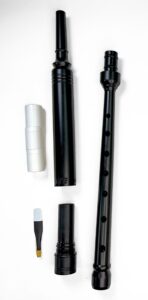 This is designed by me. It’s made by the famous R.G. Hardie & Co. in Scotland. Comes apart like your normal practice chanter. Now, this top is not a normal practice chanter top. This has a little secret compartment in here. So, you open this up. This part unscrews and then you have three little canisters. These are the Endurance Cartridges.
  Do not eat. So, this has silica gel in it.
So, what these do is that when you put it all back together, when you blow into the chanter, instead of all of the spit and the drool and the hot steamy breath going straight on your reed, it goes through those canisters. So, what that does is it dries your air out. So, you’re going to get, well, I get weeks out of it. It depends on how much you drool and how much you play, how long you get out of it. But, these cartridges work great. It comes with three. You can get more of these. And then you pop them in the oven at 200° and then they are totally dried out, ready to go. So totally sustainable, reusable, no waste, keeps your reed dry. I just heard from a piper today who has ordered a second one of these and he said he recommends it to all of his bandmates and allows you to play and play and play and play and your reeds don’t get all gummed up with all that spit and drool. So that’s how that works. The Endurance Practice Chanter made by R.G. Hardie in Scotland, designed by me and you’re going to love it.
Now I want some feedback here. I’m working on a concept for a new video. This is the plan. But if you like this idea, put a comment below that you want me to work on this. So, here’s my idea. I got a lot of questions from pipers about different size pipe bags. I’m a big fan of these Bannatyne Hybrid pipe bags. Comes in Small, Extended Small, and the Willie McCallum size. I also have two custom sizes that I have designed. A size called Super Mini for little kids. It’s what I first started my son learning. And then I also have an Extended Small bag with a long neck. And those are really popular for players that have longer arms.
So here’s my idea: I’m going to take a bunch of measurements, get all the bags hooked up with stocks and cork them up, inflate them, and then take measurements, my little tape measure around the bag, the length of the bag, all that kind of stuff, and make a PDF that you can download that’s got all the sizes on it. In the video line them all up so you can see, “this is what a Small looks like, this is what an Extended Small looks like.” So that’s my idea of this concept, is to make a video that’s like an up-close video tour and then have measurements and comparisons of all the different size pipe bags. If you like that idea, stick a comment down there.
All right, I’ve got some more questions here for you. Now, these are emailed to me through the website. I usually reply directly to each piper, but some good questions here.
Okay, one question is, “One of my biggest challenges in piping has been chanter tuning, especially that of hearing minor differences among different band members’ chanters and getting those chanters tuned together.” So, this is a great question and it’s hard. It’s hard. I remember being a young piper and hearing somebody play or maybe I was playing and then some good piper said, “Oh, well, your D’s a little bit sharp or your F’s a little bit flat.” And just being sort of baffled, like not having any sense of that and then later on developed my ear to be able to be more successful and confident at that. But to get to your question, which is like how can you get your, if you’re tuning up a pipe band, how can you get the pipe band in tune to a high precise level when you’re getting to those minor differences?
So, here’s what I would say. I would say use a tuner. Use a tuner or a tuner app. That is a great way to go. You don’t have to do it by ear. If you can do it by ear, great. But I think the best way to train your ear for tuning is to use a tuner or a tuner app because what that allows you to do is get your pipes in tune. And it also it’s like a teacher. It’s like a learning process as you’re tuning your pipes with the tuner. So there are certain types of tools that you can use that will help you do what you’re trying to do and they will teach you to do it without it. What am I talking about? Well, the tuner is one. The metronome is one.
So, the idea of a metronome is it does a couple things really, really well. It can give you a precise tempo like 70 beats per minute. And then it gives you a consistently steady tempo. So, it’s going to give you a constant tempo and a precise tempo set by a number. So, what that allows you to do is play to that tempo and get steady. Now, does that become a crutch? Do then you become reliant? Do you come to rely on the metronome? No, you don’t. You actually get better and steadier playing without the metronome by practicing with it. That’s the whole point. That’s why musicians love metronomes: it helps develop your own internal sense of timing. The other thing that it does is it can help you identify problem areas in your tunes. So, you may not realize that there’s a little part in your tune where you’re speeding up or slowing down. Or you may have a sense that there’s a little bit of an issue there, but you’re not sure exactly what’s going on. Play with your metronome and it becomes instantly clear, “Oh, I’m falling behind,” or “Oh, I’m getting ahead,” or that thing isn’t quite on the beat where it needs to be. So, that’s what the metronome does. It allows you to pinpoint and identify and fix your problem areas in your tunes as it relates to the beat and the tempo. And then you’re better without it. So, nobody would say, “Hey, you know, if you drive a car with a speedometer, it’s a crutch.” It’s not a crutch. It’s a tool. So, that’s what a metronome does.
Another thing would be the Bagpipe Gauge. So, this is my product that allows you to view the pressure inside your pipes as you’re playing. 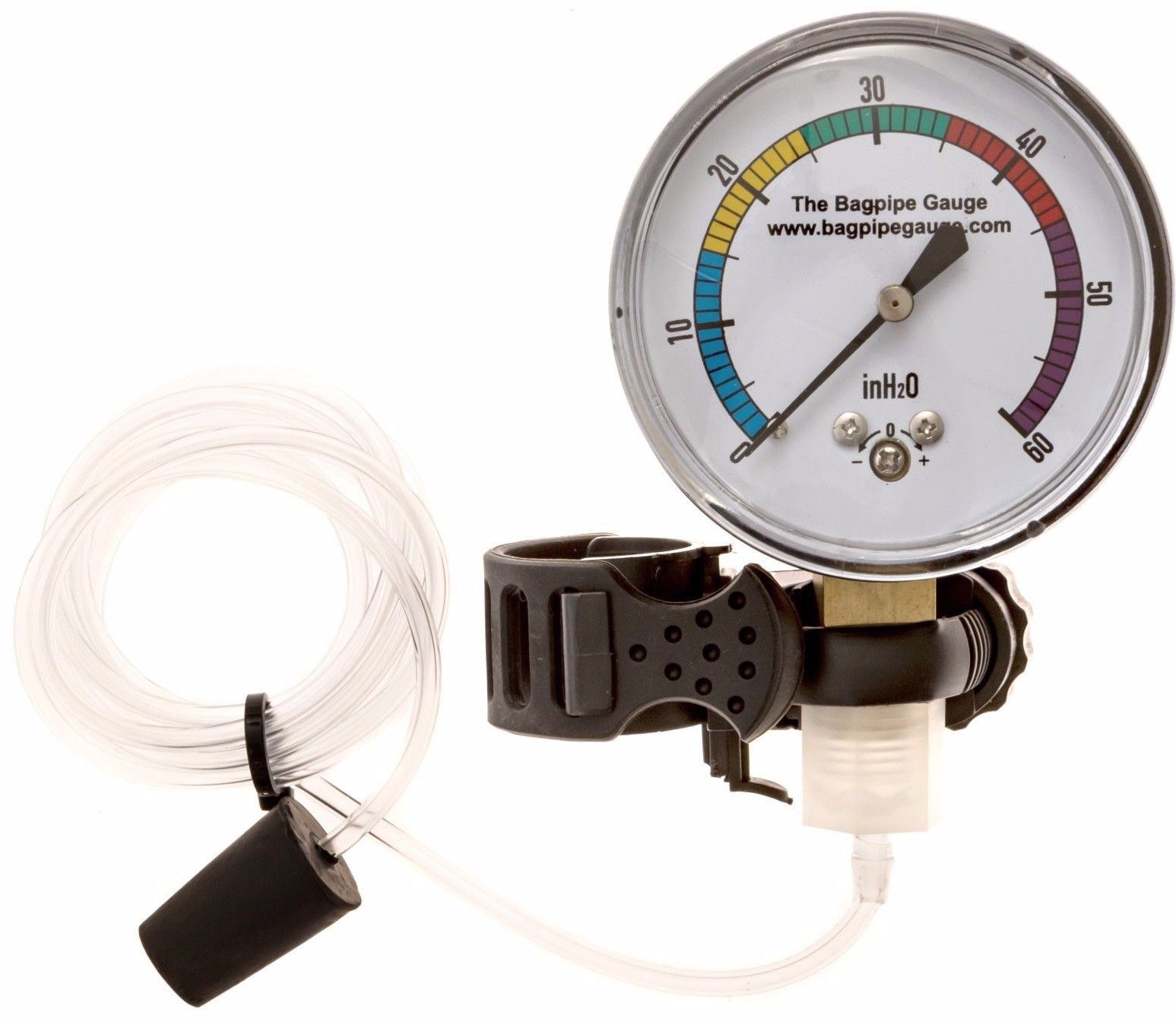 Well, the goal is not to become reliant on the gauge. The goal is to learn how to blow your pipe steady without the gauge. So, what do you do? Plug it in. The cork goes up into the top of one of your drones. Tube comes down to the gauge. You mount it on your blowpipe and you can see what’s going on with the pressure in your pipes. You can see how hard are your pipes because it gives you an exact number. 35, 30, 25. If you’re over 35, your pipes are too hard. If you’re right around 30, you’re pretty good. It also shows you the steadiness. So, what that allows you to do is identify what’s going on with your bagpipes. How hard are they? It answers the question, is it my pipes or is it me? If the gauge is showing you 30 and your pipes go really hard, you’ve got to look into that more. If your pipes are really hard and it’s showing 40, your pipes are too hard. It’s not you. It also shows you the steadiness. So, then you can figure out what’s going on. “Am I overblowing on the high A and under blowing on the low A? Is it randomly moving around? Am I nice and strong when I blow, but it gets weak when I take a breath?” All kinds of things you can figure out. It’s not a crutch. It’s a tool. It helps you get steadier instantly when you use it. And through practicing with it, it helps you get steadier without it.
So, that’s what I would say for tuning up the band. Use a tuner app. My favorite app for tuning chanters is the Braw Tuner, B-R-A-W or B in the Scottish brogue. And I have a link to that from my website. If you go to BagpipeLessons.com/tuner that will take you to the app page and it works really great because you can see exactly what’s going on with every note of the scale and you can use it as a teaching tool which is, you can be listening to somebody and you go, “I think that note maybe the F is a little bit flat,” and then you can look at the tuner and go, “Yeah, that’s right.” So you’re training yourself through that sort of feedback making a guess and then checking it. The other thing is even if you don’t do that making a guess first, just by tuning the pipes properly with the tuner, your ear starts to develop the sense of what in tune really is. And you will be more skilled and more confident and faster at identifying things by ear because you’ve heard good tuning.
The other thing I recommend is my InTune Mic, which is a wireless clip-on mic that works with your phone.  Works with any phone. It doesn’t need any specific app. It works with any app. And what that clip on the InTune Mic lets you do is just clip it to the chanter or clip it to the drones. So then you can use your smartphone and you can do it on your own. You don’t have to have three arms and eyes on the back of your head. Works really, really good. And it’s now one of my top two products along with the Tone Protector line is this InTune Mic. People just love it. Cool.
All right, another question here. Let’s see what’s going on here. Oh, I got a question from Tony Bronx 74. “Is it possible to use the Braw to tune the baritone drone on the small pipes?” The baritone drone? That’s a good question. So, normally have a tenor drone that’s A and they have a bass drone that’s A. I’m guessing the baritone drone is either an E or a D. And I would think you would be able to do it. Now, the pitch of my pipe chanter on my Highland pipes is around 480 something. So, say it’s 484. The low A on the small pipes, at least my small pipes, is not 440, it’s actually 220. So, you might have to set it to that so it actually knows where you’re at. So, I’m not really sure what you do for the baritone drone. There’s another app that I really like. It’s called the Tonal Energy Tuner. Tonal, T-O-N-A-L, tonal energy or the TE tuner for short. And this is also a paid app, but really, really good. It doesn’t have a built-in bagpipe setting, but there are bagpipe settings that you can use. If you end up getting the Tonal Energy Tuner and you want to know how to set it up for pipes, email me through my website. I’ve got a little Google Doc that I can send you. Just takes a couple minutes. And definitely with that tuner, you could tune any drone. You would just tune it to the E essentially.
All right. Pug Bob 5315 says, “I use a Medium bag. I’m thinking about trying an Extended Small, but not sure.”
Okay, I’ll give you my little quick spiel on pipe bags. I think the medium’s too big. Now, there may be somebody out there who it’s actually the perfect size for, but I’ve never met that person, and I’ve taught some really tall pipers with large upper bodies and long arms. The medium is just really huge, and there’s no advantage to a larger bag. You want a bag that is as small as possible that’s comfortable for you. Now, I get it. If you’re over six feet tall, maybe the small is too small for you. But the important thing to realize is there’s no advantage to a larger bag. There are lots of disadvantages to a larger bag. Takes longer to fill up. It can’t get up under your arm. It’s going to be slipping down more. So, I don’t even sell the medium. A large bag is like insanity. Now, I know I get that there are people that are used to it, that are comfortable with it, that that’s just what they’re used to. I was also used to a larger bag and then the first time I tried a small bag, it was like a Hallelujah moment and like angels were singing and bells were ringing because I thought, “Holy cow, this is it. This is what I’ve been looking for.” Let me get the bag way up under my armpit. Get my arm further around. Really feel like I’ve got a good firm lock on it. Really, really amazing. I play a small bag.
If you are thinking about downsizing from a medium and you want to go gradual, there’s two things to think about. One would be the Willie McCallum size. So Willie is a top piper from Scotland, great friend of mine, teacher of mine in the past, and Willie took a medium bag and slimmed it down in the front. So the front part is the important part. This part here where it comes from the neck and it sort of this angled area. What Willie did was this is quite narrow here in the front part of the bag which is the important part because that’s where your arm goes, right? So it’s like a medium in the back but more tapered in the front so that your arm is free and you’re not having the bag pushing on your forearm so I would recommend that.
The other one if you’re a taller person and you have the feeling that like that your arms want to be further out, that you feel a little bit scrunched this way. I don’t have this problem. But what I recommend is you get my Extended Small bag with the Long Neck. It’s a custom bag made by Bannatyne for me. And I don’t play it, but I ordered it for a student who has longer arms and he was struggling, really struggling. Well, basically his entire piping life to find a bag that was comfortable because he liked the size of an Extended Small, but with his longer arms, it felt too scrunched. So what we did, I worked with Bannatyne. We took a standard Extended Small and all we did is this part at the very front, just moved it out 2 inches. And two inches might not seem like much, but the feedback from people who have tried this bag is they absolutely love it. So made this bag for my student. He loved it. He immediately ordered, I think, two or three more for spares. And then I thought, well, maybe some other people want to try this bag. Put it up on the website and it’s quickly becoming one of my bestselling bags because it’s just the shape of your anatomy. These bags don’t fit everybody. So, if you have longer arms, think about my Extended Small with a custom Long Neck. So, I’ll put all the links below, but you can go to BagpipeLessons.com/shop, find all the categories, go to the pipe bag category, and it’s right there. Okay.
Jose Chimmy Changunga wants to know, “Is the Infinity Chanter a good chanter?” Are you kidding me? It’s the best chanter. I love that chanter. The Infinity Pipe Chanter is made by R.G. Hardie in Scotland. It’s a revolution in pipe chanter design because it’s got the smaller holes like the chanters they made decades ago, but it’s got this amazing bright modern sound that really projects. It doesn’t chirp. It’s super stable. It’s easy to tune. It works with all reeds. It’s got everything I like. And the smaller holes that are spaced closer together. Now, I’ve heard from people say, “Well, I have this really old chanter that’s got the smaller holes.” It’s like, that’s fine, but modern chanters, the sound is so much better. The stability is so much better. The tuning is so much better. The resistance to chirping and squeaking and squawking and all those sounds that we don’t like. That’s so much better in a modern chanter. But a lot of the other modern chanters have bigger holes because they think bigger holes, bigger sound, whatever. I’m not looking for a bigger sound. I’m looking for a very perfect sound and I want to be comfortable to play. I don’t have that big of hands on the pipe chanter. The largest holes are the ones at the bottom that use the smallest fingers with the biggest spacing. So just making those holes on the bottom and all the other ones too, but especially the larger holes on the bottom, getting them closer together with smaller holes, it’s a complete game changer. And when I go back to one of these big hole chanters after playing the Infinity for all these years, it’s like I can’t play them. I don’t want to play them. So yes to the Infinity Chanter. Cool.
Dena says, “Finally bit the bullet and got myself a tutor.” I’m guessing that means you got a teacher. That’s great. That’s great. If you want some more resources to help you on your piping journey, check out my website. I’ve got tons. Well, you’re on YouTube, so check out the YouTube channel, but I got tons of resources that’re free, totally free on BagpipeLessons.com. So, that’s my learn page. I’ve got free things you can download, tuning guides, playing guides, tons of videos. And the next level up from that would be I have downloadable tune lessons for $5. You can download sheet music and a recording and a lesson on that tune. I mean, that’s like more stuff than we could do in an hour in the lesson if you paid for a private lesson, but in that little download. There’re 74 tunes you can download. If you get on my email list, a couple times a year we run promos where we give out free tune downloads.
And then I’ve got some online courses. I’ve got a beginner’s course called Learn to Play the Pipes, 18 videos. I’ve got a 31 video course called the Bagpipe Essentials Masterclass.  I really love this class. It’s 31 videos on every piece of bagpiping fingering technique from like how to put your reed and your practice chanter together to how you put your hands on the practice chanter in the right position, where your thumb goes, the scale, gracenotes, doublings, grips, taorluaths, D-throws, burls, all that stuff. Tachums, crossing noises. That’s the Essentials Master Class. Really, really popular. So many people are using that course and really liking it.
And then if you want all that stuff included, sign up for my membership. So I have an Inner Circle Membership. I do live Zoom classes every week. Did 50 of them this year. And they’re about an hour long. We do them on Zoom and all the members can join. And and every video is recorded to watch anytime you want on your phone or computer or whatever. So it’s like one of my members said, “It’s like Netflix. I don’t have to binge watch Netflix anymore. I just binge watch Inner Circle Bagpipe Sessions.” So check that out. And there’s several hundred of those now. Plus a lesson library with hundreds of other lessons on every other piping topic you can imagine. So, check out my Inner Circle. You can join just pay monthly or you get a discount if you sign up for a year. You also get a one-on-one session with me and we’ll talk about your piping history and your goals and all that sort of stuff. So, there’s no reason that you need to be confused and practicing hard and learning things wrong or getting into dead ends. All the information is available for you and this is what I do. So, I’m happy to help.
Cool. Well, this is good. Thanks everybody for joining. Thanks for the comments. Thanks for the questions. Thanks for listening. Condolences to the family of Pipe Major Ian McLellan and to the Troys. The legacy that Ian and Jamie leave in the piping world and to those who they knew is huge. And the lessons that I learned from them, I continue to spread and teach to my students. And that’s how it works. You know, the beautiful thing about teaching is that you get to learn from others and you get to pass it on. And maybe someday some of the people that I’m teaching will teach some of these lessons to their students.
So, thanks everybody. Thanks for tuning in. If you got any questions, just post a comment below. We’ll get back to you. I appreciate it. I appreciate you for being part of BagpipeLessons.com. And we will see you next time.
Mahalo.
Secrets to Make your Pipes Easy to Play
Pipers enjoy playing more when our pipes sound and feel great. Master your instrument with these powerful and quick tips based on my 30+ years as a piper and teacher.
quick tips