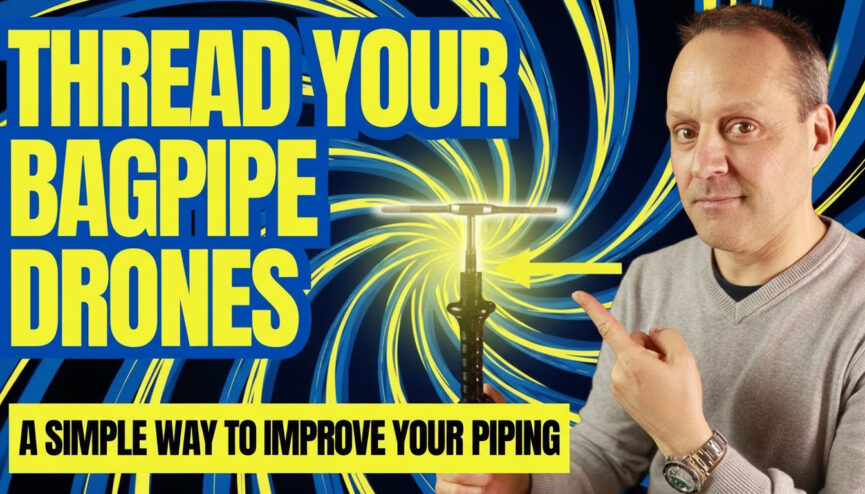


▶ Video lessonPipe setup
How to Easily Thread Your Drone Reed Seats for a Secure Fit and Better, More Stable Bagpipe Sound
Threading your drone reed seats lets you screw each drone reed in, instead of shoving it in tight with hemp and hoping it stays. You cut the threads with a tap. For most sets I have done, that is 10 mm by 1.25 for the tenors and 11 mm by 1.5 for the bass. Mark the depth with tape, go in nice and straight, and back the tap out often. It changes your pipes for good, so take your time.
The Main Ideas
Threading your drone reed seats is one of the best little modifications you can make to your pipes at home. You use a tap, which is a tool that cuts screw threads into the reed seat. Then your drone reeds screw in instead of being shoved in tight with hemp, and they never fall out again.
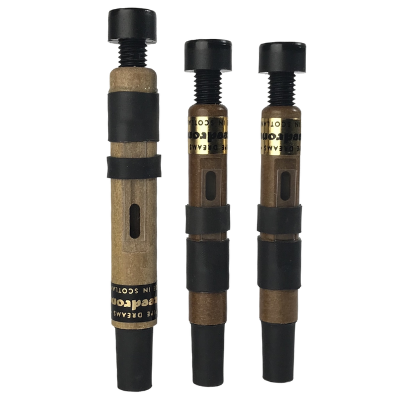
In the video I show you the tap sizes I use for most sets (10 mm by 1.25 for the tenors and 11 mm by 1.5 for the bass), how I use a piece of tape to mark how deep to go, and how to cut the threads straight and smooth. I also show what to do when a reed seat is too narrow, and how to put an Ezeedrone reed into a threaded seat.
This changes your pipes for good, so take your time and go in straight. And I actually think it helps keep my pipes in tune.
At a glance
| What it does | Cuts screw threads into the reed seat so the drone reed screws in and never falls out |
|---|---|
| The tool | A tap, with little grooves that cut threads as you turn it |
| Tenor drone tap | 10 mm by 1.25, for most of the sets I have done |
| Bass drone tap | 11 mm by 1.5, for most of the sets I have done |
| Depth | A piece of tape marks how far to go, so the threads stay no deeper than the reed |
| Is it permanent? | Yes. You are permanently altering your pipes |
| Narrow reed seats | Open them up first with a tapered reamer |
| Reeds in the video | Ezeedrone Combo Set, with a few wraps of hemp |
Video highlights
“So instead of having to shove that drone reed really tight with hemp and hope that it doesn’t fall out, we’re going to be able to just screw our drone reed right into the drone, and it will never fall out.”
“You have pretty much one shot to get that in there nice and straight.”
“You can split your wood, because you’re driving a piece of metal into a narrower and narrower bore, and it is possible that by cranking it in, the wood will be forced to expand and it will split.”
“I actually think it helps keep my pipes in tune, because it’s just a really solid connection between the drone reed, which is vibrating, and the drone.”

Free guideThe Ultimate Guide to Bagpipe Drone Reed Setup and MaintenanceMy free guide to setting up, adjusting and maintaining your drone reeds like a pro, so your drones are steadier and easier to tune.
Get the free guideThe gear in this video
Your questions, answered
Tap a time to watch that part of the video.
What does it mean to thread drone reed seats?
You cut a screw thread into the reed seat, which is where the drone reed sits in the drone. Then the reed screws in and never falls out again.
How does a threaded reed seat keep my drone reeds from falling out?
It works like a bolt and a nut. The reed seat becomes the nut, and the drone reed screws right into it. Once in a while I give the reeds a little twist, every time before I play, and they stay nice and snug.
What tools do I need to thread drone reed seats?
You need taps. A tap looks like a bolt, but it has little grooves in the metal, so every time you turn it, it cuts screw threads into the wood. The taps come with a wrench. I also use a piece of tape, a piece of paper to catch the shavings, and a brush.
Does threading permanently change my pipes?
Yes, you are permanently altering your pipes. I do not know of any bagpipe manufacturers doing this standard at the factory. Many newer chanters do have a threaded reed seat, but there it is used to adjust the reed for tuning. Here it is only to get a firm, secure grip.
What size tap do I need for tenor and bass drone reed seats?
For most of the sets I have done, the tenors take a 10 mm tap by 1.25, and the bass takes an 11 mm by 1.5. The 1.25 and 1.5 are how narrow or wide the threads are. I have seen some sets where those sizes do not work, and you need a different size.
How deep should I cut the threads?
Deep enough to give the reed a good surface to screw into, but not deeper than where the drone reed goes. I put a piece of tape on the tap and stop at that line, so no threads are exposed once the reed is all the way in. It does not affect the sound.
How do I cut the threads, step by step?
Check that the tap goes in about a third of the way, tighten the wrench on, and line it up nice and straight. Screw it in and feel the threads being cut. Back it out a few turns, go back and forth until it feels smooth, then go a little deeper, up to the tape line. Brush the shavings out.
How do I put a drone reed into a threaded reed seat?
I give the reed a few wraps of hemp. Then I hold it firmly, staying away from the tongue and the bridle, which are the fragile parts, and twist it into the drone. It ends up super snug.
Does the drone reed itself need threads?
No. The hemp and the rubber on the reed are soft, so it is as if they thread themselves just by screwing the reed in. When I pull it out, I can see on the hemp that it has been threaded.
What if my drone reed seat is too narrow for the tap?
Some older and very inexpensive sets have very narrow reed seats. First open the seat up with a tapered reamer. It is not for cutting threads. It just cuts away some material to make a wider, deeper opening, so your tap fits.
How do I avoid damaging my pipes when I tap the reed seat?
Use the right size tap and go in nice and straight. African Blackwood is strong, but you can easily mess it up at an angle, and you have pretty much one shot. Keep the tape on so you do not go too far.
Can I split the wood by tapping too far?
Yes. If the tap starts to feel really tight and hard, back it out. You are driving a piece of metal into a narrower and narrower bore, and the wood can be forced to expand and split. Use the right size tool, and go back and forth.
Does threading the reed seats help keep my pipes in tune?
I actually think it does. It makes a really solid connection between the drone reed, which is vibrating, and the drone. It keeps the reeds in there snug and secure.
Each week, the Inner Circle's lively sessions are designed to benefit pipers of all skill levels, all around the world.
LEARN FASTER. FIND GREATER ENJOYMENT FROM YOUR PIPING. JOIN ME.
Join the Inner CircleFull video transcript
0:01 Introduction – Why You Should Thread Your Drone Reed Seats
Hey, everybody, Jori Chisholm here from BagpipeLessons.com. I have been setting up a new set of pipes for a student. Last week on the YouTube channel I showed you some of these really cool new R.G. Hardie nickel and Blackwood bagpipes. And today I’m going to show you a really cool modification that you can do on your pipes at home with a couple of simple tools, that is really going to enhance your bagpipe setup.
And what I’m talking about is threading of your drone reed seats. So what the heck is threading? What we’re going to do is actually cut a screw thread into the reed seat, which is where the drone reed sits in the drone, so that they never fall out again.
0:34 What is Threading? The Secret to Secure Drone Reeds
So this is how this works. You are familiar with this: a metal bolt with a nut, and this is threads right on there, and these are everywhere. So what we’re going to do is actually use a little tool called a tap, and we are going to cut screw threads into the drone. And the way it’s going to work is that the threaded nut here is going to be like the end of your drone, and your drone reed will actually screw into it.
1:12 The Tap Tool: How It Works and Why You Need It
So instead of having to shove that drone reed really tight with hemp and hope that it doesn’t fall out, we’re going to be able to just screw our drone reed right into the drone, and it will never fall out. All you’re going to need to do is, once in a while when you’re playing, I do it every time before I play, but definitely before a performance or band practice, just give those drone reeds a little twist and they will be nice and snug.
So, some of the tools that you’re going to need. You’re going to need some taps. What a tap is, this is a Craftsman set of taps, and this is what these tools look like. Unlike this metal bolt here that I just showed you, which is metal and threaded all the way around, the tool that we’re going to use to cut the threads is similar to that, but it’s got little grooves in the metal. So what that means is that every time you turn it in there, it’s cutting those screw threads into the wood.
2:16 Choosing the Right Tap Size for Tenor and Bass Drones
So we are actually permanently altering your pipes, but don’t worry, I’m going to show you exactly how to do it, and it’s going to be perfect, and you’re going to be really glad that you’ve done this. I don’t know of any bagpipe manufacturers that are doing this standard at the factory.
Many of the newer pipe chanters have the threaded reed seat in the chanter, which is great, because you can turn the reed to make it go deeper into the reed seat, or turn it the other way to raise it. So you can use it for adjusting the position of the reed in the chanter, which helps with tuning the top hand. But in this case we’re not using the threaded drone reed seats for any tuning. We’re just using it to get a really nice, firm, secure grip between the drone reed and the drone.
So I will put the links in the description below. But essentially you need these taps. Taps come in different sizes, all the way from little tiny ones, which you’ll never use, to the ones that are going to be the right size for your drones.
So for the tenor drones, now this depends on the size of the reed seats of your pipes, but for most of the sets that I’ve done, for the tenor, this is a 10 mm. The actual size it says is 10 mm by 1.25, and 1.25 is the sort of how narrow or wide the threads are here. And then for the bass drone, for most of the sets that I’ve done, it’s an 11 mm, and I use a 1.5. So I have seen some sets of pipes where that doesn’t work and you need to get a different size.
3:46 Step-by-Step Guide to Threading Drone Reed Seats
Now, you can see I have a piece of black electrical tape there, and there’s a piece of tape on the bass drone one. The reason I do that is when I’m cutting my threads, I want to go deep enough to get enough threads on there that I’ve got a nice surface to screw my drone reeds into. But what I don’t want to do is put threads too deep into the drone, because I don’t want any of those threads to be exposed when the drone reed is all the way in there. So it’s not going to affect the sound in terms of adding any grooves into the inside of the drone once it’s in there.
So what I’ve done is, these are some new Ezeedrones here. These are the combo set that I have in the shop. It’s got the increased absorption bass and the regular tenors, my favorite set. So I just line them up and go, well, I don’t want any of those threads to be deeper than where my drone reed goes. So that’s for the bass, and that’s for the tenors. Yep, cool. So there’s no way that those threads are going to be any deeper inside than what the drone reed is going to be.
Cool. All right, so this is how you go. So I’ll start with one of my tenors. Right now the inside of the reed seat is just a cone shape with smooth metal. So I picked my tap, this is for my tenor, and just to be sure that this is the one I’m going to use, I put it in, and yep, it goes in about a third of the way, which is perfect. The taps come with a wrench here, so I tighten that on here, and there’s my tool, and I just line it up nice and straight.
Now, what I recommend is you do this on a surface that you can easily clean up. I’m just going to put a piece of paper here, because some of these little African Blackwood wood shavings are going to come out. So I just get it nice and straight. You want to be careful you don’t have it at an angle, so it’s nice and straight, and I just screw it in, and I can feel those threads being cut.
Now, as it starts to get tight, because the reed seat itself is tapered, it gets narrower the deeper you go in, I’m going to back it out a few turns, and then just go back and forth. And I can feel it’s cutting in both directions. Just go back and forth until it starts to feel nice and smooth, and then go a little bit deeper, and then back it out and go back and forth, because these tools have multiple cutting surfaces, so it cuts in one direction and it cuts in the other direction.
6:53 How to Avoid Damaging Your Pipes While Threading
I’m going to go all the way up to that line of the tape that I have on there. You can see that’s as far as I’m going to go. I’m not going to go any further in, and I’m just going to go back and forth a few more times. A little bit squeaky. And then I’m just going to remove it. There it is. So you can see that’s what I got, just on a piece of paper here. These are the little wood shavings of African Blackwood. And then I take my brush, brush it out. Beautiful. That looks absolutely perfect.
So I don’t know if you can see in there. Oh, it’s hard, it wants to focus on my face. Hard to see, but what it looks like, I can just draw something for you. So the reed seat originally had, this is what it looks like on the inside, right? So this is where your drone reed would go. So what we did with our tool is we cut some threads here. They just look like that. That’s what those threads look like, just like the bolt here. It’s got the threads on the inside, or sorry, that’s the nut. The nut has the threads on the inside, and then the bolt just screws into those threads.
8:58 Installing EzeeDrone Reeds with the New Threading
So now what we have is we can take our drone reed. Now, Ezeedrones have this little rubber gasket on it, and what I like to do is use a little bit of hemp. I’ve got yellow and black hemp in the shop. And just give it a few wraps, and then I’m going to just take it, and watch this. Hold the drone reed securely. I try to stay away from the tongue and the bridle, that’s the fragile part. Hold it firmly and twist the drone onto the reed. That is great. That is very snug. Look at that, you cannot pull that out. That is super snug.
So with the nut, this is like the part of the drone we cut the threads into. The drone reed does not need to have threads in it, because the drone reed, with that hemp and that rubber, is soft. So just like you could take something soft and just turn it into this metal nut and it would just grab onto those soft threads, it’s as if it threads automatically just by pushing it in or screwing it in. I’m going to pull it out. I can actually see on the hemp there, I can see that it’s been threaded. There we go. It’s hard to see with the stripes of the black and the hemp, but that’s exactly how it works.
10:25 Final Tips for Maximum Stability and Tuning
Hold the drone reed, turn it on the drone. Boom, piece of cake. So that’s exactly the process I would repeat for the other tenor drone. And for the bass drone, you want to have the right size. Here’s the bass drone, so that it goes in about a quarter, a third of the way, and then those threads are going to cut beautifully in there.
There’s one last thing that I want to show you, and that is if you do have a drone that is really narrow. So this is a set of pipes. This is nothing fancy. This is a very inexpensive set made in Pakistan, but this is very narrow on the reed seat, and some of the older sets of pipes have very narrow reed seats. What you’re going to want to do first is bore this out with the tapered reamer. So this is a tapered reamer, Craftsman model 5479, and it’s tapered and it has cutting surfaces. This is not to cut threads. This is simply to open it up.
So what it’s doing is, you’re going to push it in and it’s going to cut away some of this material to make a wider opening here and a deeper opening. And what that’s going to allow you to do is then fit in your tap so you can thread it. So the first thing you do here, push it in. Now it’s not doing anything, and what I’m going to do, I’m just going to use my finger here just to keep track of how far I’m going in. And some of the wood comes out.
You can actually see, I don’t know if you can see, it’s actually really light-colored wood. A lot of these bagpipes of Pakistani origin, they’re actually not Blackwood, because Blackwood is expensive and hard to get, and this is a much cheaper, lighter wood that’s been painted. So I’m just going to keep doing this. Yep, there we go. And let’s see if our, I’m going to have to do a little bit more here. Cool.
So then eventually I get to the point where it’s wide enough that I can get my tap in there, and then I’m just going to repeat the process and so on. I’m not going to finish this, because I’m not going to be playing these pipes. I was just using this piece as an example for using the tapered reamer. So there you go.
Now, I’ll just say the important things are to get the right size. I mentioned the sizes of the taps. It’s cheaper to get an entire set. I’ll put the links in the description below. And you want to go straight in and careful. I mean, African Blackwood is strong wood, but you can easily mess it up if you go at an angle. You have pretty much one shot to get that in there nice and straight. Turn it. There we go. Get my paper here, and you’re going to go back and forth, turn it in, back and forth.
And you want to make sure that you have a piece of tape on there so that you don’t go too far. If it starts to feel really tight and hard, be careful and back it out. You can split your wood, because you’re driving a piece of metal into a narrower and narrower bore, and it is possible that by cranking it in, the wood will be forced to expand and it will split. So you want to have the right size tool and be careful. So, lots of back and forth. Nice, clean set of threads. And there we go. Brush it out. Beautiful, beautiful threads.
So there you go. A simple and powerful tool modification that you can make on your pipes that is going to keep those drone reeds in there really snug and secure. I actually think it helps keep my pipes in tune, because it’s just a really solid connection between the drone reed, which is vibrating, and the drone.
So check out everything in the description below for the links to the tools that you need, for the tapered reamer and for the set of metric taps. Also, I’ve got the Ezeedrone reeds and a bunch of other stuff in my shop. So thanks for watching. Don’t forget to subscribe to the YouTube channel. Check out everything in the description below, the link to the shop, and all my other cool resources at BagpipeLessons.com. Thanks, everybody. See you next time. Mahalo.
My exact words from the video, lightly cleaned up for reading. Click any time to jump the video to that moment.

About Jori Chisholm
Jori started BagpipeLessons.com in 1999, and in 2003 he became the first piper to teach one-on-one lessons by video. His online teaching has been featured on the front page of the New York Times, and thousands of pipers around the world have used his lessons, tools and products.
He is a four-time U.S. Gold Medalist for Piping, has won prizes at the Argyllshire Gathering, the Northern Meeting, Cowal and Braemar, and won the World Pipe Band Championships three times with the Simon Fraser University Pipe Band. He invented the Tone Protector, the InTune Mic and the Endurance Practice Chanter, and in 2011 he founded the World Online Piping & Drumming Championships.
More about Jori →
The Inner Circle
Ready to take your piping further?
Get unlimited access to 790+ lessons, videos and tunes, plus a live Zoom class with me every week. Every replay is searchable to the exact moment anything was taught.
$399/year works out to $33.25 a month$45/month month to month
For pipe bandsBring your whole band into the Inner Circle
Every piper gets their own login, and we start with a band coaching session on Zoom with me to map out your season. From $10 per piper per month.See band memberships →