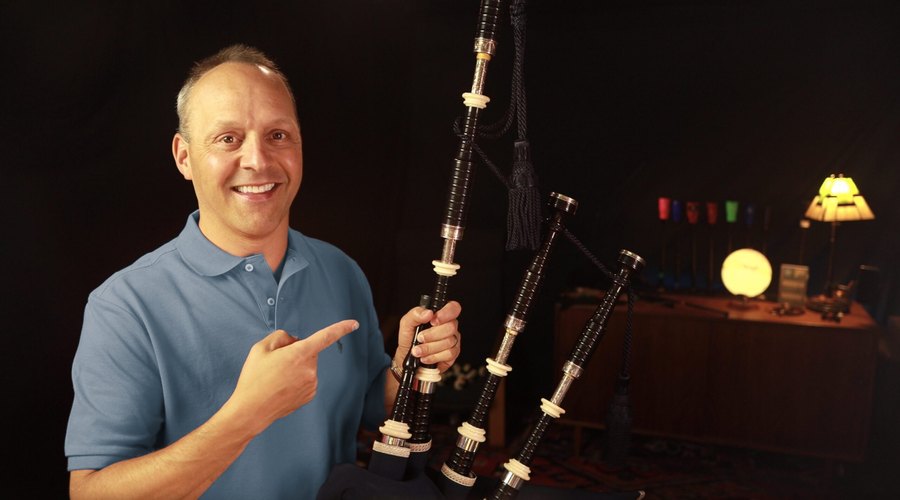
▶ Video lessonComfort and setup
The #1 Mistake Bagpipers Make with Their Blowpipe & How to Fix It For Stronger & Pain-Free Piping
The wrong blowpipe length, or clenching your teeth to keep the blowpipe in place, can cause pain, headaches and even TMJ disorder. Get a blowpipe that is the right length for you, add a rubber mouthpiece protector, and use the Perfect Angle™ Blowpipe Positioner to keep the blowpipe in place without strain.
The Main Ideas
Most pipers never think about the blowpipe, but it decides how comfortable you are every time you play. If it is the wrong length, you end up reaching or craning your neck. And if you clench your teeth to keep it in place, it adds up to pain, headaches and even TMJ disorder.
Here is what I do. First, get a blowpipe that is the right length for you, so you sit in a neutral position with your head up and shoulders relaxed. Second, add a rubber mouthpiece protector to soften the bite.
Even then, the blowpipe still wants to pop out, so I invented the Perfect Angle™ Blowpipe Positioner. In this video I explain the problem and show you how to set it up.
At a glance
| The problem | A blowpipe that is the wrong length, or that you clench your teeth to hold |
|---|---|
| What can go wrong | Pain, soreness, chipped teeth, headaches, neck aches and TMJ disorder |
| The goal | A neutral position: head up, shoulders relaxed, blowpipe in the center of your mouth |
| Too long or too short | Too long and you reach for the chanter. Too short and you drop your head forward |
| Fix 1 | A blowpipe that is the right length, such as the R.G. Hardie Adjusti-Stick |
| Fix 2 | A rubber mouthpiece protector to soften the bite |
| Fix 3 | The Perfect Angle™ Blowpipe Positioner, so the blowpipe stays put |
| Guarantee | Money-back guarantee on the Perfect Angle™ |
Video highlights
“You want to achieve what I call a ‘neutral position.’ This means when you’re playing, your head is up, shoulders relaxed, no reaching or craning, just comfortable playing.”
“Not only do you have to use your mouth and lips to seal tightly to blow into the bag, you also have to hold the blowpipe with your mouth.”
“The second thing you want to do is add some cushioning to the mouthpiece so it’s softer on your teeth.”
“You can even take your mouth completely off of the blowpipe and it won’t pop out at all.”
Free guideSecrets for Making Your Pipes Easy to PlayA comfortable blowpipe is part of a set of pipes that is easy to play, and this free guide shows you more of what I do to get there.
Get the free guideThe gear in this video
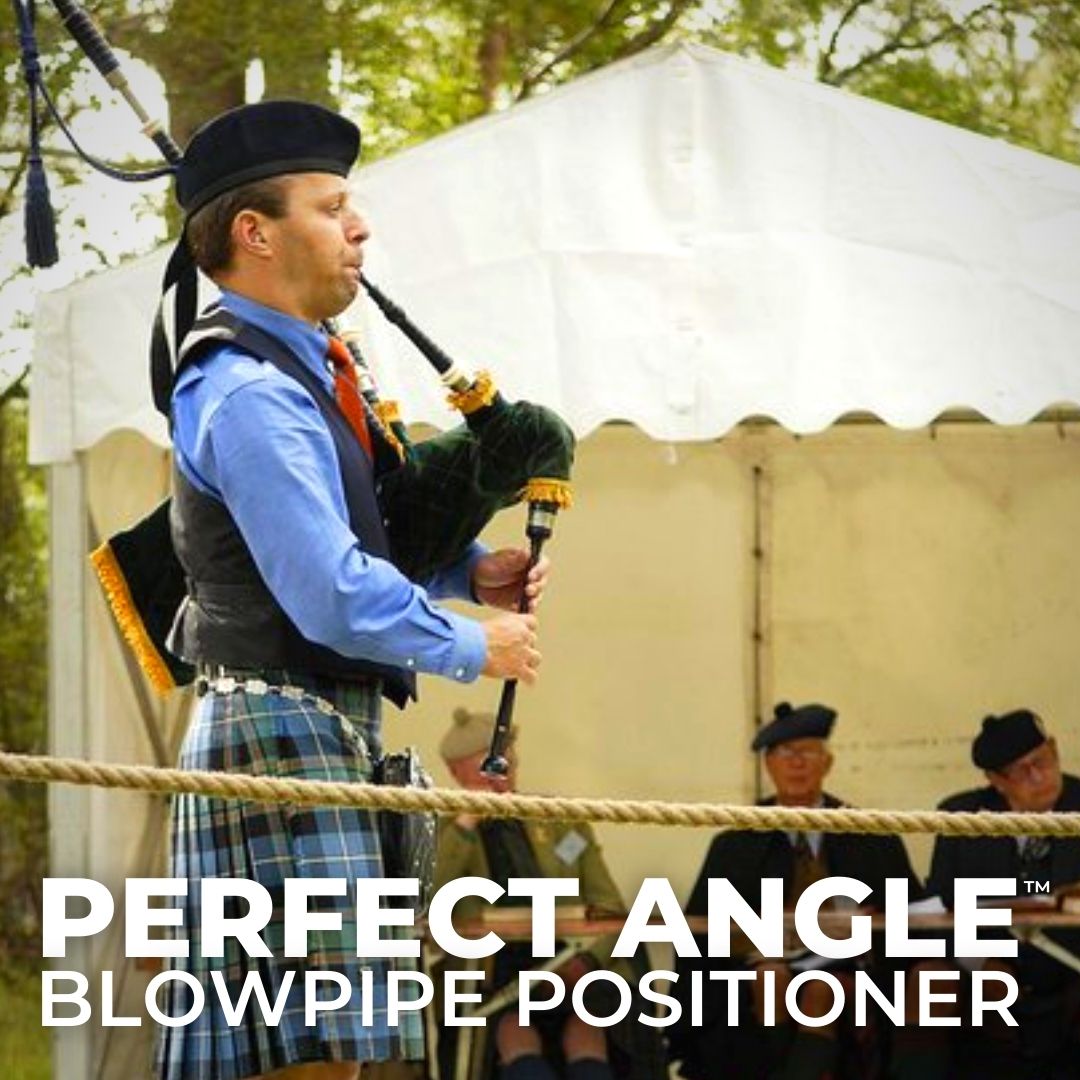 The Perfect Angle™ Blowpipe PositionerMy invention that holds your blowpipe at the right angle with no strain on your mouth, jaw or teeth. It comes with two of my mouthpiece protectors.Learn more →
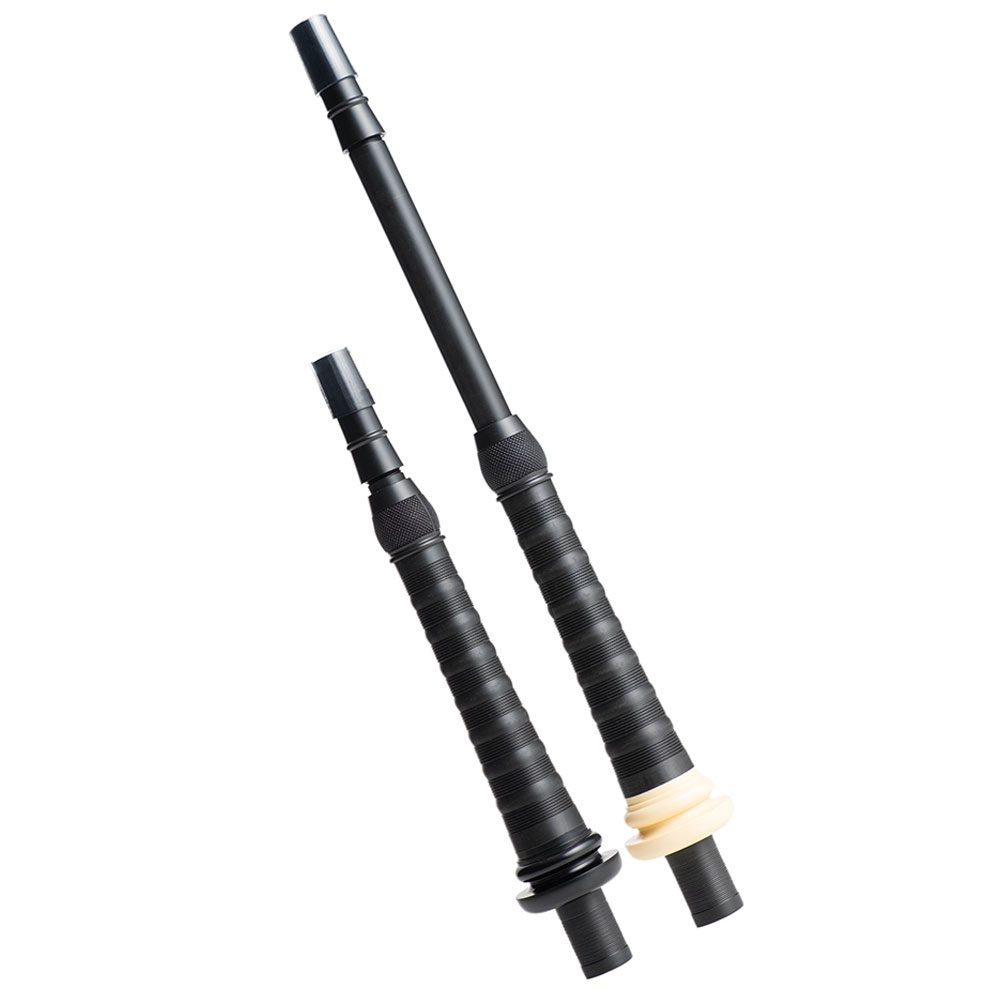 Adjustable Length Blowpipe (Adjusti-Stick)The adjustable length blowpipe from R.G. Hardie & Co. in Scotland, so you can find the length that fits you.Learn more →
 Premium Blowpipe Mouthpiece ProtectorsThick, durable black rubber protectors that soften the bite and ease jaw strain. A set of four.Learn more →Blowpipes, Moisture Control and MoreBrowse the blowpipes, mouthpieces and other pipe accessories in my shop.Learn more →
Your questions, answered
Tap a time to watch that part of the video.
Why does the blowpipe matter so much for comfort?
Chanters and drones are standard length, but the blowpipe has to be the right length for your size. We are all built differently, so one size does not fit everyone, and you may be in this position for hours every week.
Can playing the bagpipes cause jaw and dental problems?
Yes. I talked with Dr. Gord Pollock, a piper and dentist, about the constant clenching of your teeth to keep the blowpipe in place. It adds up to pain, soreness, chipped teeth, headaches, neck aches and even TMJ disorder.
What happens if my blowpipe is too long or too short?
If it is too long, you reach down to find the holes on the chanter or crane your neck to one side. If it is too short, you drop your head down and forward to reach the mouthpiece, which strains your neck and back.
How is the bagpipe different from other wind instruments?
With a clarinet, saxophone or trumpet, you hold the instrument and the mouthpiece stays in a fixed position. With bagpipes, the blowpipe is attached to a flexible bag that moves as you play, so your mouth has to seal tightly and hold the blowpipe too.
Why does my blowpipe keep popping out of my mouth?
Try letting go of the blowpipe with your mouth after you blow up the bag. For most pipers, and me too, it would pop out. That is why so many pipers clench their teeth to keep it steady.
What is TMJ disorder and how does it relate to piping?
TMJ stands for the temporomandibular joint, which connects your jawbone to your skull. Holding the blowpipe between your teeth for long periods, especially with poor alignment, can lead to jaw pain, fatigue and misalignment.
How can I make my blowpipe more comfortable?
Two things helped me a lot. Get a blowpipe that is the right length, and add some cushioning to the mouthpiece so it is softer on your teeth.
How do I know if my blowpipe is the right length?
Look at yourself in a mirror. You want your head centered, the blowpipe in the middle of your mouth and your shoulders relaxed. Then look at your forearms: on top pipers they are horizontal or very slightly angled down.
Do mouthpiece protectors really help?
They did for me. Without a mouthpiece protector, my jaw would shift slightly to the side and over time caused some serious jaw pain. The ones in my shop are thicker, more durable and longer lasting than anything else on the market.
How does the Perfect Angle™ Blowpipe Positioner work?
It keeps your blowpipe in the perfect position with zero strain on your mouth, jaw or teeth. You can take your mouth completely off the blowpipe and it will not pop out at all.
Do top pipers use the Perfect Angle™?
Yes. Pipe Major Kenny MacLeod from McCallum Bagpipes swears by it, and so do Ian K. MacDonald and Bruce Gandy. Some pipers have told me it fixed years of neck pain from piping.
How do I install the Perfect Angle™ Blowpipe Positioner?
Attach the three stock rings, two for the drones and one for the blowpipe, with the buckles facing up. Then feed the straps through the buckles, starting from the bottom slot, and tighten them to position the blowpipe.
How do I fine-tune my blowpipe position?
Pulling the bass drone strap tighter changes the angle of the blowpipe. The middle tenor strap adjusts it from side to side. Play your pipes, or pretend to play by corking them, and tweak the straps until you feel comfortable.
Is there a guarantee on the Perfect Angle™?
Yes. I am backing it with a money-back guarantee. If you do not feel a significant improvement in your playing comfort, I will refund you, no questions asked.
Each week, the Inner Circle's lively sessions are designed to benefit pipers of all skill levels, all around the world.
LEARN FASTER. FIND GREATER ENJOYMENT FROM YOUR PIPING. JOIN ME.
Join the Inner CircleFull video transcript
0:01 Introduction to Ergonomics and Comfort
Hey everyone, I’m Jori Chisholm. Welcome back to the BagpipeLesson.com channel! Today, we’re talking about something that doesn’t get nearly enough attention but can make a huge difference in how you play your bagpipes – ergonomics which is about making sure your instrument fits your body just right, so you can play longer, more comfortably, and without any strain.
Unlike many other musical instruments, playing the bagpipes takes a lot of physical and breathing effort. You have to play your pipes enough to be in shape, but you also need to make sure you’ve made the ergonomic adjustments right. This is the key to not just your comfort, but also to being able to pay your best so you can nail your next performance or practice session.
0:33 Blowpipe Length and Position Explained
Today we’re going to focus on an often overlooked part of your pipes—the blowpipe. This is an important component and you want to make sure you have two things set up perfectly for you and that is the blowpipe length and its position.
I recently had a chat with Dr. Gord Pollock, a piper, plays a bunch of different kinds of bagpipes, who’s also a dentist and has a ton of experience helping musicians. We talked about many types of serious jaw and dental issues that can be caused by bagpipes that are set up properly, particularly the blowpipe. We talked about the problems we pipers can experience from the constant clenching of your teeth to keep that blowpipe in place—it adds up, causing pain, soreness, chipped teeth, headaches, neck aches and even more serious issues like TMJ disorder.
1:04 Discussion with Dr. Gourd Pollock About Jaw Issues
So, setting up your blowpipe correctly isn’t only about comfort—it’s about avoiding injury. We’ve all heard of or maybe even experienced those pesky repetitive strain injuries. Wrong blowpipe length? Poor posture? These are not just pains in the neck; they can affect your spine, jaw, and even your long-term dental health. Getting this right means you can avoid some potential serious pain and injury and focus more on your music and enjoying playing.
The Role of Blowpipe Length & Position
So let’s talk about blowpipe length and position. Now, we’re all built differently, right? Tall, short, long arms, shorter arms, you name it. That’s why the one-size-fits-all approach doesn’t work well with the blowpipe, especially with the blowpipe. Chanters are generally standard length, the drones are too but that’s fine because they start here and go up towards the sky. But the blowpipe needs to be the perfect length based on your size and getting the right length is crucial. If it’s too long, you’re going to be reaching down to find the holes on the chanter, or craning your neck to one side. If it’s too short, you’ll be dropping your head down and forward to try and reach the mouthpiece, putting strain on your neck and back. And if you are a real piper, you are going to be in that position for hours and hours every week so you can be setting yourself up for some serious discomfort or injury. So, what’s the sweet spot? You want to achieve what I call a ‘neutral position.’ This means when you’re playing, your head is up, shoulders relaxed, no reaching or craning, just comfortable playing. Your blowpipe should sit just right so it sits right in the center of your mouth while the bag is comfortably under your arm. This setup isn’t just about comfort; it ensures you can control your bag with the minimum amount of effort, keeping your music flowing just as it should.
2:12 The Importance of Proper Blowpipe Length
Blowpipe Challenges: Length vs. Position
Now, even with the perfect sized blowpipe, it can be a challenge to keep it in the right position. The design of the bagpipes really sets them apart from other wind instruments. Take the clarinet, saxophone, or trumpet, for instance. You hold your instrument with your hands, and the mouthpiece stays in a fixed position, right? But with bagpipes, it’s a different story. Your blowpipe is in your mouth, and it’s attached to the pipe bag which is a flexible bag and moves with your playing. It adds an additional challenge. Not only do you have to use your mouth and lips to seal tightly to blow into the bag, you also have to hold the blowpipe with your mouth. Just try it the next time you play your pipes, blow your pipes up as you always do and then let go of the blowpipe with your mouth, completely. What happens? For most pipers, and me too, it would pop out. I’ve actually seen this happen in a competition. Everything was going just fine and then the piper must have gotten fatigued or lost concentration and the blowpipe popped out—and there’s basically nothing you can do except take your hand off the chanter and pull it back in. In a competition scenario, this is instant disqualification. In a performance, it looks really bad. So how do pipers avoid this: pipers often end up clenching their teeth just to keep the blowpipe steady. But here’s the thing—clenching isn’t just uncomfortable, it’s like running with clenched fists but only much much worse.
4:06 Blowpipe "Pop Out" Problem Explained
When you clench your teeth you can feel the muscles contract in your and your head near your temples. When you chew there’s movement. When you pipe, if you have to bite down hard to do this you are doing it for the entire time you’re playing.
Dr. Pollock told me about how the jaw moves bilaterally, which means both sides of your jaw should be moving evenly. Often a piper’s blowpipe length or position forces their jaw into an awkward position, where it’s out of alignment or one side is working harder than the other side. Over time, this can lead to soreness, pain, headaches, neck aches, or something even more serious like TMJ Disorders.
5:05 Jaw and TMJ Disorders from Poor Blowpipe Positioning
TMJ stands for the temporomandibular joint, which is the joint that connects your jawbone to your skull. You have two TMJs, one on each side of your jaw, and they allow your jaw to move up and down and side to side, enabling you to talk, chew, yawn, and play the bagpipes
TMJ disorders which can be caused by playing the pipes with a bad ergonomic setup of the blowpipe can cause pain in the jaw, face, neck, and even the shoulders. Common symptoms include:
- Jaw pain or tenderness
- Difficulty or discomfort while chewing
- Aching pain around the ear
- Locking of the jaw, making it difficult to open or close the mouth
- Clicking or popping sounds when moving the jaw
For pipers, TMJ issues can arise from the strain of holding the blowpipe between the teeth for extended periods, especially if there’s improper alignment or excess pressure. This can lead to jaw fatigue, misalignment, or even long-term jaw joint issues.
The Perfect Angle™ Blowpipe Positioner Solution
Count yourself as lucky If you haven’t experienced any mouth or jaw soreness from piping. Year ago I discovered two things that really helped my overall comfort and stamina with piping. 1. Get a blowpipe the right length. The blowpipe that came with my first set of pipes was too long and in old photos I can see my bottom hard reaching way down to reach the chanter and my head turned away. These days you have some great options for blowpipe sizing. Take a look at yourself in the mirror, you want to see yourself in a neutral position with head centered, blowpipe in the middle of your mouth and shoulders relaxed. Look at your forearms. If you look at top pipers, you’ll see their forearms are horizontal or very slightly angled down. Not way down: that means your blowpipe is too long. And not up here. That means your blowpipe is too long. If you discover your blowpipe isn’t quite right, I recommend getting an adjustable length blowpipe. MY favorite is the Adjusti-Stick from the famous bagpipe maker R.G. Hardie & Co. in Scotland. I’ll put the link in the video notes in the description below. The second thing you want to do is add some cushioning to the mouthpiece so it’s softer on your teeth. For years I’ve been using these high-quality black rubber mouthpiece protectors that soften the bite and solve the jaw pain that was getting when I was playing my pipes without them. Without the mouthpiece protector my jaw would shift slightly over to the side and over time caused some serious jaw pain. These are available exclusively on the BagpipeLessons.com Shop—they are thicker and more durable and longer lasting than anything else on the market. The link is in the description below.
8:16 Rubber Mouthpiece Protector Benefits
But even with the right length blowpipe and the rubber mouthpiece protector, you still have the issue of the blowpipe wanting to pop out. So, if you know me, you know that I look at this as a problem that can be solved. And that’s what I have done with my invention which is called the Perfect Angle™ Blowpipe Positioner. It’s a game-changer, designed specifically to ensure that you can keep your blowpipe in the perfect position without zero strain on your mouth, jaw, or teeth. You can even take your mouth completely off of the blowpipe and it won’t pop out at all.
8:41 Introduction to the Perfect Angle™ Blowpipe Positioner
This means you can achieve perfect playing posture and keep your blowpipe aligned perfectly in your mouth. Playing will be easier, your pipes will be more comfortable, you’ll have confidence your pipes will stay right where you want them so you can focus on your music.
9:11 How the Perfect Angle™ Blowpipe Positioner Works
Now, here’s something extra special for you. With your Perfect Angle™ Blowpipe Positioner, you also get two of my high-quality black rubber mouthpiece protectors. These protectors are crafted to protect your teeth with a soft, durable layer that enhances comfort and improves your stamina.
Benefits
The Perfect Angle™ Blowpipe Positioner is being used by piper pipers and pipe bands around the world.
P/M Kenny MacLeod from world famous McCallum Bagpipes swears by it. Double Gold Medallist Ian K. MacDonald loves the Perfect Angle and so does Bruce Gandy, and so do many others. I’ve heard from pipers who have said specifically that the perfect angle has fixed years of neck pain from piping. And from pipers who only after trying the perfect angle have discovered what a big deal it is in terms of the overall improved piping experience. I love hearing from pipers who use my inventions to help them find greater success and enjoyment from their piping. So if you use the Perfect Angle or any of my products, I’d love to hear from you. Leave a comment or drop me a message.
10:13 Real Testimonials from Top Pipers
How to Use the Perfect Angle™ Blowpipe Positioner
Alright, let’s set up your bagpipes perfectly with these simple steps. First, you need to attach the stock rings. You have two rings for the drones and one for the blowpipe. Attach each ring to the corresponding part of your pipes. Make sure the buckles on these rings are facing up so they work correctly.
10:43 How to Install and Adjust the Perfect Angle™
Next up, we’re adjusting the straps. Grab the straps and slide them through the buckles. Start from the bottom slot. It’s important to do this right so the straps hold tight and allow you to make small adjustments easily.
Now, let’s tighten these straps to position the blowpipe just right. By pulling the base drone strap tighter, you can change the angle of the blowpipe to make it easier to reach when you play. The middle tenor strap lets you adjust the blowpipe from side to side. This makes sure the blowpipe sits comfortably and you don’t have to change how you stand or sit.
Once everything is in place, it’s time to make sure it fits perfectly. You can either play your pipes if you’re ready or just pretend to play by corking the pipes. While doing this, tweak the straps until you feel totally comfortable. This final step makes sure your pipes fit just right for how you play and move.
11:44 Fine-Tuning Your Blowpipe Position
Once you’ve got the positioner installed, the difference is night and day. You’ll feel it immediately—the blowpipe just stays put, rock solid, no matter how active your performance or how much you move. This stability is a game changer. It allows you to relax, not just physically but mentally too. No more worrying about keeping that blowpipe in place with a tense jaw or awkward head tilts.
12:12 The Comfort and Confidence Benefits of the Perfect Angle™
The real magic happens when you start playing. You’ll notice you can keep your jaw and teeth relaxed, which feels much more natural. This comfort translates directly into longer, more productive playing sessions where you can focus purely on your music and technique.
Playing your bagpipes is supposed to be fun. So if you’re on the lookout for a way to elevate both your comfort and performance while playing the bagpipes, check out The Perfect Angle™ Blowpipe Positioner. I’m so convinced you will love it that I’m backing it with a money-back guarantee. If you don’t feel a significant improvement in your playing comfort, I’ll refund, no questions asked.
12:42 Money-Back Guarantee and Final Thoughts
Visit my shop and order the Perfect Angle™ Blowpipe Positioner today. The link is in the description below.
Why wait to experience the ease and improvement in your playing? Head over to our website at https://bagpipelessons.com/perfectangle order your Perfect Angle™ Blowpipe Positioner today. The clickable link is in the description below. You deserve to play your bagpipes with comfort and precision. You deserve the opportunity to play your pipes pain-free and stress-free.
And if you are looking to take your piping to the next level check out the link below to join my Inner Circle for exclusive content, tutorials, and direct access to all our courses and resources. Check out the BagpipeLessons.com shop for all of my very best gear and tools, and don’t forget to hit that subscribe button and ring the bell for updates on all our latest videos.
Thank you for watching, and happy piping!
My exact words from the video, lightly cleaned up for reading. Click any time to jump the video to that moment.

About Jori Chisholm
Jori started BagpipeLessons.com in 1999, and in 2003 he became the first piper to teach one-on-one lessons by video. His online teaching has been featured on the front page of the New York Times, and thousands of pipers around the world have used his lessons, tools and products.
He is a four-time U.S. Gold Medalist for Piping, has won prizes at the Argyllshire Gathering, the Northern Meeting, Cowal and Braemar, and won the World Pipe Band Championships three times with the Simon Fraser University Pipe Band. He invented the Tone Protector, the InTune Mic and the Endurance Practice Chanter, and in 2011 he founded the World Online Piping & Drumming Championships.
More about Jori →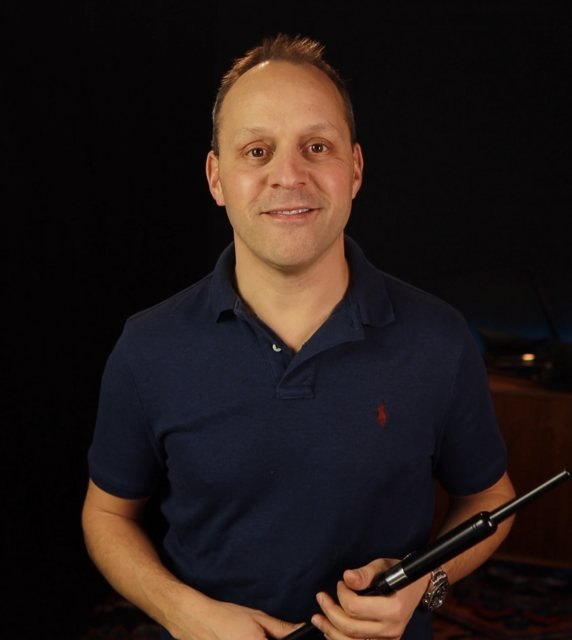
The Inner Circle
Ready to take your piping further?
Get unlimited access to 790+ lessons, videos and tunes, plus a live Zoom class with me every week. Every replay is searchable to the exact moment anything was taught.
$399/year works out to $33.25 a month$45/month month to month
For pipe bandsBring your whole band into the Inner Circle
Every piper gets their own login, and we start with a band coaching session on Zoom with me to map out your season. From $10 per piper per month.See band memberships →