AS FEATURED IN

7 Point Mindful Bagpipe Practice Checklist
by Jori Chisholm, Founder of BagpipeLessons.com
Last Updated: February 6, 2026
Many pipers waste a lot of practice time, not because they’re lazy or untalented, but because they practice mindlessly instead of mindfully.
Repetition without attention reinforces bad habits. Mindful practice means full attention and clear intention, and it helps you improve faster in less time.
In this video, I describe my Mindful Practice Checklist, a simple 7-point checklist to run continuously while you practice so you stay focused and make real progress.
Watch the video below.
Read the full video transcript below.
Video Transcript: Hey everybody. Jori Chisholm here from BagpipeLessons.com. Here’s an uncomfortable truth. Many pipers waste lots of their practice time, not because they’re lazy, not because they lack ability, but because they’re practicing mindlessly instead of mindfully. We’ve all been there. You put in the hours, but you’re not actually improving.
You might think, “I’ve played this tune a hundred times,” but that doesn’t help you make progress if you’ve played it wrong a hundred times. Here’s the thing: growth and change always require attention. Repetition without attention just reinforces habits and usually bad habits. You can’t learn when you practice on autopilot.
You need to take control, make a plan, and pay attention to what your fingers are doing. Amateurs go through the motions. Top performers pay attention to what they’re doing constantly. So today, what I want to share with you is what I call the Mindful Practice Checklist. It’s a 7 point checklist that you should be running through continuously as you practice.
I have to say it’s been a game changer for my own playing and for my students. I’ve got a free printable version of this checklist you can download. The link is in the description below. Print it out, keep it with you, keep it in your music folder and on your music stand, or with you in your practice room and use it every time you practice.
Mindful practice means practicing with full attention and clear intention. It means you know exactly what you’re working on and why. Ten or 20 minutes of mindful practice beats an hour of mindless repetition every time. So to help you stay focused, check out my 7 point checklist and run through these questions every time you practice.
Number one, am I playing the correct notes? Might seem obvious, but this is a foundational thing to pay attention to. Are there notes you’re missing? Every time you repeat an error, it becomes harder and harder to fix, so pay attention. Look at your sheet music, make sure you’re playing the right notes.
Number two, am I playing the correct gracenotes? Gracenotes are important. Each gracenote should be correct and clean. You won’t always be able to hear the difference between a high G gracenote or an E gracenote, but you can feel the difference in your fingers when you play. So make sure you’re playing what’s actually written, not just what you’ve gotten used to.
Number three, am I playing with good form? Check your hands. Are you keeping your fingers close to the chanter? Are you keeping your fingers relaxed? Good form is the foundation of speed and endurance. Fingers that are stiff and tight or raise too high reduce your finger dexterity and make it harder to play clean and fast. If you’ve been watching my other videos here on the YouTube channel, you know I’m always talking about keeping the hands as relaxed as possible. It’s super, super important.
Number four, am I playing with the correct timing? Is every note getting the correct and proper duration as it’s written in the sheet? Are your dot cuts properly expressed? Are the even notes even? Timing issues can be invisible to you, the player, but really obvious to the listener. This is one of those areas where recording yourself and listening back is really, really helpful.
Number five, is my tempo controlled? Are you slowing down or speeding up through the difficult parts? Jumping the beat? The Piper’s Metronome is your best friend here, and it keeps you honest. If you’re playing something and you speed up through the hard parts and slow down through the easy parts, that’s telling you something, that’s telling you the hard parts aren’t solid yet.
Number six, am I playing clean? Are there crossing noises crushed? Doublings, sloppy transitions? Clean playing requires all the previous elements to be working together consistently. That’s where everything comes together.
Finally number seven, is it repeatable? Can you play it correctly again and again? One perfect run followed by three sloppy ones isn’t mastery. Consistency is your goal. If you can’t repeat it, you haven’t learned it yet.
So how do you actually use this checklist? Download it. The link is in the description below. Print it out and keep it with you. You can use it during your warmup. Pay attention to your playing and fix issues early when you’re learning tunes and when you’re just getting started in your practice sessions.
When you’re learning new tunes, focus on a bar or a phrase or a part until you can check off all seven points. It might sound like a slow process, but trust me, it’s actually faster in the long run because you’re learning things properly and not learning bad habits that you have to fix later when you’re drilling problem spots.
Use the checklist to diagnose. Why is a passage giving you trouble? Which of the seven points is failing? That gives you a target and something to focus on in your practice. Maybe your notes are right, but your timing is off. Maybe your timing is good, but you’re not clean.
The checklist helps you identify exactly what you need to work on, and here’s what’s really cool about this: mindful practice compounds. Every session builds on the last because you’re actually learning and improving, not just repeating over the weeks and months. The difference between mindful and mindless practice becomes huge. If you practice mindfully for 20 minutes a day, you’ll make faster progress than someone who just practices mechanically and grinds mindlessly for hours.
I’ve seen this over and over with my students. The ones who make the fastest progress aren’t always the ones who practice the most. They’re the ones who practice with the most focus and attention. Your future self will thank you. So check it out. And if you want to supercharge your piping, join my BagpipeLessons.com Inner Circle. It’s a great way to learn faster and find greater enjoyment in your piping. You get access to my weekly live online classes where you can get fast answers to your questions.
Plus unlimited access to my massive online lesson library with hundreds and hundreds of recorded lessons, tunes, workshops, product demonstrations, and more. Plus, it’s a supportive community of pipers from around the world who are ready to support you and help you reach your full potential today. If you like these videos, hit the subscribe button on the YouTube channel and hit the little bell to get a notification whenever I put a new video up.
And check out BagpipeLessons.com/learn. I’ve got tons of free resources there and downloadable guides. I also have all the videos from my YouTube channel, and you can watch the videos there along with transcripts so you can read along. Check out all of my products, the Tone Protectors, the InTune Mic, the Bagpipe Gauge, Foundation reed, and more at BagpipeLessons.com/shop.
Thanks for watching. I’d love to hear from you. Make a comment below. Tell me how your practice is going. Download my Mindful Practice checklist and let me know how it’s working for you. Thanks for being part of everything. I’ll see you next time. Happy piping.
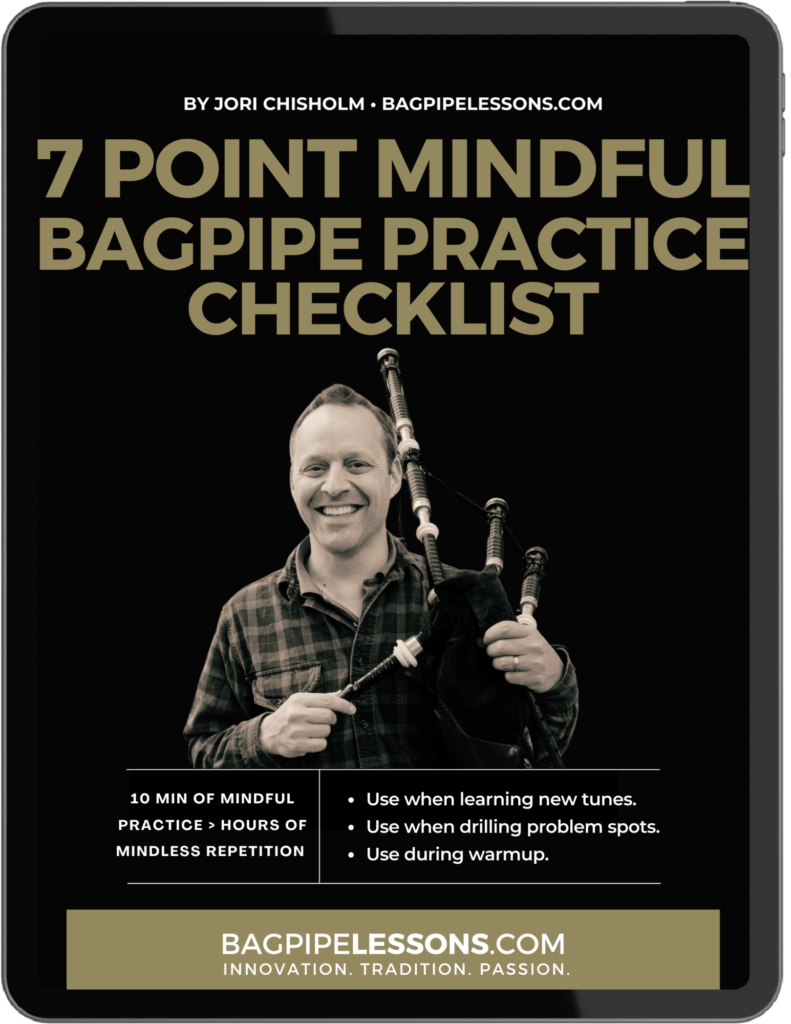
7 Point Mindful Bagpipe Practice Checklist
Mindful practice is the key to faster progress. Ten minutes of focused effort beats an hour of 'going through the motions.'
7 points to win