

AS FEATURED IN

Your Pipes Will Never Stay In Tune Until You Fix This One Thing: It Is More Than Just Steady Blowing
by Jori Chisholm, Founder of BagpipeLessons.com
Last Updated: May 2, 2026
How do you know exactly how hard to blow into your bagpipes? What is steady blowing, and why is it so hard to master? In this video (Part 1), I break down what steady bag pressure really is, why it’s the single most important skill for a great bagpipe sound, and the most common blowing mistakes that make your tone and tuning waver.
I also show you how the Bagpipe Gauge lets you SEE what’s happening inside your bag in real time, so you can fix pressure problems fast instead of guessing for years.
In this video you’ll learn:
- The difference between “steady blowing” and steady bag pressure (and why it matters)
- Why releasing the arm when you blow (or pressing harder when you breathe) creates pressure spikes and drops
- Two things the Bagpipe Gauge helps you master: steadiness + exact pressure (in inches of water)
- What “too easy” and “too hard” pipes look like on a gauge (and why both cause problems)
- Why you should never blow harder on top hand notes to “fix” tuning
- A transition mistake that causes most pressure dips (and how to eliminate it)
- The best way to find your ideal pressure using your high A
Links to Products Mentioned in the Video:
Watch the video below.
Read the full video transcript below.
Video Transcript: How do you know exactly how hard you need to blow into your bagpipes? What is the perfect pressure for your pipes? And what precisely determines how hard your pipes are? What is steady blowing? What is steady bag pressure? Are they the same thing?
What are the most common mistakes pipers make with their blowing? How should you blow into the bag—long, deep breaths or short, fast ones? Should you blow harder on some notes and slack off on other notes? How do you coordinate blowing with the squeezing of your arm?
And finally, if we look at the world’s very best pipers who get that amazing world-class tone that is bright and rich and full and steady, is there a specific secret blowing technique that these top pipers use that’s different from everybody else?
The answer to that last question is yes. And this video is in two parts.
In this first part, I’m going to break down exactly what steady blowing is, why it’s so hard, the most common mistakes pipers make, and show you a tool that finally lets you see what’s happening inside your bag when you play.
And then in Part 2, I’m going to reveal for the very first time publicly what I discovered when I studied exactly how the world’s top champion pipers blow their pipes and how they do it differently than everybody else.
There’s a pattern. There’s a consistent technique, and once you see it and understand it, it will change the way you play.
So, let’s get into it.
First, let’s talk about why blowing is the single most important skill you need to develop to get a great bagpipe sound and why it’s so incredibly difficult to master.
Some of the most common questions I get from people who are new to bagpipes—and honestly from experienced pipers too—are about how blowing works. How do you know when to take a breath? Do you blow harder or softer on certain notes? How do you coordinate the blowing with the squeezing of your arm?
What we pipers call steady blowing is essential if you want pipes that sound great, are easy to tune, and stay in tune.
Your bagpipes have four sound-producing pipes: the chanter, which plays the main melody, and three drones.
Each has its own reed. All four reeds are powered by your breath, and because they’re all attached to a single pipe bag, they all receive the exact same air pressure.
Other woodwind instruments like the saxophone, clarinet, oboe, and bassoon have a single reed that you blow directly with your mouth. When you blow, it makes a sound. When you stop blowing to take a breath, the sound stops.
But the pipes are different. The reeds are enclosed in the bag, so you don’t need to keep them all in your mouth. And the bag also allows you to keep the sound going continuously.
The bag inflates when you blow, and it deflates when you take a breath, and you keep the pressure constant with your arm.
This is the most important skill that every piper needs to master, and it’s very challenging. I know it sounds simple, but every piper who’s tried blowing steady knows it’s not that simple.
Steady blowing might be more accurately referred to as steady bag pressure because you achieve it with a combination of two things: blowing into the bag and squeezing the bag with your arm.
Your arm has to maintain a constant pressure at all times.
Now, think of your arm as a weight sitting on the bag. The amount of weight never changes. Your arm is applying the same amount of pressure—the same weight.
Now, it can look like the piper is releasing the arm when they blow into the bag and then pressing down harder when they stop blowing to take a breath. But that doesn’t work. If you do that, the bag pressure is uneven. You’re going to get a pressure spike or a pressure drop every time you take a breath.
You have to maintain constant arm pressure, which means you are squeezing even when you’re blowing into the bag. Now, this makes it harder to blow into the bag because you’re actually blowing against the pressure that you keep with your arm.
Without steady bag pressure, your sound will waver. Your chanter pitch will go up and down, and the tone of your drones will fluctuate and go in and out of tune.
This makes your pipes difficult or impossible to tune, and it’s going to sound bad to everyone who hears you.
Your goal is pipes that sound great, feel great, are easy to tune, and stay in tune—not just at the start of the performance, but a sweet, steady, and stable sound until the very end, with every note of the chanter in tune and the drones locked to each other and to low A.
That’s the goal.
You can’t achieve this if your bag pressure is too high or too low or constantly moving around. You have to master the balance: the pressure applied by blowing into the bag and the pressure applied by squeezing the bag continuously with your arm.
Like with any musical instrument, there’s a physical conditioning component to playing the bagpipes—your lips, your cheeks, your breathing muscles, your shoulder and arm and back.
And with practice, you can build up the strength and stamina. But there’s a specific technique that is not natural for most people—but you can learn it.
So if steady blowing is so important, why is it also so difficult? Why do so many pipers struggle with it even after years of playing?
Well, here’s a big problem: it’s invisible. You can’t see the air pressure in your bag. You can’t see the fluctuations. You’re relying on feel, and developing that feel takes years of trial and error and practice and struggle.
And honestly, most pipers never fully get there because they don’t have a way to know exactly what’s happening.
And even your ears can’t always help you. Your drones are right next to your head. The volume is loud, and subtle unsteadiness is hard to detect when you’re in the middle of playing a tune and working on your fingering and your expression.
Now, maybe you can hear when a note goes in and out of tune or when a drone starts to flutter or drift, but it can be subtle and really hard to pinpoint exactly how and why your pressure is unsteady and moving around.
Now, if you play in a pipe band, it’s even worse. You’re surrounded by pipers and drummers. There could be 10, 15, or 20 other musicians all playing at the same time—loud. You literally can’t hear yourself.
So how are you supposed to know if you’re keeping your pressure steady when there’s so much sound around you?
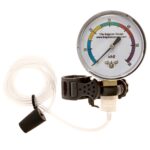
This is the Bagpipe Gauge. This is a tool I designed that plugs into one of your drones and gives you a real-time visual readout of the air pressure inside your pipes.
With your gauge, you can actually see what’s happening inside your pipes while you play. No more guessing. No more relying purely on feel or hoping you can hear what’s going on.
The gauge gives you instant, clear, and precise feedback on the pressure inside your instrument. It’s intuitive and straightforward.
You attach it to your blowpipe stock and plug it into your tenor drone, and it gives you instant visual feedback.
Now, this works for pipers at any skill level, whether you’re a beginner just learning to blow your pipes or an experienced piper looking to get your blowing steadiness perfected.
But here’s something really important to understand: the Bagpipe Gauge does two things, and they’re both essential.
The first function is steadiness. That’s how consistent your bag pressure is as you play.
When you play, the needle on the gauge should be completely still. If it’s bouncing around, it tells you your pressure is fluctuating. It shows even the smallest fluctuations in real time, so you can make the precise, proper adjustments.
You watch the gauge as you’re practicing and observe your own playing and determine exactly where you need to improve, and you will make progress fast.
The second function of the Bagpipe Gauge is absolute pressure. It’s a number.
It’s measured in inches of water, and it tells you exactly how hard your pipes are. Think of it as a strength reading for your setup.
Most pipers I’ve tested with the gauge are right around 30, which is straight up and down on the dial, right in the middle of the green zone.
If your pipes are below 25, they’re really easy to blow, but if you get much lower than that, you can lose a certain amount of projection in your sound and steadiness when the reed gets that easy.
If you’re over 35, you’re wasting energy. It’s harder to keep steady, and it’s harder to play well when you’re putting out so much effort just to keep your pipes going.
Here’s a common issue every piper faces from time to time: your pipes don’t feel right. And one of the challenges is figuring out—is it me or is it my pipes? Am I out of shape? Am I doing something wrong? Or are my pipes too hard?
With the Bagpipe Gauge, you’ve got a precise, objective measurement. It’s right there on the gauge. No more guessing.
I’ve got another video on my YouTube channel about the most common blowing mistakes. I’ll link to it in the description below. It goes deep on each one of these, but I just want to talk about the highlights here because understanding these mistakes is key to understanding what the gauge can do for you.
Have you ever been told to “blow out your top hand” or “blow out your high A”?
If you need to blow a little stronger to get your high A sounding right, then you need to maintain that pressure for every note. Don’t blow harder on the top hand notes.
If you do this, you’ll see it instantly on the Bagpipe Gauge.
If your bag pressure drops every time you take a breath, the cause is lack of adequate pressure from your arm on the bag. Remember, your arm is the constant.
Make sure you’re keeping that strong, steady pressure with the upper arm on the bag so when you take a breath, the pressure doesn’t drop.
This is one of the hardest things to fix if you’re going by ear or by feel, but it’s way easier when you can see those pressure dips on the Bagpipe Gauge.
Unsteady transitions.
Now, this is something a lot of pipers struggle with, and this is the transition point—the moment when you switch from blowing to taking a breath and then back again.
You don’t need to coordinate the arm with the blowing. You just keep that arm pressure strong the whole time you’re playing.
Don’t release it when you blow, and don’t press down harder when you take a breath. The Bagpipe Gauge really helps with this one.
Now remember, the sound and tuning of every reed is affected by the pressure. This means it’s really important that you maintain the same bag pressure whether you’re tuning or playing.
A lot of pipers will blow harder or softer when they’re focused on tuning compared to when they’re playing the tune.
Be careful that you don’t adjust your pressure to try and fix tuning problems by blowing softer or harder.
You can get your pipes in tune quickly and easily using a smartphone app and using my InTune Mic clip-on microphone, but these tools work best when you’re able to keep your bag pressure constant.
Finally, it’s totally normal that when you’re focused on one aspect of your playing—like tricky fingerwork in a hard tune—other areas might suffer.
But your goal is to maintain that nice, steady sound throughout all of your tunes, whether you’re warming up, playing a slow air, playing your march, or ripping through a hard and fast tune.
What you’re doing with your blowing and your arm should be steady and totally separate from whatever is happening with your fingers.
Sometimes, under performance pressure or fatigue, pipers will overblow their chanter at the start, which makes it E-sharp and puts you out of tune with the rest of your band.
Or at the end, it’s common to get a pressure drop-off in the last bar or two as you’re heading for the cutoff.
Strong and steady tuning requires strong and steady bag pressure, and the Bagpipe Gauge will give you the confidence and the skills you need to do everything right when it really matters.
Many pipers struggle with several of these—or all of these.
And the frustrating part is, until you can actually see what’s happening with your bag pressure, you might not even know which mistakes you’re making.
This is where the Bagpipe Gauge comes in. You can watch it while you practice and see exactly where your problems are. The immediate visual feedback is what speeds up your progress to mastery.
You’re not waiting years to develop a vague sense of feel. You can see the problem, make the adjustments, and fix it now.
So whether you’re a beginner or an experienced piper, using the Bagpipe Gauge will help you quickly understand and correct your pressure issues, and you’re going to immediately notice an improvement in your stability and sound quality.
Let’s talk about some practical tips that will make an immediate difference in your playing.
How should you squeeze the bag?
You want to use your shoulder and upper back muscles to control the movement of your upper arm towards your body. Do not use your bicep to squeeze. It puts a lot of pressure on your forearm and wrist, and that leads to tightness in your top hand.
Your goal is strong, constant engagement from your shoulder and back muscles to control your upper arm, while your lower arm, wrist, hand, and fingers stay relaxed and loose.
Next question: how do you know exactly how hard to blow your pipes?
Well, the exact pressure is determined primarily by the strength of your pipe chanter reed. That’s why getting a pipe chanter reed that’s the right strength is crucial for your overall comfort and the efficiency of your bagpipes.
If the bag pressure is too low for your chanter reed, the chanter reed will cut out. It takes a second to kick back in—we call that a choke. If that happens in a solo competition, it basically means you’re out of the prize list.
If the bag pressure is too high for your reed, bad things happen on the other end. The reed can go really sharp, and you can get some really ugly sounds—chirps and squeals.
This is very disruptive and definitely something you want to avoid.
So in between the choke point on the low end and the chirping and squealing at the high end, there’s a range of pressures that could work for your reed.
But is there a way to pinpoint the exact pressure you want to be at?
Yes. It’s your high A.
The high A, more than any other note, has the narrowest window where it produces the right sound.
Under pressure, you get that scratchy, crowy sound. Over pressure, it gets thin and sharp and chirpy.
But at the perfect pressure, you get this beautiful, resonant, vibrant sound that only high A can produce. It’s amazing. It’s beautiful. It’s incredible.
Pipers love that high A maybe more than any other note.
We want all of our notes to be perfectly in tune, but the high A has that special quality—that texture of sound that you can only get when your bag pressure is exactly right.
So use your high A to figure out your ideal bag pressure, and then keep it there.
With the Bagpipe Gauge, you can see the number, you can target it. That’s the number you want to see on the gauge every time you play, for every note.
So now you know what steady blowing really is, why it’s so hard to master, the most common mistakes pipers make, and how the Bagpipe Gauge lets you see exactly what’s happening inside your pipes when you play.
If you don’t have one, get the Bagpipe Gauge at bagpipelessons.com/bagpipegauge.
This is a great investment you can make in your piping—not only in your sound, but in your confidence.
I’ve also put together a free download for you. It’s called How to Master Steady Blowing: The Number One Skill Every Piper Needs for a Great Bagpipe Sound.
It covers all of the info and steps from today’s video in a free PDF that you can download, print out, and reference during your practice.
Download it at bagpipelessons.com/steadyblowing. The link is in the description below.
But we’re not done yet, because there is one big question I have not yet answered.
Is there a specific secret blowing technique that the world’s very best pipers use? A pattern? A method?
The answer is yes.
And in the second part of this video, I’m going to reveal for the very first time publicly what I discovered when I studied exactly how world champion pipers blow their pipes.
You do not want to miss it.
So make sure to subscribe to my YouTube channel and hit the bell icon so you don’t miss out.
What’s your biggest challenge with steady blowing? I’d love to hear from you. Please post a comment below.
Thanks again for watching. Happy piping.
See you next time.
free guide
WATCH More Videos