
AS FEATURED IN

The Truth About Pipe Bags: Pros and Cons of Sheepskin, Synthetic, or Hybrid Bags
by Jori Chisholm, Founder of BagpipeLessons.com
Last Updated: April 2, 2026
One of the most debated topics in piping is pipe bags. In this video, I break down the three main types up close: traditional hide bags (sheepskin), synthetic bags, and modern hybrid bags.
I explain how each one works, and the real advantages and disadvantages in terms of sound, setup, maintenance, and cost. I also cover the bag features that matter most in real life: grommets, zippers, and hose clamps.
3 Key Bag Features I Recommend:
- Grommets for easy, airtight installation
- Bottom Zipper so you can easily install stocks and use a moisture control system and so it stays out of your forearm
- Electrial Tape, if you use hose clamps, wrap them with electrical tape to protect your bag, cover, and pipes
Links to Products Mentioned in the Video:
- Dri-Flo Bannatyne Lightweight Bagpipe Moisture Control Canister Drying System
- Tone Protector
- Bannatyne Hybrid Small Bag
- Bannatyne Hybrid Extended Small Bag
- Bannatyne Hybrid Extended Small with Extra-long Neck Bag
- Bannatyne Hybrid Super Mini Bag
- Bannatyne Hybrid Willie McCallum Bag
Watch the video below.
Read the full video transcript below.
Video Transcript: One of the most discussed and debated topics in the piping world is pipe bags and specifically different types of pipe bags. Today we’re going to talk about and look up-close at the three main types of pipe bags: traditional leather bags, modern synthetic bags, and the hybrid bag. We’ll talk about how they work, the differences between them, advantages and disadvantages in terms of sound setup, maintenance, and cost. We’ll look at some other features of bags like zippers, grommets, and clamps. We’re going to go through them one by one, hopefully dispel some myths along the way, and after watching this video, you should have a clear understanding of the three types of pipe bags to help you pick the perfect bag for you. Let’s get into it.
So, first, let’s start with the traditional hide bag. This is usually sheepskin, but you’ll also see cow hide and goat skin. These are traditional tie-in bags. No zippers, no grommets, just leather and tie-in cord. The shiny side of the leather, like the outside of a leather jacket, not the suede or the nappy side, is on the inside. It’s that smooth interior surface that creates the airtight seal along with bag seasoning. Now, this is a liquid mixture that you heat up and you pour into the bag and you rub it in there. This keeps the leather airtight and supple.
Without seasoning, the leather dries out, cracks, and leaks air. So, when played well, a hide bag gives a very specific, rich, complex, and buzzy harmonic sound that a lot of pipe majors of top pipe bands love. Sheepskin bags feel really good under your arm. Feels really solid, and pipers have been using this for generations.
But there’s some real big disadvantages to a sheepskin bag. It’s really expensive, and it takes a lot of maintenance. You have to deal with seasoning. It’s messy, smelly, and time consuming. If you get too much in there or if you play your hide bag in really wet conditions, the seasoning and the moisture can bleed through the leather and permanently ruin the bag. One really long bad session in pouring rain can ruin a bag. Your pipes get instantly wet because there’s no moisture control system. So, you’re basically playing with a ticking clock. You cannot play for 45 minutes or an hour in the rain with a sheepskin bag and expect your pipes to stay in tune. Anyone playing with a tubeless hide bag has a clock that’s running and when it runs out, your tuning is gone.
If it’s really wet where you are and you play a lot, your bag is going to get soaked, your reeds are going to get wet, and you’re going to have problems.
If it’s really dry where you are, the leather dries out and becomes stiff and hard and it’s no longer airtight. So, hide bags only work well in a specific scenario within a pretty narrow range of playing conditions. Because it dries out, you have to play it all the time to keep it airtight. And sheepskin bags don’t last very long. I know pipers who have to replace them every 6 to 12 months. Sheepskin is expensive. The bags are handmade. So, overall, a sheepskin bag is going to be way more expensive than other types of bags.
Next, we have the synthetic bag. In the 1980s, the first synthetic bags came on the market. We had the Ross bag coming from Australia and we had the Canmore bag coming from Scotland that was made with brand name Gortex. Today, you can still get these bags made out of Gortex or other similar materials. Takes zero maintenance, no seasoning, no tying in because you have these nifty little rubber grommets. Your pipes dry out when you’re done playing them and you start with the same dry bag every time you play. This is a really big advantage for consistency.
And the bag works independent of the climate no matter where you are. If you’re in Arizona or you’re in Hawaii or Washington or Scotland or wherever you are in the world, they’re lightweight and durable.
They usually come with the grommets and with a zipper, making it really easy to install your new pipe bag with your stocks and to use a moisture control system. We will get more to that. Probably the biggest disadvantage of the synthetic bag is that they don’t weigh very much and they’re really floppy. They don’t hold their shape like a traditional leather bag does when it’s deflated. Some pipers find these slippery or thin feeling or just too lightweight and it somehow the balance of their pipes is a little bit off. It’s really a personal preference thing, but I agree with that. The synthetic bag is just too light and too floppy for me. And finally, we have hybrid bags.
A hybrid bag is a combination of leather on the outside with a synthetic liner that keeps the bag super airtight without seasoning. Pipers love the feel of this bag. The leather holds its shape, has a nice weight to it. It feels substantial without being heavy. It also has the huge advantage that it does not require seasoning and does not need moisture in the bag itself to keep its airtightness. Hybrid bags come in several sizes. I’ve got five different sizes available here in my shop: three standard sizes and two custom sizes that are exclusive to BagpipLessons.com. So, there really are a lot of advantages to the hybrid bag. And the most popular best-selling bags in the world today are hybrid bags.
I play and recommend the Bannatyne hybrid bags, but there are other companies that make hybrid bags as well. Now, let’s look at some of the other features that you can get in pipe bags today.
Grommets. Grommets are rubber rings that are attached to the bag itself, and it allows you to install a bag very quickly and easily. It’s simply a matter of putting the stock inside the bag and pushing it through. They are very strong and really airtight. I recommend grommets because they make it so much easier to install your stocks into your bag. It’s really a big hassle and a specific skill to tie in a bag the old-fashioned way. It takes a long time. It’s hard to get it right. And you’re much more likely to have something go wrong and have a leak and have to retie your stocks. They’re already on the bag when you get it, so you don’t have to go through the process of measuring and cutting the holes. Some players like a bag without the grommets because they want to measure and cut their own holes in a very specific way, but for most people, the advantages of grommets are going to be great.
There’s some discussion about whether grommets change the sound or reduce the volume or resonance of your bagpipes. No. I have seen no evidence whatsoever that having this rubber ring on the bottom of your stock reduces the resonance. I’ve played bags with grommets and without grommets. I played hide bags and synthetic bags and hybrid bags. I played hybrid bags without grommets and with grommets. There’s literally no difference. You can try it yourself. Blow up your pipes, get your drones in tune, and put your hand on the bottom of your drone stock. It does not change the sound of the drone.
Some people will say, “Well, doesn’t it make sense that having this rubber thing on the bottom of the stock is going to somehow muffle it?” Well, that doesn’t make sense to me. But even if you think it makes sense logically, just do the experiment. Wrap a bunch of electrical tape or rubber bands or put a clamp on the bottom of your drone stock. Doesn’t change the sound. The sound is coming out mostly from the top of the drone. Having this little rubber ring at the bottom of your stock does not affect the sound. Certainly not in any way that I have ever been able to measure.
One experiment you could do would be to order a custom bag and have one of the drones have a grommet and the other no grommet. And then you could measure if there’s any difference in the sound, volume, resonance. If you disagree with me or you’ve done this experiment and you have something to share, I’d love to hear from you. The link to contact me is in the description below.
Now, here’s another great feature on pipe bags these days, and that is the zipper. This is a really cool piece of technology. It’s an airtight, watertight zipper. Unlike the zipper that’s on your clothes or your backpack or your pipe case that holds fabric together, the zipper on a pipe bag when it’s closed, it’s totally airtight and watertight. The way that it works is that on the inside of the zipper teeth, there’s a rubber strip. So when the teeth come together, they push against the rubber and they seal. It’s pretty amazing. I think they use these types of zippers in scuba equipment and in dry bags.
So why would you want a zipper? A zipper allows you to get inside the bag and there are huge advantages to that. Makes it a lot easier to install your stocks into the bag. You just open the zipper, put the stock in, and push it out through the grommets. It also allows you to use a moisture control system, which I’ll get to in a minute. Sometimes you can get a bag with a zipper on the side or a zipper on the bottom. I don’t like the side zipper because where the zipper is, it presses right on my arm when I’m playing, which is not comfortable. I prefer the zipper on the bottom. My arm just presses right here on the nice leather and the zipper stays on the bottom out of the way. They function exactly the same. It’s just a slight difference in the position of the zipper. So, if you’re shopping for bags, I definitely recommend the bottom zipper so it’s not going to be bothering your arm.
So, my recommendation is regardless of what type of bag you get, you definitely want to get a bag with the zipper. It’s going to allow you to get inside the bag and use a moisture control system. It’s absolutely worth it. So, the Bannatyne hybrid bags, standard Bannatyne hybrid bags come with four grommets. Three grommets for the drones and a grommet for the blowpipe stock. The chanter stock doesn’t have a grommet. It just has this material here where your chanter stock goes in. And you have to attach your chanter stock with a hose clamp. This is a metal clamp that you tighten with a screwdriver or a wrench. So, here you can see the chanter stock.
Other hybrid bags like the Ross bag have metal hose clamps on all of the stocks. I don’t like having hose clamps everywhere. They’re metal, they’re heavy, they’re sharp, and they add some bulk. What I would recommend if you do have hose clamps, whether it’s just the one on your chanter stock or on all of your stocks, you’re going to want to wrap those clamps with some electrical tape to protect your pipe bag, to protect your bag pipe cover, and protect your pipes from getting scratched or cut by the metal on your hose clamp.
So, what’s the deal with moisture control systems? Well, I’m working on a whole new video on this important topic, but here’s the short version of what a moisture control system does. It allows you to reduce the amount of moisture that gets into your drones and into your reeds, which allows you to play longer and have your pipes stay in tune for much, much longer than if you didn’t have the moisture control system.
My favorite is the Dri Flo system. Here’s how it works. There’s three of these little tubes and these rubber cups attached to the bottom of each one of your drone stocks. This is inside your bag so you don’t see it when you’re playing. And these stay attached to the bottom of your drone stocks. And then each one of these Dri Flo tubes attaches there to the little rubber cup and it sits inside your bag. The air you blow into the bag which is full of moisture from your breath fills your bag. But the only way it can get to your drone is by passing through this tube. You can see there’s little mesh there at the end so the air can get in. And inside here is silica gel. These are little beads. It’s a desiccant which removes moisture from the air.
So you’re blowing in this hot, steamy, wet breath into your bag and it fills up your bag and it travels through the desiccant and dries it out. And by the time it gets to the other end, it’s dry and warm. So you have dry and warm air going to your drone reeds, which is exactly what you want. Your pipes will sound great and they will stay in tune because they don’t have moisture building up on the reeds. A longer, more detailed video all about different moisture control systems coming soon. But my favorite is the Dri Flo. Lightweight, stays in there, and really effective for drying out the air to your drones.
Now, here’s the debate that a lot of people talk about and argue about. What is going on with the sound? Is there a certain type of pipe bag that gives you a better sound? People debate this endlessly and they have all sorts of theories about it. People will argue that a sheepskin bag is better because you get a better, richer, more harmonic sound. Or people will argue that a hybrid bag is better because you get more stability, more precision of tuning and longevity of performance. What I would say is that the sound that you get from a sheepskin bag with nothing inside, no moisture control system, is different than a sound that you’re going to get with a hybrid bag with a moisture control system. Not better, different.
Let’s talk about that some more. Sheepskin bags and hide bags are played by a much much smaller number of pipers in very specific situations. If you look at the top pipe bands, what you’ll see is that they play sheepskin bags because what they’re going for is a very specific type of sound that they can achieve with those bags. But if you look at those individual players in those top bands when they’re playing in solos, you will see that almost all of them play a different bag. They will usually play a hybrid bag with the grommets and the zipper and a moisture control system. So, the world’s greatest players are playing one bag and one setup for band and then a different bag with a different setup for solo. Well, why would they do that? Well, they’re going to do whatever they need to so that their pipes sound the best for the situation where they’re playing.
So, you can’t say that sheepskin gives you a better sound when the top players in the world on the solo platform are not using sheepskin. They’re playing hybrid bags, many of them with the Dri Flo system and a Tone Protector. So, when you’re playing in a band, you’re prioritizing a certain quality of sound for a very short period of time. Band performances are short. The medleys in the top bands are seven minutes max. MSRs are much shorter, around five minutes. And in pipe band, it’s all about the blend. As long as you blend, a little bit of tuning instability gets covered up by the group. When your pipes go a little bit out of tune, which they probably will with sheepskin, and no moisture control system because the moisture is building up on your reeds, that’s okay because it blends in.
But when you’re playing on your own, even if you’re not competing, but just performing on your own, you are totally exposed. What you need is precision of tuning, consistency, and stability. You cannot afford to have a drone go out of tune because it got wet. In a competition, when your drones go out of tune or a drone shuts off, you’re basically disqualified. It doesn’t matter if the first few minutes of your performance sounded great, your drones go out of tune, you’re done. And if you’re performing, you want your pipes to sound good at the end of the performance, not just at the beginning. These players in the top bands who play sheepskin are really trying to minimize the amount of time that they play.
If it’s a rainy day, they might tune up for 20 minutes or less. None of this stuff where you just get your pipes out and play and play a bunch of tunes for 45 minutes or an hour. Your pipes will be absolutely soaked. Any soloist who plays a sheepskin bag without a moisture control system, their absolute number one thing they’re thinking about is how wet are my pipes, how wet are they going to get, how long do I have to play until I need to stop and brush out my drones and dry out my bag and my reeds?
But what about getting a sheepskin bag with a zipper? Is that even a thing? Yes, it is. Here it is. So, you might be thinking, can I get the magical sheepskin sound that these top bands and these top pipe majors crave and also use a moisture control system? You can get a sheepskin bag with a zipper and you can use a moisture control system. And you will get the advantages of the drier drones, more stable tuning and longer playing time.
But here’s the thing. When you look at what those top pipe bands are doing, the bands who play sheepskin bags, they mostly do not use moisture control systems. Why? Here’s why. Whatever specific sound they’re looking for is a combination of the bag material and the fact that it doesn’t have a bunch of tubes and canisters inside the bag. That sheepskin sound, it’s affected by the bag material and also affected by the fact that it’s usually played without a moisture control system.
Once you start putting tubes and canisters inside the bag, you change the acoustic environment inside the bag. You’re isolating the chanter from the drones, so you’re really not getting that sheepskin sound anymore. Now, that’s another topic for another video, and it’s very interesting. But if you want the advantages for tuning and stability of a moisture control system, which I highly recommend, and most pipers at every level agree with me on that, you might as well get a hybrid bag for the advantages. Stays airtight. It’s got grommets. It’s got the zipper. There’s basically no maintenance. It lasts longer. They’re cheaper versus a sheepskin bag with the zipper, which has all the disadvantages of sheepskin seasoning, the cost, the climate sensitivity, the short lifespan, and you really aren’t getting that effect of the “sheepskin sound” anyway once you put your moisture control system in there.
So, which bag should you play? What type of bag and setup does what you need for your piping in your situation. And for almost everybody, I’m going to recommend a hybrid pipe bag. If you play on your own, solo competitions, performances are just for your own enjoyment. Really, what you want is precision, consistency, stability. You want to know that every day when you get your pipes out, you’re starting with a dry bag.
You use your Tone Protector to keep your reed exactly where it needs to be in terms of moisture content. And your instrument becomes reliable and predictable and stable. You don’t want to make your piping harder than it needs to be. Hybrid pipe bags with zippers and grommets and moisture control systems make your pipes easier to play. They make it easier for you to get your pipes in tune and they will stay in tune.
Now, if you’re an elite player and you play in a top top pipe band, you probably don’t get to pick what type of pipe bag you play anyway, but your pipe major may very well want a specific sound that comes from a sheepskin bag. You’re going to have to deal with the expense and the maintenance and the seasoning and your pipes getting wet every time you play and dealing and managing that moisture. Now, if this is something that you’re required to do or something that you want to do, you need to be ready for the maintenance and the cost and the moisture management.
A lot of sheepskin bags don’t even last a full year. A synthetic or hybrid bag can easily last three, five years or way more. Now, for beginners, some instructors will tell you to start on a hide bag and learn about moisture management. I think that’s bad advice. Having a moisture control system in your bag, like the Dri Flo, does not make your pipes harder to play. It makes it easier to play. Dealing with your Dri Flo canister is completely separate from the playing experience, and it’s trivial. Without it, you’re making your pipes less stable and harder to play for no good reason.
If you’re in a really dry climate, you definitely don’t want sheepskin. The dry air destroys the bag. If you’re in a really wet climate, also not great for sheepskin because that heavy moisture saturates the leather and can permanently ruin your bag. Synthetic and hybrid bags are climate independent. They work the same everywhere. They can get wet and then they dry out. Trying to decide between the synthetic and the hybrid. I prefer the leather feel. It gives me control and precision. Now, the full synthetic bag is really, really light, but for me, it’s just too light. That’s why I recommend a hybrid bag with the zipper on the bottom. That’s the only one I sell and that’s the only one that I would recommend.
So, if you have any questions about the type of bag which is best for you, put them in the comments below or send me an email. There’s a link in the description below. In my shop, I have Bannatyne hybrid bags in five sizes. I’ve got the Small, the Extended Small, the Willie McCallum size, plus two custom sizes: Extended Small with the Extra-Long Neck, which is a great option if you’re over six feet tall and have long arms, and the Super Mini, which is a custom bag I made for my son Colin when he was learning. It’s 2 inches smaller than a small.
If you have questions about the size, type of bag, moisture control systems, or anything else related to piping, send me a message. I would love to hear from you. If you have thoughts about anything I’ve said here, let me know. I read all the comments. If you found this video helpful, hit the subscribe button and click the little bell so you get notified when I post new videos. I’ve got some great new videos coming up.
And if you like what I have to say and want to learn from me and be part of my community, join my BagpipeLessons.com Inner Circle. You get access to my lesson library with hundreds and hundreds of hours of recorded lessons, tunes, product guides, and more. And you get personal feedback from me. I do a live Zoom class almost every week for my members. And you even have the opportunity to submit videos of your own playing and get feedback from me, too. Check that all out at bagpipelessons.com/membership.
Thanks everybody for watching. See you next time.
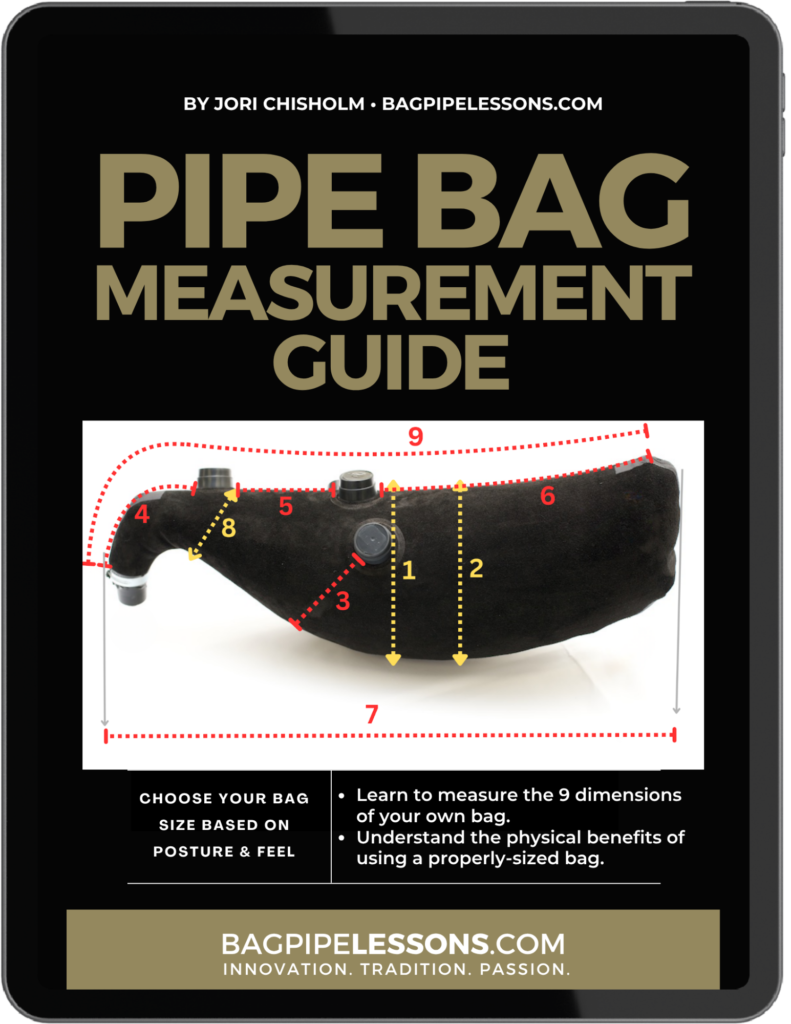
Pipe Bag Measurement Guide
Pipers enjoy playing more when our pipes sound and feel great. Master your bag and find the perfect fit for you.
9 key numbers
WATCH More Videos