AS FEATURED IN

Pipe Bag Sizes Explained: Close-Up Look and Exact Measurements
by Jori Chisholm, Founder of BagpipeLessons.com
Last Updated: March 30, 2026
Do you know what type of pipe bag you’re playing, what size it is, and whether it’s truly the perfect fit for you?
In this video, I show you five different pipe bag sizes up close, with exact measurements, so you can compare what’s actually available and choose the smallest bag you can play comfortably.
Bag size has a real physical impact. Bags that are too big make it harder to maintain steady pressure, increase fatigue, and can contribute to neck, jaw, shoulder, back, and wrist issues. There’s no advantage to a larger bag, but there are lots of disadvantages if it’s bigger than what you need.
I also share how to choose based on posture and feel, what to look for in photos and video of your playing, and the most common signs your bag is too big. I also include a link in the description to submit your own bag measurements so we can build a bigger community list.
Links to Products Mentioned in the Video:
- Bannatyne Hybrid Small Bag
- Bannatyne Hybrid Extended Small Bag
- Bannatyne Hybrid Extended Small with Extra-long Neck Bag
- Bannatyne Hybrid Super Mini Bag
- Bannatyne Hybrid Willie McCallum Bag
Watch the video below.
Read the full video transcript below.
Video Transcript: Do you know what type of pipe bag you’re playing? Do you know what size it is?
And here’s the real question: are you 100% confident that it’s the perfect size for you? This is one of the most common questions and concerns I hear from pipers, and most people don’t know with certainty.
Today, I’m going to show you every size of pipe bags that I have here up close, with the exact measurements, so you can see exactly what’s available and figure out which pipe bag size is perfect for you.
I have five different sizes of pipe bags available, and I have measured each one of them. We’re going to go through them one by one so you can find the bag that’s perfect for you. As far as I know, this is the first time that anyone has measured all these different dimensions and made them available to everybody.
Pipe bags come in different sizes, but what do those sizes mean? What’s the difference between a small and an extended small? Is it longer in the back, or is it also bigger around?
And what about the really popular Willie McCallum style? Where does that fit in? Is it closer to a small, extended small, or medium, or is it somewhere in between?
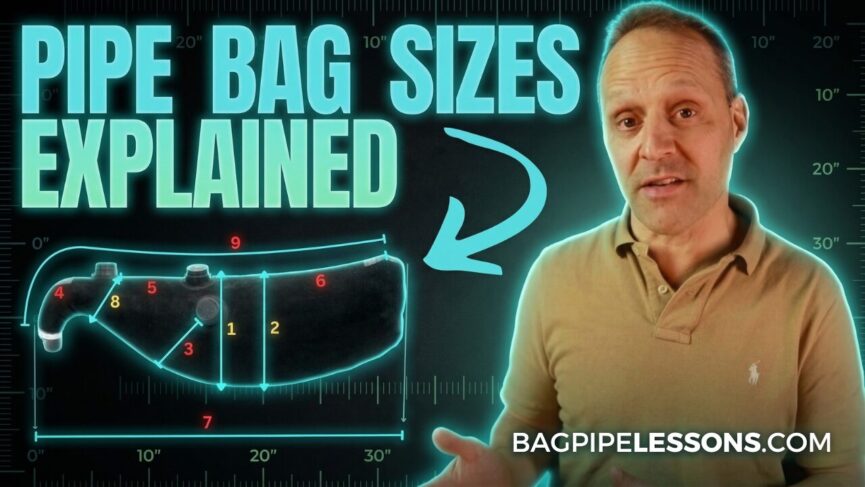
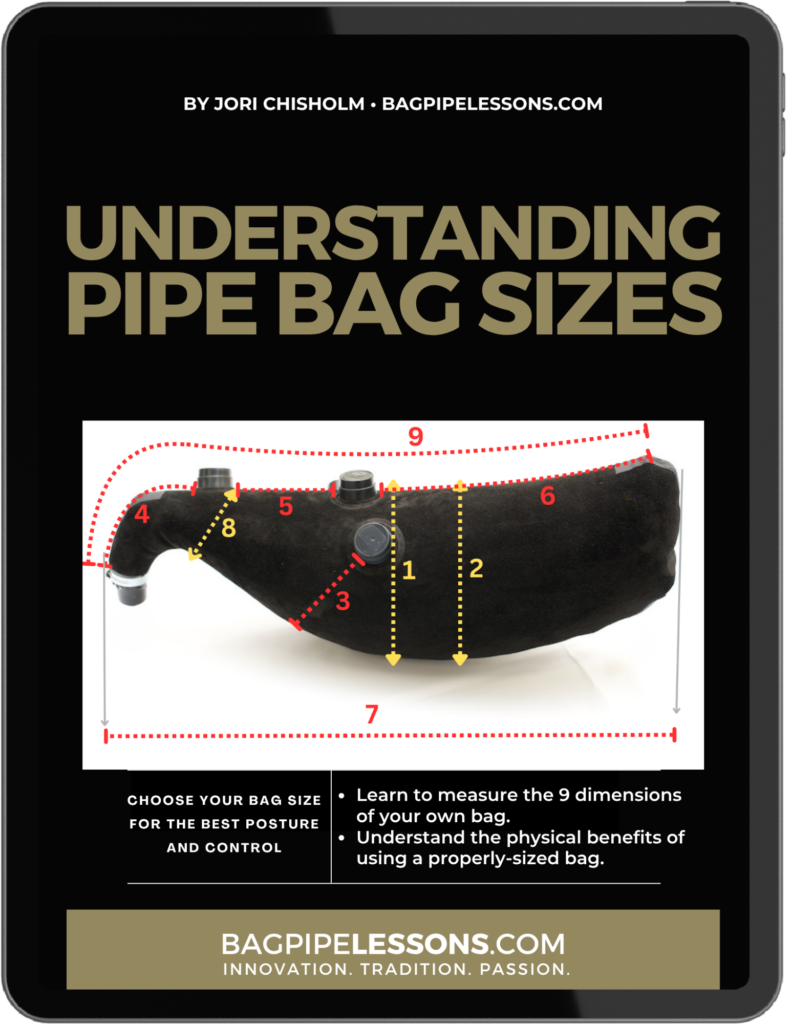
I’ve taken each one of these bags, inflated them, and measured them with a tape measure. Here are the nine measurements I’ve taken for every single pipe bag:
- How big around is the bag right behind the stocks? This is the important one where you’re squeezing the bag.
- How big around is the bag at the widest point?
- Distance from the tenor to the seam at a 45-degree angle. This is where your arm squeezes the bag.
- Distance from the blowpipe to the end of the bag. This shows you how long the neck is.
- Distance between the blowpipe and the drones.
- Length of the top of the bag from the drones to the back corner. This tells you the length of the back part of the bag.
- Overall length of the bag measured horizontally from the very back to the very front of the neck.
- How big is the bag around right behind the blowpipe stock? This gives you an idea of how wide the neck is.
- Entire length of the bag from the neck, following the curve along the top all the way to the back corner.
Nine different measurements, five different bags. I’ll go through them each one by one, and you can check out these measurements for yourself. There’s a link in the description below.
You know, there are only two truly sizable things on your bagpipes: your blowpipe length and your pipe bag size. And here’s what I see most often from a lot of pipers—their pipe bags are too big.
And this has a real physical impact. Too large of a bag means less strength in your arms. Pressing on your forearm is harder to keep steady blowing pressure. Your arms get tired. Your hands get tight. With a longer blowpipe and a larger bag, you can have all kinds of problems—neck problems, jaw problems, shoulder problems, back problems. You might get pain in your wrists.
It’s really important that you get the right size. There is no advantage to a larger bag, but there are lots of disadvantages to a bag that is larger than the perfect size for you.
You get the right size, you get the perfect fit. Your pipes are more comfortable. They’re easier to play, easier to tune, easier to blow steady—everything gets better.
So first, let’s start with the Small bag. This is the bag that I play every time I play my pipes. I’m playing the Bannatyne small hybrid bag. This is the smallest standard bag made by Bannatyne.
The smaller bag allows me to get the bag higher up. I get better leverage. I get better control. And I’m not squeezing the bag with my forearm—my wrist is really free. I love this bag.
- around the bag just behind the drone stocks: 48 cm.
- around the bag at the widest point: 49.5 cm.
- distance from the outside tenor to the seam at a 45-degree angle: 15 cm.
- length of the neck from the blowpipe to the end of the curve: 17 cm.
- distance between the blowpipe and the drones: 11 cm.
- distance from the drones to the back corner of the bag: 30 cm.
- entire length of the bag measured straight across: 62.5 cm.
- circumference of the bag around the neck just behind the blowpipe: 25 cm.
- entire length following the curve to the back corner: 67 cm.
You check the label on your shirt and say, “I’m not a small. I’m a medium person or I’m a large person.” You still might love this bag. There’s no advantage to a larger bag. The smaller bag—get it higher up under your arm, get better leverage.
I’ve recommended this bag to many pipers, even pipers that are way taller than me, and they love it.
The next size up: the Extended Small.
Now, you might think extended small is just a small bag with a little bit more length in the back. That’s not entirely true. It is longer in the back, but it is also slightly larger around.
- circumference just behind the drone stocks: 52 cm
- the widest point: 56 cm
- distance from tenor to seam: 15 cm (same as the small)
- neck length: 17 cm
- distance between blowpipe and drones: 12 cm
- distance from drones to back corner: 36 cm
- overall length: 71 cm
- neck circumference: 26.5 cm
- full curved length: 73 cm
Comparing the small and the extended small, you can see the small is a little bit smaller around and shorter. So if you’re playing a larger bag and thinking about going smaller but are concerned the small might be too small, the extended small might be perfect.
Next, let’s look at the standard Bannatyne size designed by Willie McCallum.
Willie wanted a bag that was like a medium in the back with a little more room, but the neck is cut away—it’s tapered—so your forearm is a little bit more free. So, a little bit roomier in the back but narrower in the front.
- circumference behind the stocks: 56 cm
- widest part: 62.3 cm
- tenor to seam: 15 cm
- neck length: 17 cm
- blowpipe to drones: 12 cm
- drones to back corner: 37 cm
- horizontal length: 73 cm
- neck circumference: 27.5 cm
- full curved length: 77 cm
So you can see we go from small to extended small to the Willie McCallum size. It is slightly larger in all the important dimensions.
I had a student who loved the Bannatyne extended small bag—the diameter, the feel, the control—everything was perfect, except for the position of the chanter. He felt like it was too close in for his longer arms.
So I worked with Bannatyne to design a custom bag: same as an extended small, but with an extra 2 inches in the neck.
When he got this custom long-neck bag, he loved it so much he immediately ordered four more. I suggested it to another student—same result.
So now this custom option is available: the Extended Small with the Extra-long Neck.
Every dimension is identical to the extended small except the neck is moved out 2 inches. It might not look like much, but it makes a big difference in comfort.
If you like a smaller bag but have long arms, this might be the way to go.
And finally, the Super Mini.
This one is personal. When my son Colin started learning, he was young and small. It’s important to learn with good posture and technique from the beginning, and for that, everything has to fit.
So I worked with Bannatyne to make a bag that is 2 inches smaller in every dimension.
The Super Mini is perfect for someone under 5 feet tall. It allows proper positioning, relaxed shoulders, and good habits from day one.
Now, you might be wondering about medium and large. I do not sell them, and I would not recommend them. They are way too big.
If you’re playing one and like it, fine—but there is no advantage to a bag that is too large.
These five sizes cover every piper I’ve worked with—from children to the tallest players.
Here they are: small, extended small, Willie McCallum size, extended small with the long neck, and the Super Mini.
You can see the progression in size. No bag is better—they’re just different. The right one is the smallest one that you can play comfortably. There’s no advantage to a larger bag.
I’ve put a link in the description below where you can download all of these measurements and compare them to your current bag.
So how do you choose? Remembering that smaller is probably better—if you’re playing a medium or a large, in my opinion, you’re definitely playing a bag that is too big.
How do your pipes feel? If your bag slips down and you feel like you’re having to push your bag up, that’s a sign your bag is too big. Take a look at yourself in the mirror or look at photos or videos of yourself playing. Compare it to photos and videos of top players.
Do you feel like your bagpipe is pushing away from you? Do you feel like your hands are way down below your sporran?
Remember, top pipers all have a very similar posture: the arms are horizontal to the ground or very slightly angled down. If you find yourself with your arm way out, your bag is definitely too big.
You can always reach out—my info is in the description below. Send me some details about what you’re looking for, maybe even a photo of yourself playing your pipes, and I can help you find the perfect pipe bag for you.
If you found this video helpful, please subscribe to my channel so you don’t miss out on all of my videos. I’m posting things regularly.
And if you want to get more dedicated, focused help from me to help you reach your piping goals, join my Inner Circle. I do live weekly Zoom classes for my members almost every week, and you get access to my huge lesson library with hundreds and hundreds of videos, tunes, lessons, sheet music, exercises, product demonstrations, and more.
That’s all exclusive for members of my Inner Circle.
And I want to hear from you: what type of pipe bag are you playing right now? What size are you playing? Do you like it? How tall are you? Have you ever switched to a different size? And if you did, how did that go for you?
What advice would you give for other pipers who are trying to figure out their perfect pipe bag type and size? I read all the comments, and I would love to hear your experience.
And one more thing: in the description, I’ve got a link to a Google form where you can submit your own pipe bag measurements. If you have a different bag than what I’ve shown here—a natural leather bag, sheepskin, or some other bag—you can measure it and add it to our list. It’s got instructions on exactly how to do it.
Then I will share this with everybody. I hope it will be helpful for the whole piping community so we can find the perfect pipe bag for you.
And if you have any other questions about pipe bags or anything else, put a comment below or send me an email. My contact info is below.
Thanks very much. We’ll see you next time. Happy piping. Mahalo.