▶ Video lessonTune types
Understanding Bagpipe Music: The Complete Guide to Every Tune Type & Time Signature
Every pipe tune is either piobaireachd, the big music, or light music: marches, dance tunes and slow airs. I go through each tune type, its time signature, its common rhythmic groupings and its style of expression, and play classic examples. Compound time marches are in 6/8, 9/8 and 12/8. Simple time marches are in 2/4, 3/4, 4/4 and others.
The Main Ideas
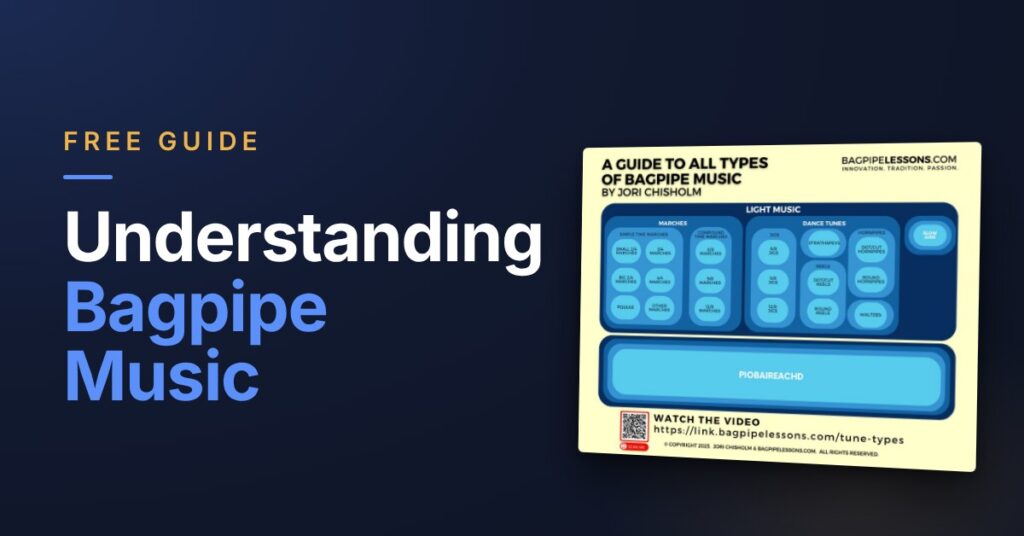
I put together a new infographic that shows how all the different kinds of pipe tunes fit together, and in this video I go through every one. For each tune type I tell you where it is played, its time signature, the common rhythmic groupings, and the style of expression, and I play a few classic examples.
All pipe tunes fall into two groups: piobaireachd, the big music, and light music, which includes marches, dance tunes and slow airs. Marches are in simple or compound time. Dance tunes are jigs, hornpipes, strathspeys, reels and waltzes.
You can get the whole chart in my free Understanding Bagpipe Music guide.
At a glance
| Two main categories | Piobaireachd (ceòl mór, big music) and light music (ceòl beag, little music) |
|---|---|
| Light music includes | Marches, dance tunes and slow airs |
| Compound time marches | 6/8, 9/8 and 12/8, with beats made of groups of three eighth notes |
| Simple time marches | 2/4 (little and competition style), 3/4, 4/4, polkas and other signatures |
| Dance tunes | Jigs, hornpipes, strathspeys, reels and waltzes |
| Strathspeys | 4/4 with a strong dot cut feel and pulsing |
| Hornpipes and reels | Each comes in a pointed style (dots and cuts) and a round style (even notes) |
| Jigs | 6/8, 9/8 and 12/8. Smooth and flowing, with no dot cuts |
Video highlights
“The more you learn about it, the more you find out about it, the more you explore it, the more you like it and that certainly seems to be the case with many pipers in the world.”
“The simplest way to think about compound time tunes is that your beats are made up of groups of 3 eighth notes.”
“The best jig playing is smooth and easy.”
“So the only way to emphasize a note is by making it longer.”
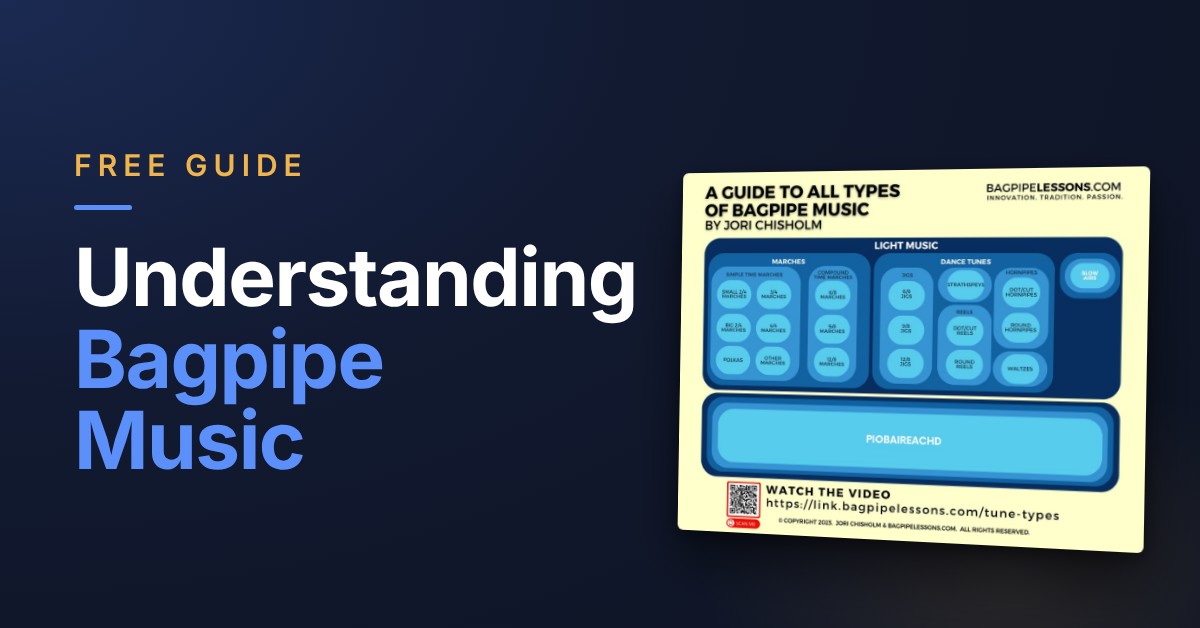
Free guideUnderstanding Bagpipe MusicThe infographic from this video, summarizing every tune type and how they relate, so you can keep it handy.
Get the free guideThe tunes in this video
 The Little SpreeA piobaireachd that I often teach to pipers as their first tune.Learn more →
 Mist Covered MountainsA classic slow air in 6/8, with a lullaby feel and lovely slow triplets.Learn more →
 Amazing GraceOne of the most commonly played tunes around the world. Most scores show it in 3/4, but pipers play it in 9/8.Learn more →
 Bonnie DundeeA classic 6/8 march with that wonderful compound time rhythm and the dot on it.Learn more →
 79th Farewell to GibraltarA great competition tune for starting out, in the big competition style 2/4.Learn more →
 Green Hills of TyrolA classic 3/4 march that almost every piper knows or should know.Learn more →
 Scotland the BraveThe most famous 4/4 march of all time.Learn more →
 Cork HillA 6/8 jig, and often the first jig I teach my students. You will never outgrow it.Learn more →
 Crossing the MinchA traditional dot cut style hornpipe, with doubling strikes.Learn more →
 Orange and BlueOne of my favorite strathspeys.Learn more →
 Piper of DrummondA nice little pointed style reel.Learn more →
 Bagpipe Revolution AlbumMy album, which includes the round style reel “Morning Dew.”Learn more →
Your questions, answered
Tap a time to watch that part of the video.
What is piobaireachd?
It is the big music, ceòl mór in Gaelic. The tunes are very long, from seven minutes for a short one up to 24 minutes or longer. There is no strict beat. It is a theme and variations, starting with the ground, and the variations get more complex and faster as the tune goes on.
What is a slow air in bagpipe music?
Slow airs are a category with a lot of musical variety, in almost every time signature, like 2/4, 3/4, 6/8 or 9/8. Some come from Gaelic songs, some from hymns, and some are pipe or fiddle tunes written for bagpipes or another instrument. The tempo is slow, and a piper usually taps their foot or wanders, but is not marching.
Why do pipers play Amazing Grace in 9/8?
It comes from the hymn. Most printed scores show Amazing Grace in 3/4, but the way pipers play it, we actually play it in 9/8. I have a whole other YouTube video about it.
What is the difference between compound time and simple time marches?
Compound time tunes are in 6/8, 9/8 or 12/8, and the beats are made up of groups of three eighth notes. That gives you 2 beats per bar in 6/8, 3 in 9/8 and 4 in 12/8. In simple time marches, the beats split into twos and fours.
What does a 6/8 march sound like?
We do not play even triplets. We usually hold one of the notes, typically the first, and that gives you the wonderful compound time rhythm with the dot on it. Classic 6/8 marches are Bonnie Dundee, Major John MacLennan and Major Donald MacLean of Lewis.
What is the difference between a little 2/4 march and a competition style 2/4?
The little two-fours, like Highland Laddie and the High Road to Gairloch, have simple rhythmic patterns, usually one or two notes per beat, and tend to be two-parted. The big competition style two-fours have more complex groupings, with a lot of three note and four note patterns.
What is a 3/4 retreat march?
Some of the most popular and classic pipe tunes are 3/4 marches. They are sometimes called retreat marches, from the Scottish regimental tradition where they played 3/4s at the end of the day. A classic that almost every piper knows or should know is the Green Hills of Tyrol.
Why is Cullen Bay in 5/4?
The story, as I understand it, is that the composer wrote it as a 4/4. Friends and bandmates started playing around with it and extended the last note of every bar an extra beat, adding a fifth beat. The composer liked it so much he rearranged it in 5/4.
What is the difference between a jig and a 6/8 march?
The 6/8 jig is very similar to a 6/8 march, except we get rid of the dot cuts, so the triplets are three even notes. Jigs come in 6/8, 9/8 and 12/8, with two, three or four triplets per bar. The expression is smoothness and flow, with no dotted notes and no pulsing.
What is the difference between a pointed and a round hornpipe?
Both are in 2/4. The pointed, or dot cut, style has dots and cuts, long and short notes throughout, like Crossing the Minch. The round style takes out all of the dots and cuts, like my Merry Wedding Hornpipe.
What makes a strathspey different from a 4/4 march?
A strathspey never has a pair of even eighth notes. There is always a dotted note and a cut, so it has a really strong dot cut feel. It also has heavy pulsing: we lengthen the dotted note on the first and third beats and slightly shorten the dotted note on the second and fourth.
What is the difference between a pointed reel and a round reel?
A pointed reel has dot cuts, and a round reel is all even notes, just like the two hornpipe styles. Reels are in cut time, which is two beats per bar. When you play a round reel, it helps to bring the tempo up a little bit and drive it.
What is a bagpipe waltz?
A waltz is in threes, one, two, three, just like the traditional dance. Pretty much a waltz is a reel played in groups of three. Fox Hunters was originally a jig and then it was arranged as a waltz.
Each week, the Inner Circle's lively sessions are designed to benefit pipers of all skill levels, all around the world.
LEARN FASTER. FIND GREATER ENJOYMENT FROM YOUR PIPING. JOIN ME.
Join the Inner CircleFull video transcript
0:00 Introduction and Welcome
Today I want to talk about bagpipe tunes and all of the different categories of tunes that we have from piobaireachd to slow airs to our dance tunes to all of our wonderful marching tunes. I created this new infographic to summarize and show the relationships between all of our different styles of pipe tunes.
0:06 Overview of Tune Categories: Piobaireachd, Light Music, Marches, Dance Tunes, Slow Airs
We have piobaireachd and light music, marches, dance tunes and slow airs and then within the categories of marches and dance tunes, all of our different subcategories. So what I want to do today is go into detail on each one of these tune types.
We’ll talk about where we use these tunes in terms of where they’re played in the piping repertoire. We’ll talk about the time signature for each one of these tunes. We’ll look at the different common rhythmic groupings in each of these tunes, and then we’ll talk about patterns or styles of expression.
And for each one of these categories of tunes, I will give you some examples of some classic tunes and play a few tunes for you. So here we go. Welcome to BagpipeLessons.com where you’ll find the inspiration and knowledge to fulfill your piping dreams.
All of our pipe tunes fit into two main categories. We have piobaireachd and everything else which falls into the category of light music. So all of our marches, our dance tunes, and our slow airs all fall into this category of light music.
1:13 Main Categories of Pipe Tunes: Piobaireachd and Light Music
The Gaelic word for that is ceòl beag which means little music. Or we have piobaireachd. Another word for that is ceòl mór which means big music. Piobaireachd is a wonderful style of music. The tunes tend to be very long. Seven minutes would be a short one all the way up to 24 minutes or longer, some of our longest tunes. Many pipers who play at the high level who compete at the world-class level like I did for many many years consider piobaireachd to be the ultimate form of bagpipe music in terms of being the most complex and also the most interesting and the most rewarding to play. The more you learn about it, the more you find out about it, the more you explore it, the more you like it and that certainly seems to be the case with many pipers in the world.
1:38 Piobaireachd: Characteristics and Complexity
It’s different from our other tunes in that it doesn’t have a strict beat. Piobaireachd is organized in terms of a theme and variations on a theme. The first musical theme is the ground and then you have different variations on that theme. Some of these tunes can have one or two or three variations, some tunes can have more than 20. As the tunes progress, things tend to get more complex in terms of the fingering, and faster. So the earlier variations, the ground in particular, tends to have the most light and shade and subtlety of expression, and then things get more rhythmic and more regular and faster as we progress.
Here’s a great tune that I often teach to pipers as their first tune. It’s called ‘The Little Spree.’ One of the greatest piobaireachd ever written is the ‘Lament for Patrick Ogg McCrimmon.’ It features the high G note prominently, which is really an emotional and powerful note in piobaireachd.
3:15 The Lament for Patrick Og MacCrimmon
Also has a wonderful variation, one in doubling. Although most of our piobaireachds are hundreds of years old, there are modern tunes being written. I’ve written several piobaireachds. A very popular modern tune is ‘Field of Gold’ by Donald McCloud.
4:03 Modern Piobaireachd: Field of Gold
So once we move out of piobaireachds, into light music. We basically have three categories. So, when we move away from piobaireachd and we get into light music, we have three main categories. We have marches, dance tunes, and slow airs. Now slow airs are a category that has a lot of musical variety. There are tunes in almost every time signature that you can think of, 2, 4, 3, 4, or compound time like 6, 8, or 9, 8. Some of our slow airs come from Gaelic songs. Some of our slow airs come from hymns. Other slow airs are just pipe tunes or fiddle tunes that have been written specifically for the bagpipes or another instrument. The tempo for slow airs is slow, and typically when a piper is playing a slow air, they’re tapping their foot, or they’re wandering, but they’re not marching.
5:05 Slow Airs: Time Signatures and Varieties
The rhythmic groupings that you get in your slow airs depends on the time signature. So if you’re playing a 6, 8 slow air, you’ll have some triplet patterns. One of my favorite slow airs comes from a Gaelic song. It’s called the ‘South Georgia Wailing Song’ and it’s in 6- 8. ‘Mist Covered Mountains’ is another classic also played in 6/8. Almost like a lullaby kind of feel with those lovely slow triplets. A couple of the tunes that I teach right at the beginning with my new students is ‘Scots Wha Hae.’ and ‘Going Home.’ Both of these tunes are also in 6/8. Simple and lovely. One of the most well known pipe tunes and most commonly played tunes around the world is ‘Amazing Grace.’ It comes from the hymn. Most printed scores for Amazing Grace show the tune in 3-4 but the way that pipers play it, we actually play it in 9/8.
7:17 Amazing Grace in 9/8 Time
I have a whole other YouTube video all about Amazing Grace and how it’s 9/8. The next category of tunes I want to look at are marches. Marches are used widely by pipers. If you compete solo, the 2-4 march category is one of the most common competition events you’ll ever see. In the higher grades, you have a march, strathspey, reel competition, and that is always a big competition style 2-4 march to start your MSR. And in pipe band competitions, we have the medley event. It’s required that you start with some sort of marching tune. It could be a hornpipe, but more commonly, it’s a march. If we look at our two subcategories of marches, we split them into simple time marches, and compound time. So what does this mean, simple versus compound time?
8:02 Introduction to Marches: Simple and Compound Time
Let’s start with compound time first. Compound time tunes are in 6/8, 9/8, or 12/8. So what that means is you have 6 eighth notes per bar in a 6/8, or in a 9/8 you would have 9 eighth notes per bar. Then the rarest form of compound time tune we have, 12/8 marches, and that would be 12 eighth notes per bar. But if you look at the 6, 9, and 12, each one of those are divisible by 3, and that’s exactly what you do to figure out your number of beats per bar. A 6/8 march would have 6 eighth notes, but they’re grouped in threes. So you have 2 beats per bar. 9/8 March would have 3 beats per bar, and a 12/8 march would have 4 beats per bar. The simplest way to think about compound time tunes is that your beats are made up of groups of 3 eighth notes. |
9:02 Bonnie Dundee (6/8 March)
We don’t have even triplets. We usually hold one of the notes, typically the first note, but it could be the second note. So here’s a classic 6/8 march, ‘Bonnie Dundee.’ You get that wonderful compound time rhythm with the dot on it. A really great 4-parted 6/8 march that I love to play, and that I teach to my students is ‘Major John McLennan.’ Maybe the most popular 6/8, ‘Pipe Major Donald McLean of Lewis.’ Listen to this amazing musical phrase that starts the tune – so simple, so powerful, so catchy.
10:29 Major Donald MacLean of Lewis (6/8 March)
So a 9/8 march is going to sound much like a 6/8, but instead of having two of those dotted triplets, we have three of them. Nine, one, two, three, four, five, six, seven, eight, nine. Three triplets instead.
A classic tune, the ‘Heights of Dargai’ also known as the ‘Dagshai Hills.” Another popular 9/8 is the ‘Battle of the Somme,’ which is also used to play for the highland dance, for the lilt. There aren’t many 12/8 marches, but what you’ll find in a 12/8 is that it just has twice as many triplets as a 6/8.
11:55 12/8 Marches
Most of our pipe tunes have eight bars per part, and that goes for 6/8s and 12/8s. But the 12/8s have four of those triplets instead of the 6/8, which only have two. So in terms of the feel and the overall style of expression between the 12/8 and the 9/8 and the 6/8, it’s exactly the same.
We still have those dotted triplets. It’s just the number of triplets per bar changes depending on 6/8, 9/8, or 12/8. Now let’s look at simple time marches. Unlike the compound time tunes that have beats that are split up into threes, here we have beats that are split up into twos and fours.
12:28 Simple Time Marches: 2/4, 3/4, 4/4
With our simple time marches, we break them up by time signature. We have two fours, three fours, four fours, and other. The two fours are all tunes that are in the two four time signature, and I’ve split up the two fours into two categories, what I call the little two fours and then the big competition style two fours. Those tunes have a lot of similarities, but there are some important differences too. The little two fours are tunes like ‘Highland Laddie,’ the ‘High Road to Gairloch,’ what makes these tunes two fours, a little two fours, is that the rhythmic patterns are quite simple.
13:06 Highland Laddie (2/4 March)
Usually you have beats with one note, two notes, occasionally three or four. But these smaller tunes have simpler rhythmic patterns. Also these tunes tend to be two-parted tunes. This is contrasted with our big competition style two fours, which have more complex rhythmic groupings.
We still do have some one and two note patterns per beat, but we have a lot of three note patterns and four note patterns. A great competition tune for starting out is the ‘79th Farewell to Gibraltar.’ One of my all-time competition style two four marches is written by the great John McColl, who I think is the greatest composer of all time of 2-4 marches. He just wrote so many tunes that are so great and interesting and different and are played by pipers around the world. This might be his best tune, ‘Mrs. John McColl.’ Some of these big competition style marches really do get big. A classic tune that’s a six parter is ‘Lord Alexander Kennedy,’ a really popular tune with top bands.
14:59 Mrs. John MacColl (2/4 March)
So where our 2-4 marches have 2 beats per bar, our 3-4 marches have 3 beats per bar. Some of the most popular and classic well known pipe tunes fall into the 3-4 march category. They are sometimes also called retreat marches and this comes from the Scottish regimental tradition where they would play 3-4s at the end of the day. So a classic 3-4 that almost every piper knows or should know is the ‘Green Hills of Tyrol.’ The all-time king of 3-4 march composers is none other than John McClellan of Danoon. McClellan lived around the turn of the last century, so early 1900s, and he wrote some of the absolute best 3-4s, the ‘Dream Valley of Glendaruel,’ ‘Lochinside,’ the ‘Highland Brigade at Magersfontein,’ and (the) 3-4 which might be my favorite 3-4 and one of my favorite tunes of all time, the ‘Bloody Fields of Flanders.’
16:07 Green Hills of Tyrol (3/4 March)
So three fourths, three quarter notes per bar, each quarter note gets a beat, so we have three beats per bar. Now moving on, four fours, the most famous four four of all time? You guessed it, ‘Scotland the Brave.’ ‘The Rowan Tree,’ ‘Battle of Waterloo,’ a lot of the four fours are two parted but one of my favorite four parters is the ‘Meeting of the Waters.’ Also in our simple time march category we have polkas. Polkas are an interesting tune because they’re 2-4 and I debated whether they even belong in this chart.
17:50 The Meeting of the Waters (4/4 March)
It’s sort of a hybrid tune style. It fits in between a 2-4 march and a hornpipe. There aren’t that many polkas out there, and if you heard one you might think, “Oh that’s a hornpipe,” or you might hear it and think, “Oh that’s a 2-4 march.” Two of the most famous polkas are the ‘Royal Scots Polka’ and the ‘Black Watch Polka.’ So it definitely has that up-tempo bouncy feel like we get from a hornpipe but it’s not quite a hornpipe. A little bit like a 2-4 march so it’s right in between those two.
18:24 Royal Scots Polka
Our final category in simple time marches is what I called other tunes. So this would be simple time marches that don’t fit into one of these other time signatures we’ve already talked about. They’re not 2-4, they’re not 3-4, they’re not 4-4. So what are we talking about? Well there’s a famous tune. It’s a 5-4. It’s called ‘Cullen Bay,’ and the story as I understand it was that the composer wrote it originally as a 4-4, and then some of his friends and bandmates started playing around with the tune and they extended the last note of every bar an extra beat, adding a fifth beat. The composer liked it so much that way, he rearranged it to be in 5-4 and we have ‘Cullen Bay.’
18:59 Cullen Bay (5/4 March)
So see if you can count the five beats per bar. But it works much better as a 5-4, really popular tune for that reason. So we’ve looked at piobaireachd, we’ve looked at slow airs, we’ve looked at all of these different march styles, compound time and simple time.
Our final big category of tunes within light music are dance tunes. We have a lot of different time signatures here. What these tunes have in common is that they tend to be upbeat and fast. So first let’s look at jigs. Jigs come in three different time signatures, 6/8, 9/8 and 12/8. So they’re in compound time just like our compound time marches. In fact, the 6/8 jig is very similar to a 6/8 march, with a couple of important exceptions.
20:09 Jigs: 6/8, 9/8, 12/8 Time Signatures
We get rid of the dot cuts, so instead of a triplet with a dot and a cut, we have three even notes for our triplets, four jigs. So in 6/8 we’ll have two triplets, and 9/8 we’ll have three triplets, and in our 12/8 jigs, our too many 12/8 jigs out there, we have four triplets in each bar.
I love the tune, ‘Cork Hill.’ It’s often the first jig that I’ll teach my students, but I play it myself. You’ll never outgrow ‘Cork Hill.’ I love the jig that I play almost every time I’m performing somewhere, because it’s such a fun tune, and such an exciting tune for the audience, is a Donald McLeod composition, the ‘Glasgow City Police Pipers.’
21:14 Glasgow City Police Pipers (6/8 Jig)
I love the jig. That’s just the first two parts of a four-parted tune, which I love. Another classic jig that features the B note a lot is ‘Paddy’s Leather Breeches.’ Another one of my favorite jigs is written by the great piper Donald McPherson, and features a long D to start every part, and that’s called the ‘Curlew.’ So if you go to the highland games, you’ll see the piping competitions. You might see some athletic events, but you’ll probably also see highland dancing competitions. And one of the dances they have for the highland dancers is a jig, and you’re going to hear a 6/8 jig played for those dancers.
22:24 The Curlew (6/8 Jig)
Often it’s ‘Paddy’s Leather Breeches,’ but it can be any other 6/8 jig. 9/8 jigs have a similar feel. We still have our even style triplets, but we have three triplets in each bar. One of the most famous and loved 9/8s is ‘Donald Willy and his Dog.’ Another one of my favorite 9/8’s is ‘Paddy Be Easy.’ An interesting thing about 9/8 jigs is that they typically have 4 bars per part and that’s interesting because it’s unusual. Almost all of our pipe tunes have 8 bars per part, 9/8 jigs have 4.
23:44 Going to the Well for Water (12/8 Jig)
There aren’t too many 12/8 jigs but one of my favorites is called ‘’ as long as a 6/8 jig because you have 4 triplets per bar instead of 2. Regardless of what time signature you’re playing for a jig, whether it’s 6/8, 9/8, or 12/8, the whole idea of the expression is smoothness and flow. There’s no dotted notes, there’s no pulsing, there’s no holding of anything. The best jig playing is smooth and easy. Let the excitement from the tune come from the fast tempo and from the composition.
24:27 Jig Playing Style: Smoothness and Flow
What kind of tune goes great with a jig? A hornpipe. Hornpipes are in 2-4 time signature and there are two distinct styles of hornpipe. They’re both in 2-4. One is the pointed style or the dot cut style where we have dots and cuts, long and short notes throughout.
24:48 Introduction to Hornpipes: Pointed and Round Styles
The other is the even style also called round. So a traditional classic dot cut style hornpipe would be ‘Crossing the Minch.’ A feature of these traditional dot cut style horn pipes is you’ll have these doubling strikes.
25:15 Crossing the Minch (Pointed Hornpipe)
For example, in that tune you have a doubling strike on B which is a G gracenote and E gracenote on B and then a strike. That goes really well in contrast to the birl. In the round style hornpipe we take out all of the dots and cuts. It’s still 2-4. Sounds a little bit something like this. That’s a tune I wrote called the ‘Merry Wedding Hornpipe.’ Another favorite in the round style would be ‘Sandy’s New Chanter.’ So those hornpipes can be used in band competition or solo competition.
26:12 The Merry Wedding Hornpipe (Round Hornpipe)
Either way, I think I probably prefer the dot cut traditional style for my own solo competitions, but you hear both styles being played. Some of the modern hornpipes, a lot of them tend to be in the round style and some of the new composers are bringing in some really interesting syncopation.
26:31 Strathspeys in Bagpipe Music
Strathspeys are everywhere in Scottish music. I think of it as the quintessentially Scottish style of bagpipe tune. Strathspeys are in 4-4 time, written sometimes as 4-4, sometimes written with a C, which means common time.
Common time, 4-4 time, exactly the same thing. One of the things that distinguishes a strathspey from a 4-4 march is the strathspey will never have a pair of even eighth notes. Never. It just doesn’t exist.
26:59 Characteristics of Strathspeys: Dot Cut and Pulsing
You’ll always have a pair of notes where one note is dotted and one note is cut. So a feature of the strathspey is that really, really strong dot cut feel. The other thing that we have in a strathspey is we have a really, really heavy style of pulsing.
So what pulsing means is you emphasize certain beats more than other beats. But on the bagpipe, we don’t change our volume. We all have one volume that we play all the time. So the only way to emphasize a note is by making it longer. So what we do in strathspey is we lengthen the long note, which is the dotted note, on the first beat and the third beat. And we slightly shorten the dotted note on the second beat and the fourth beat.
27:26 Orange and Blue
Here’s one of my favorite strathspey, it’s called ‘Orange and Blue.’ Probably the most popular modern strathspey, and I mean modern written in the last few decades, is a short tune called ‘Molly Connell’ written by Jim Warr.
I was playing at a concert in Scotland several years ago and it was announced before a set of tunes we were going to play, that in the audience that day were the two most famous ladies of piping. Everyone in the audience got really excited, and looked around and thought, who could it be? It was Susan McLeod and Fiona McLeod, the two daughters of the famous piper and composer Donald McLeod. What we played for them was a set of Donald McLeod’s tunes, ‘The Night’s Wood Caley’ and then the strathspey ‘Susan McLeod’ and the real ‘Fiona McLeod.’ All three of those tunes are absolute classics but ‘Susan MacLeod’ stands out as maybe one of the best tunes ever written. I certainly think so. I’ll never forget where I was when I first heard ‘Susan MacLeod’ played, and that memory is so strong in my mind. It’s a wonderful tune for competition. You hear it played by bands and soloists. Really, really cool tune. I could go on for hours about all the really cool, interesting, beautiful things in ‘Susan MacLeod.’
28:45 Susan MacLeod
One of the biggest, most technically complex and impressive tunes ever written is an eight-part strathspey called the ‘Cameronian Rant.’ I love this tune. Anytime you hear a piper play this tune in competition, it features some really quick GDE triplets throughout the tune. Unlike the GDE triplet that we have in jigs where it’s three even eighth notes, the strathspey triplets are played with a short, short, long pattern. It’s a really cool sound. One of the most common groupings of some tunes would be the March, Strathspey, and Reel.
29:58 The Cameronian Rant
So that is a classic performance and competition set called the MSR. There are two styles of reel. There’s the pointed reel, which has dot cuts, or the round style reel, which is all even notes. So just like in our hornpipes where we have the pointed, the round style, the same thing in the reel.
30:44 Introduction to Reels: Pointed and Round Styles
Our reels are in cut time or cut common time, which is 2-2. So 2-2 would mean two beats per bar and each beat gets a half note. Now we don’t typically have a lot of half notes in our reels. So another way to think about it, is it’s 4-4, meaning there’s four quarter notes per bar but instead of tapping out four beats, we only do two beats. So our first two quarter notes are a beat, and our third and fourth quarter notes are a beat. So it’s two beats per bar, but four quarter notes. In our pointed style reels we have some nice little reels like the ‘Piper of Drummond’ or something like the ‘Ale is Dear.’
31:37 The Piper of Drummond (Pointed Reel)
For competition we’re going to want a four parted reel. So a good one would be ‘Lachlan McPhail of Tyree.’ When we get into the bigger competition reels, there’s some really great ones like the six parted masterpiece, ‘John Morrison of Ascent House.’ One of my favorite competition reels is a six-parter called the ‘Smith of Killahassee.’ Lots of GDEs, lots of tachums, lots of fun stuff on the bottom hand. When you get to a round style reel, you just take all the dot cuts out.
32:18 John Morrison of Assynt House (Pointed Reel)
There are some reels that are written in the dot cut style that are also played in the round style. There are a lot of competition-style, traditional reels that are only played in the pointed style and there are some reels that are only played in the round style. Here’s one of my favorite tunes. It was on my Bagpipe Revolution album called ‘Morning Dew.’ So when you play a round style reel, it helps to bring the tempo up a little bit and just drive it. A round style reel has a lot in common with a jig.
32:59 Morning Dew (Round Reel)
In our round reels, we have eighth notes in groups of two and four. In our jigs, we have eighth notes in groups of three but the overall effect is even steady rhythmic playing with lots of tempo and lots of drive. The ‘Ale is Dear’ can also be played in the round style, in the pointed style. But when you do play the round style, it helps to bump the tempo up to just keep the excitement going. Our final category of tune is the waltz.
And if you know anything about the traditional dance of a waltz, it’s in threes. One, two, three. One, two, three. And that’s exactly what we have in the bagpipe waltz. Here’s a tune called the ‘Traditional Irish Reel.’ I’ll play it first as a reel and then as a waltz. So instead of one, two, one, two, it’s one, two, three, one, two, three, one, two, three. Another example going back to ‘Ale is Dear.’ If I play it first as a round reel and then as a waltz. One, two, three. One, two, three. Another famous piping waltz is the ‘Fox Hunters.’ ‘Fox Hunters’ was originally a jig and then it was arranged as a waltz.
34:39 Traditional Irish Reel (as a Waltz)
So there you have it. You’ve got the PDF that you can refer to. We got piobaireachd and light music. Our light music we categorize into slow airs, marches and dance tunes. Our marches we can sub-categorize into compound time and simple time.
35:41 Wrap Up
Within our simple time we have our little two-fours, our big two-fours, our three-fours, our four-fours, our polkas and then everything else. Within our compound time marches we just go by time signature 6, 8, 9, 8, 12, 8.
In dance tunes we have our compound time jigs, triplets, but real even fast smooth playing with a lot of drive. We have our strathspeys with a strong dot cut, with that really strong beat emphasis on our first and third beats. And we have our reels in the round and pointed style.
In our hornpipes we have pointed hornpipes and round hornpipes and then finally we have waltzes which are pretty much reels but played in groups of three. Thanks for watching. Check out the description below to download my free guide called How to Get the Most Out of Your Practice and please hit the subscribe button and click the little bell to be notified when I post new things here on the BagpipeLessons.com YouTube channel and visit BagpipeLessons.com/learn to watch and download some more videos, lessons and free guides like this one.
Happy piping!
My exact words from the video, lightly cleaned up for reading. Click any time to jump the video to that moment.

About Jori Chisholm
Jori started BagpipeLessons.com in 1999, and in 2003 he became the first piper to teach one-on-one lessons by video. His online teaching has been featured on the front page of the New York Times, and thousands of pipers around the world have used his lessons, tools and products.
He is a four-time U.S. Gold Medalist for Piping, has won prizes at the Argyllshire Gathering, the Northern Meeting, Cowal and Braemar, and won the World Pipe Band Championships three times with the Simon Fraser University Pipe Band. He invented the Tone Protector, the InTune Mic and the Endurance Practice Chanter, and in 2011 he founded the World Online Piping & Drumming Championships.
More about Jori →
The Inner Circle
Ready to take your piping further?
Get unlimited access to 790+ lessons, videos and tunes, plus a live Zoom class with me every week. Every replay is searchable to the exact moment anything was taught.
$399/year works out to $33.25 a month$45/month month to month
For pipe bandsBring your whole band into the Inner Circle
Every piper gets their own login, and we start with a band coaching session on Zoom with me to map out your season. From $10 per piper per month.See band memberships →