

Free articleTunes
Learn Tunes Faster by Highlighting Your Sheet Music
Before you play a note, mark up the page. Highlighting repeated phrases and rhythmic patterns shows you the structure of a tune and cuts memorization time.
The Short Version
Before you play a single note of a new tune, look at it and mark it up. Most pipe tunes are built from repeating two-bar phrases, and once you can see which bars repeat, you have far less to memorize than you thought.
Print the tune on real paper, grab colored highlighters, and mark every repeated phrase in the same color. Then do it again for rhythmic patterns rather than notes, color every beat that shares the same rhythm. The structure of the tune jumps off the page.
Think of it as a memory aid, not homework. Use your brain for learning the music, not for remembering where the hard bits are.
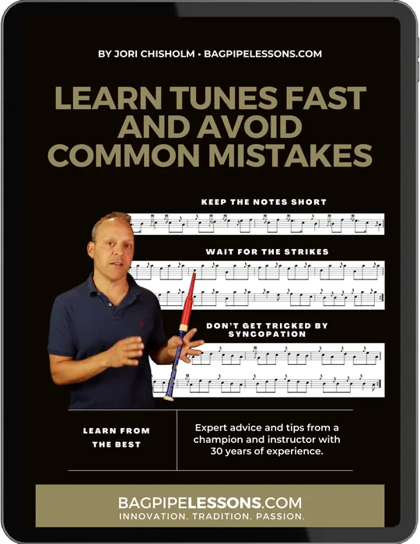
Free guide (PDF)Learn Tunes FastPrefer a printable copy? Get the free guide, sent straight to your inbox.
Get the free guideTo help learn and memorize a new tune, it’s helpful to look over the tune to identify its unique and repeating elements. Before picking up your chanter to start playing, take a few minutes to look and understand the tune’s structure.
 ▶Watch the videoHow to Read and Play the Repeats: Understand and Master the Repeats in Your Bagpipe TunesJori Chisholm explains how to read and play repeats in bagpipe tunes, including repeat signs, first and second endings, and why strathspeys, reels and…
How Pipe Tunes Are Built
Most pipe tunes fall in the traditional structure:
- Parts, usually 2 or 4, but sometimes 3, 5, 6, 8 or more
- Lines, almost always 2 lines per part
- Bars, almost always 4 bars per line, 8 bars per part
Oftentimes the bars repeat in groups of two. We call this a phrase. Sometimes phrases are one bar or three or more bars, but most typically we have two bar phrases.
The Exercise: Mark Up a Tune
Download and print out this copy of the classic 2/4 march The 79th’s Farewell to Gibraltar.
You will need a copy printed on real paper. Looking at it on your computer screen won’t work for this exercise. Grab your colored highlighters, colored pens or pencils will work in a pinch, too.
Step one: find the repeating phrases
Take a look over The 79th’s and try to identify any two bar phrases that occur more than once. Mark the phrase with the same colored pen each time it shows up.
Resist the urge to play the tune or to try and find a recording to listen to. Look over the whole tune and find as many repeating phrases as you can.
Video Demonstration
Step Two: Highlight the Rhythms, Not the Notes
There’s a second way to use your colored highlighters that most pipers never try, and it’s the one that really opens a tune up. Instead of marking repeated phrases, mark repeated rhythms.
You’re not looking at which notes are the same. You’re looking at individual beats and identifying what the rhythm is, then coloring them accordingly. Take your default pattern, the dot-cut, and circle every single one of those in the tune in one color. Then the reversed cut-dot gets a different color. A double-cut beat gets another. Keep going until every beat is accounted for.
What you’ll see is that there is a definite pattern to it, often within each part. The rhythm pops out, because you can suddenly see where the composer flips the pattern to make things interesting. And the places where the pattern reverses are almost always the phrases that trip everybody up, now you can see them coming.
Highlight Three More Tunes
- A tune you have been playing for a while, a tune you know well.
- A tune you have been working on, a tune in progress.
- A brand new tune, a tune you’ve never played or never even heard.
What did you observe? Was it easier or harder than you expected? Did you notice anything odd or unexpected? Did your tune follow a similar pattern of phrases as in The 79th’s?
Once you get the hang of it, print out fresh copies of the three tunes you selected for your self recordings and highlight them as well. You’ll find that this exercise can help you learn faster and memorize tunes with less effort.
Why This Works
Think of your marked-up sheet like a patient’s chart. A doctor doesn’t carry every detail about you in their head, they open the chart, look at it, and hit the ground running. You’re jogging your memory, and you have the information right before you need it, which is at your practice.
That’s the real point. Use your brain for memorizing the music, not for remembering where the hard parts and the crossing noises are. Write those down and let the page carry them.
Suggested Products
 Seventy Tune Super Discount DealSeventy of my tune lesson downloads in one package.Learn more →
 Bagpipe Essentials MasterclassMy complete video course for the foundations of bagpipe technique.Learn more →
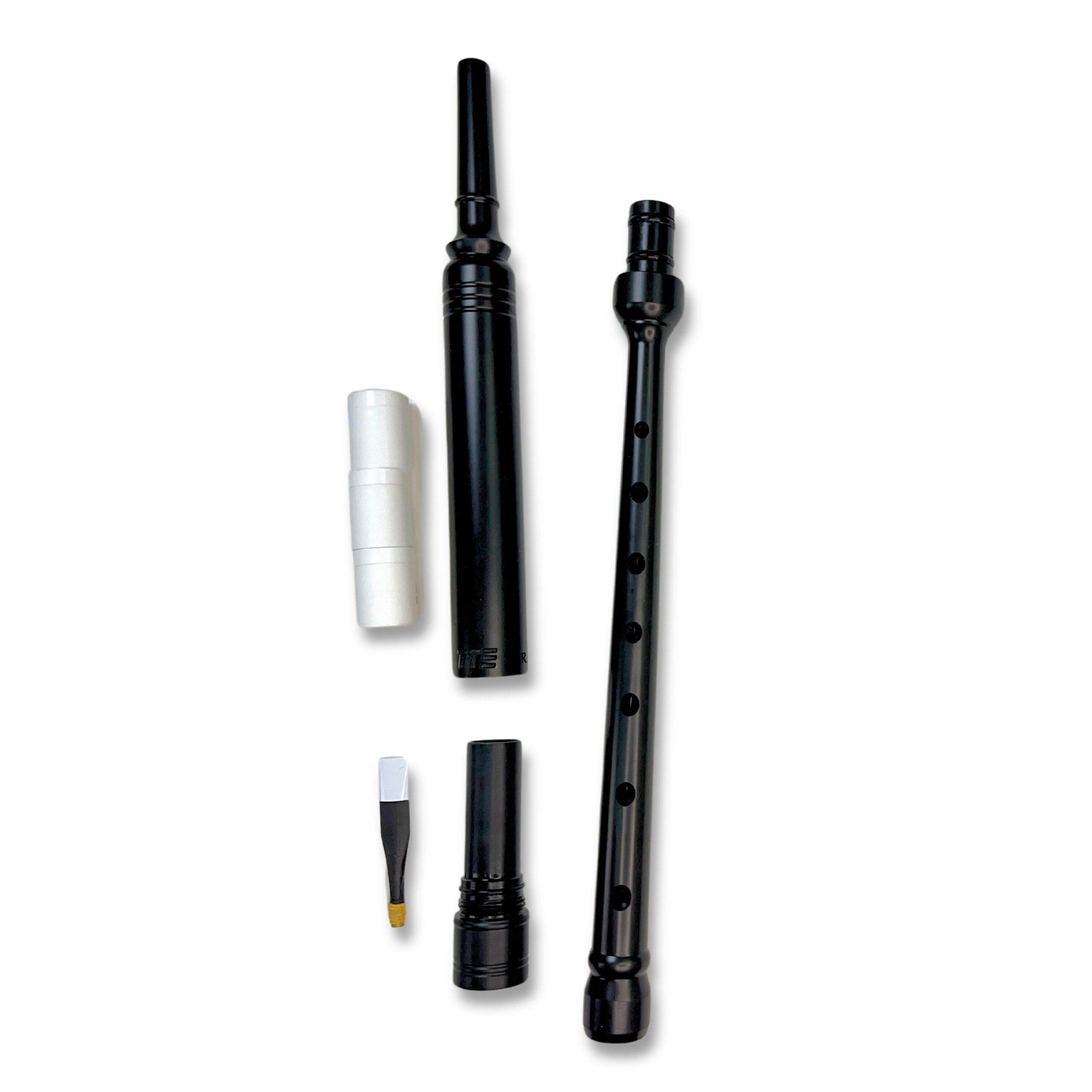 Endurance Practice ChanterThe only practice chanter with complete moisture control. I designed it, and R.G. Hardie & Co. makes it.Learn more →
 Piper’s Advantage Phone MountKeeps your phone right where you play, for tuners, recordings and sheet music.Learn more →
More Free Guides
Pick any guide, enter your email, and I’ll send it straight to your inbox. See them all on the Free Resources page.
 Learn Tunes Fast
Avoid the common rhythm and timing mistakes.
Get the free guide → Your First 100 Days as a Piper
What to expect in your first 100 days, from your first notes to your first tune.
Get the free guide → Secrets for Making Your Pipes Easy to Play
Find out why your pipes feel hard to play, and fix it step by step.
Get the free guide → How to Get the Most Out of Your Practice
Clear goals and a simple routine for every practice session.
Get the free guide → Understanding Pipe Chanter Reeds
Choose and adjust pipe chanter reeds for a clear, stable sound.
Get the free guide → Bagpipe Tuning Made Easy
Tune your drones and pipe chanter by ear or with any bagpipe tuner app.
Get the free guide →Frequently Asked Questions
Why highlight sheet music before playing a tune?
Because most pipe tunes repeat far more than they look like they do. Marking repeated two-bar phrases shows you how much of the tune you already know, so you memorize structure instead of memorizing every bar separately.
What should I highlight first?
Repeated two-bar phrases. Mark each phrase in the same color every time it appears, working across the whole tune before you play a note.
What’s the difference between highlighting phrases and highlighting rhythms?
Phrases are about the notes, which bars repeat. Rhythms are about the beats, which beats share the same pattern, such as dot-cut or cut-dot, regardless of the notes. The second one reveals where a composer flips the pattern, which is usually exactly where players stumble.
Do I have to print the tune out?
Yes. Looking at it on a screen won’t work for this exercise. You need real paper and colored highlighters, pens or pencils.
Should I listen to a recording first?
Not for this exercise. Resist the urge to play the tune or find a recording. The whole point is to read the structure with your eyes before your ears or fingers get involved.
Does this actually make memorizing faster?
Yes. You end up with far fewer independent things to remember, and the marked page acts as a memory aid at practice time, jogging your memory right before you need it.
Free guide (PDF)Learn Tunes FastPrefer a printable copy? Get the free guide, sent straight to your inbox.
Get the free guide
About the authorJori Chisholm
Bagpiper, bagpipe teacher and founder of BagpipeLessons.com. Teaching the bagpipes full time since 1999, now with live classes almost every week in the Inner Circle. Four-time U.S. Gold Medalist. Inventor of the Tone Protector, InTune Mic and Bagpipe Gauge.
More about Jori →