AS FEATURED IN

Don’t Start Learning to Play the Bagpipes Until You Watch This
by Jori Chisholm, Founder of BagpipeLessons.com
Last Updated: October 20, 2026
Do not start learning to play the bagpipes until you watch this. There are things that are not obvious if you haven’t done this before, and knowing them will save you money, time, effort, and a whole lot of second guessing. Can you learn on your own? Are you too old to start? (The short answer is no.)
In this video, I answer the top 10 questions I get from people curious about learning to play the pipes, plus a bonus question about joining a pipe band. I’ve been playing bagpipes for almost 40 years, and I’ve been teaching pipers online by webcam since 2003, with students all around the world.
Key Points in this Video:
- What you need to get started (you don’t need bagpipes yet)
- The three sizes of practice chanter, and which one I recommend
- Why every piper starts on the practice chanter (even world champions use one)
- Can you learn on your own?
- The $100 bagpipes on Amazon and eBay, and why they will not work
- How long it takes to get on the pipes, and to play a tune in public
- Am I too old? Memory, fingers, strength and stamina
- Do I need a teacher?
- Do I have to read sheet music?
- What practicing looks like: 15 minutes a day, slow and clean
- Bonus: joining a pipe band
Links Mentioned in the Video:
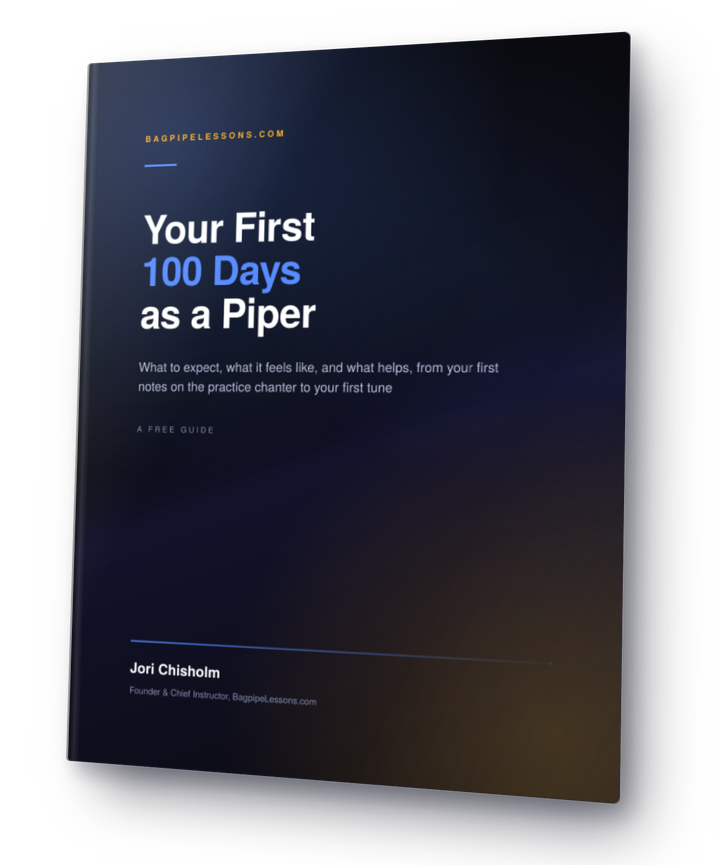
- Your First 100 Days as a Piper (free guide)
- Endurance Practice Chanter
- All Practice Chanters
- Infinity Pipe Chanter
- All Bagpipes
- Bagpipe Essentials Masterclass, free video 1: Master Top Hand Position
- Bagpipe Essentials Masterclass, free video 2: Master Bottom Hand Position
- My video: What Bagpipes Should I Buy?
- The Bagpipe Buyer’s Guide
- Join the Inner Circle
Chapters:
00:00: Don’t start learning the bagpipes until you watch this
00:43: What do I need to get started?
01:04: Which practice chanter?
02:01: Do I start on the pipes or the chanter?
02:39: Can I learn to play the bagpipes on my own?
03:46: What about a $100 set of bagpipes online?
05:04: How long does it take?
06:07: Am I too old?
08:11 : Do I need a teacher?
09:23: Do I have to read sheet music?
10:06: What does practicing look like?
10:52 Bonus: What about joining a pipe band?
11:26 Your free guide, the Masterclass, and the Inner Circle
Watch the video above, or read the full transcript below.
Video Transcript: Do not start learning to play the bagpipes until you watch this video, because there are things that are not obvious if you haven’t done this before, and if you know them, you’ll save money, time, effort, and a whole lot of second guessing. I’ve been playing bagpipes for almost 40 years. I started BagpipeLessons.com 25 years ago, and these are the top questions I get asked by people who are curious about learning to play the pipes. And if you’re wondering whether you’re too old to start, that’s question number seven, and the short answer is no. I’m Jori Chisholm. I started teaching pipers online by webcam in 2003, and I have students all around the world.
Q1: What do I need to get started?
A practice chanter. This is a recorder-like instrument. This is where you learn the bagpipe fingering and where you learn your first few tunes. And if it’s your first musical instrument, this is where you learn to read music and tap your foot. You don’t need bagpipes yet. If you have a practice chanter, you can get started today.
Q2: Which practice chanter?
Well, practice chanters come in three sizes. There’s the standard size, or regular size. There’s the long practice chanter, which some people like. It has a bit of a lower pitch. And then there’s what they call the child size, or junior size. That is for kids, or for adults with really small hands. For most people, I’d recommend the regular or the long.
I have some really great practice chanters on my shop, and one that I invented. It’s called the Endurance Practice Chanter. It’s my favorite because inside it has a one-of-a-kind moisture control system. When you play the chanter, the moisture from your breath condenses, but the Endurance chanter filters it out so your reed stays dry. It’s way easier to play. It sounds better. Your practice sessions last longer, and your reeds last longer, too. The important thing is that you get a practice chanter that sounds good and is easy to play so that you can practice. Links to all my practice chanters are in the description below.
Q3: Do I start on the pipes or the chanter?
Every piper starts on the practice chanter regardless of your age, and most people stay on the chanter for somewhere between a few months and a year. But here’s the part that might be unexpected. Every piper, even once you’ve learned, uses the practice chanter. It’s quieter, it’s easier to blow, and it doesn’t have all the complicated parts with the bag and the drones and the reeds and everything else. All pipers, even world champions, use a practice chanter as a practice tool. It’s a real practice instrument. This is where a lot of us work on our music. We work on our fingering technique. We work on our expression and our timing.
Q4: Can I learn to play the bagpipes on my own?
Well, what you need is a practice chanter with a reed and good information. And people ask, “Can I learn on my own? Can I learn from a book? Can I learn from the internet? Do I need a teacher?” Yes, of course, having a great teacher is the best option, an expert who can give you good information and keep you on the right track. But not everybody has access to a great bagpipe teacher where they live. That’s what BagpipeLessons.com is for.
I also know that one-on-one private lessons are not for everybody, because of scheduling or because of budget. That’s what my Inner Circle membership is all about. It gives you access to hundreds of hours of videos and lessons that you can watch wherever you are in the world, and I do live Zoom classes almost every week for my members. So it’s a really good balance. And here’s something that you should know. Video and audio are way better than trying to learn from a book. It’s really, really hard to learn music from a book. That’s why the Inner Circle has written material and sheet music, but also audio recordings and recorded video lessons, hundreds and hundreds of hours of video.
Q5: What about a $100 set of bagpipes online?
Are those any good? So these are bagpipes you might see on Amazon or eBay or on other online shops that cost maybe $150. These are not going to work. These are what I call a bagpipe-like decorative object. Bagpipes are way too complicated to work well when they are that cheaply made. There are too many parts that need to be working together. You have four reeds, and everything has to be totally airtight, or they just won’t function. These cheap sets will not work.
If you bought one and you’re thinking, “Well, can I make it work?” my honest advice is, I would cut your losses. To get that set anywhere close to functioning, you’re looking at a new pipe bag, you’re looking at a new set of drone reeds, you’re looking at a new pipe chanter and pipe chanter reed, and you’re going to spend easily many times what you paid for that set just to get it to sort of work. And it’s still really not going to be great, because those cheap bagpipes are so low quality in the materials and design that they’re never going to sound good, stay in tune, or be comfortable to play. So when the time comes and you’re ready, buy a quality set. I have a video on my YouTube channel all about different types of pipes and how to choose what to spend your money on.
Q6: How long does it take?
Well, it depends. You talk to any musician, and they’ll tell you that they feel like they’re still learning no matter how good they get. So the real question is, how long does it take to get on the bagpipes, and how long does it take to get good enough to play for people? I have a student who got on the pipes in about two months. I’d say the average is about a year. Now, to play a tune in public, say, at a wedding or a family event, I would say you’re looking at a couple of years. It could be sooner. It also depends on how much you practice, your previous musical experience, and the level of commitment you have to your piping.
But here’s what I want you to know. Playing the pipes is not one skill. It’s many, many different skills, and we all learn a little differently, at our own pace. Don’t rush the process. You start on the practice chanter and develop your good fundamentals, and when you’re ready, you move on to the big pipes and you learn all about playing the full instrument. I have a free guide you can download called Your First 100 Days as a Piper. The link is in the description below.
Q7: Am I too old?
A lot of people get interested in the bagpipes and take it up in adulthood, some in middle age, some in their retirement years. You might be wondering, is this something I can do? Maybe you’ve never learned a musical instrument. Maybe you’ve never learned something new at this stage of your life. But you can do it. Let’s talk about some of the things people worry about.
Memory. You don’t have to memorize anything to practice. A music stand is fine, and a tune you’ve really spent time with is mostly memorized anyway, even without trying. There are lots of tools and tricks you can use to help with memorization: working on repeating phrases, breaking your tunes down into small chunks, and highlighting on the sheet music to identify the repeating patterns.
Let’s talk about fingers. Now, pipers of any age have to work on this. This is not just for pipers in middle age or older. The key to good piping with clean technique is good form. Keep your hands relaxed and light. Keep your fingers in close to the chanter. No squeezing, no clenching. With good form, deliberate practice, doing the right kinds of repetitions while you’re paying attention, does the rest.
What about strength and stamina? Well, you build up to it. You’re starting on the practice chanter, which takes a little bit of air, and then you move on to the pipes. And bagpipes today are way more comfortable, more efficient and way easier to play than at any time in the past, with modern pipe bags and modern reeds. I recommend you play an easy reed or a very easy reed. My favorite chanter for the bagpipes is the Infinity Chanter. It’s got smaller holes and closer spaced holes, which makes it really comfortable to play, and it sounds great. There are all kinds of different sizes of pipe bags. I play a small bag made by Bannatyne. It’s really, really airtight, and it’s comfortable to play.
So it’s a matter of getting the right equipment that fits you and having it set up properly. With all that in place, it should be totally possible to play the bagpipes at any age. I have several videos on my channel all about this topic, how to set up your bagpipes so they sound great and feel great to play.
Q8: Do I need a teacher?
Yes, you need a teacher. I hear from pipers every day, all over the world, who are interested in learning. Of course, the best thing would be to have one-on-one private lessons with a world-class teacher, but I know that is not an option for most of us. So the good news is, with the internet, you can have access to world-class instruction no matter where you live. That was my original dream when I started BagpipeLessons.com all those years ago: a place where people could get good information about learning to play the pipes.
But now we have video and streaming and Zoom and live classes, and the website has grown into so much more. My new website, which I just launched for my Inner Circle members, is the greatest bagpipe learning website ever created. It has all of my lessons, all of my videos, hundreds and hundreds of hours, tune lessons, skill guides. You can ask questions. You can post videos. Everything is there. Everything is searchable, so you can get any question answered instantly, whether you’re on your computer or on your phone. No matter where you are in the world, it’s all right there at your fingertips. And I’m adding new lessons and new features all the time.
Q9: Do I have to read sheet music?
First of all, bagpipe music is much simpler than other types of written music. We only have nine notes. That’s a piano about this wide. The sheet music tells you which notes you need to play and the timing, not what the tune sounds like. So yes, I do recommend that you learn to read sheet music, but don’t be afraid. Maybe you tried earlier in life and struggled with it. Bagpipe music is totally doable for anybody at any age.
And having high-quality recordings and videos of your tunes really helps you learn with the sheet music, because you’re learning by ear. Think about singing the Happy Birthday song. You’ve heard it so many times, you know how it goes, even though you’ve never looked at the sheet music for it.
Learn From the Best
I'm Jori Chisholm. I created BagpipeLessons.com to help you fulfill your dream of becoming a piper. I hope to see you soon at weekly online sessions of my Inner Circle.
Q10: What does practicing look like?
I recommend 15 minutes a day, at least four or five days a week. You can take a day off if you need to, but I recommend you don’t take too many days off in a row, to keep your progress and your momentum going. Keep your practice chanter where you can find it easily. Don’t put it away. Keep it out where you can pick it up and play a tune or play a scale or just play a couple of notes. Short sessions through the day and through the week are better than taking five days off and trying to do a big marathon session on Saturday.
You want to practice slow and clean, and bring in speed later. And I think it’s a good idea to work on tunes or exercises at different levels: some things you’re really comfortable with, and some things which are a fun, exciting stretch challenge.
Bonus: What about joining a pipe band?
This is a great question, because a band is about finding people locally. You don’t have to join a pipe band, but if you have one locally, check it out. Most of these groups are interested in helping out new local pipers. Find out when they practice and if there’s any way that you can learn from them. Not every pipe band is in the position to give great instruction to beginners, but a lot of them will try and will be very encouraging. And even if you’re mostly learning online with a teacher or through BagpipeLessons.com, it’s nice to have local pipers to connect with.
Your free guide, the Masterclass, and the Inner Circle
So check out the link below for my free guide, Your First 100 Days as a Piper. And if you like this video, please subscribe to my channel and hit the bell. And when you’re ready to get started, check out my Bagpipe Essentials Masterclass. It’s 31 videos on all the essentials of bagpipe fingering, perfect for getting started right. I have the first two for free on my YouTube channel, and they’re linked below. If you like them, you can get the entire masterclass, or it’s included as part of my Inner Circle membership. You can find out all about my Inner Circle at BagpipeLessons.com/innercircle.
And I would love to hear from you. What made you want to play the bagpipes? I’d love to hear your story. Thanks, everybody, for watching. See you next time. Happy piping. Mahalo!
WATCH More Videos