AS FEATURED IN

Set Up Your Bagpipes Fast with the New Precision Reed Tester & Drone Adapter from BagpipeLessons.com
by Jori Chisholm, Founder of BagpipeLessons.com
Last Updated: May 16, 2026
Is it me, or is it my pipes? This is the question every piper asks when something does not feel right. Is your chanter reed too hard? Is a drone reed taking too much air? Is something leaking? Up until now, most pipers have had to figure this out by feel and by ear, which can take a lifetime to master.
In this video, I introduce my new product: the Precision Reed Tester and Drone Adapter for the Bagpipe Gauge. These two upgrades turn your Bagpipe Gauge into a complete reed-testing and setup system. No more guessing. Just real numbers and a clear picture of what every reed is doing.
Key Points in this Video:
- How to tell the difference between pipes that are too hard and pipes taking too much air.
- How to use the Precision Reed Tester to measure your chanter reed and each drone reed individually.
- How to use the Drone Adapter to practice with all three drones sounding while you monitor pressure on the Bagpipe Gauge.
- My complete 5-step process for matching all four reeds for ultimate efficiency and steadiness.
- Common pipe problems this tool solves in minutes instead of days.
Links to Products Mentioned in the Video:
- Bagpipe Gauge
- Precision Reed Tester and Drone Adapter
Watch the video below.
Read the full video transcript below.
Let me explain something that’s really important to understand, because a lot of pipers get confused between these two different things.
When your pipes are too hard, or if your pipes are taking too much air, they feel similar in certain ways, but they’re quite different problems with different causes.
If your pipes are too hard, that’s mostly about the pipe chanter reed. Your pipe chanter reed is the main thing that determines how hard your pipes are to blow—how much pressure you need to maintain to keep everything going. When your chanter reed is too hard, you have to blow harder to get it to kick in and to stay going and not cut out. You’re working way too hard. You get tired, and your steadiness suffers because you’re just exerting yourself harder than you can manage.
But when your pipes are taking too much air, you feel like you just can’t keep the bag full. Air is disappearing from the bag faster than you can get it inflated. It could be leaking from somewhere in your bag, from your hemp joints, but most commonly the cause of your pipes taking too much air is your drone reeds.
If even just one drone reed is open too wide, air is escaping through that drone reed, and you can’t keep your pipes going. Just a single drone reed that’s open too wide and taking too much air can make your pipes difficult or impossible to play.
Whether your pipes are too hard or taking too much air, they feel similar—but the causes are different, and the fixes are different. It’s important to figure out which one you’re dealing with so you can fix the problem.
Here’s something that every piper faces: you’ve got all these different hemp joints and slides that could be leaking. You’ve got a bag that might not be totally airtight. If one thing is off, everything can feel off.
And it can be a challenge to isolate the problem. But that’s what you need to do to get the right solution. To solve your problem, you need to figure out exactly what’s going on. And that can be hard to do when you’re doing it by feel and by ear.
What you end up doing is starting and stopping—adjusting a bridle here, adding a little bit of hemp here, moving a tuning screw, putting your pipes back together, playing again, trying to figure out if things feel better or worse.
It can be confusing, frustrating, and exhausting. And I talk to a lot of pipers who don’t even want to get started. You start out thinking you’re going to make just one tiny little adjustment, and then two hours later you feel like you haven’t made any progress, and things might actually feel worse than when you started.
So then you’re afraid to touch anything. You know something’s wrong, but you’d rather just leave it and live with it than risk making things worse.
If you’ve ever had a problem with your pipes and you didn’t know what to do, or you knew something was wrong but you were afraid even to touch things, you’re not alone. This is very common.
You can’t achieve this if your bag pressure is too high or too low or constantly moving around. You have to master the balance: the pressure applied by blowing into the bag and the pressure applied by squeezing the bag continuously with your arm.
Like with any musical instrument, there’s a physical conditioning component to playing the bagpipes—your lips, your cheeks, your breathing muscles, your shoulder and arm and back.
And with practice, you can build up the strength and stamina. But there’s a specific technique that is not natural for most people—but you can learn it.
So if steady blowing is so important, why is it also so difficult? Why do so many pipers struggle with it even after years of playing?
Well, here’s a big problem: it’s invisible. You can’t see the air pressure in your bag. You can’t see the fluctuations. You’re relying on feel, and developing that feel takes years of trial and error and practice and struggle.
And honestly, most pipers never fully get there because they don’t have a way to know exactly what’s happening.
And even your ears can’t always help you. Your drones are right next to your head. The volume is loud, and subtle unsteadiness is hard to detect when you’re in the middle of playing a tune and working on your fingering and your expression.
Now, maybe you can hear when a note goes in and out of tune or when a drone starts to flutter or drift, but it can be subtle and really hard to pinpoint exactly how and why your pressure is unsteady and moving around.
Now, if you play in a pipe band, it’s even worse. You’re surrounded by pipers and drummers. There could be 10, 15, or 20 other musicians all playing at the same time—loud. You literally can’t hear yourself.
So how are you supposed to know if you’re keeping your pressure steady when there’s so much sound around you?
What you need is a system, a method, a tool, and a step-by-step plan to figure out exactly what’s going on with your pipes so you’re not guessing—so you can make the right adjustments, verify that it worked, and move on. No stress, no wasted practice time, not making things worse but making things better, fixing things for good.
In two recent videos on my YouTube channel, we talked about the importance of steady blowing and this secret of world-class pipers called the 80/20 Rule. And we talked about how you can use the Bagpipe Gauge to see your bag pressure in real time to really make a difference for your steadiness.
But let’s talk in a little deeper detail about this.
You have one bag, which is one air reservoir, all at one pressure. And all your pipes—your chanter and your three drones—are all sharing that same bag and sharing that same air pressure.
So it’s really important not only that you keep a steady, constant pressure in the bag, but it’s got to be the exact right pressure. And that is determined primarily by your pipe chanter reed.
The chanter reed sets your target pressure. That’s the number you need to figure out and maintain on the Bagpipe Gauge.
But you also need to make sure that your drone reeds are set up so they’re operating efficiently and properly, and they’re happy at that same pressure.
Your bagpipes will not work if your chanter reed wants one pressure, but your drone reeds are either taking too much air because they’re too open, or they’re shutting off because you’re giving them more pressure than they can handle.
So it’s a matter of getting everything totally set up to work together—four reeds, all matched, all working at the same pressure.
Your pipe chanter reed determines how hard your pipes are. Your two tenor drone reeds need to be matched perfectly together with each other. And your bass drone, that provides that deep, rich, room-filling sound, also needs to be operating efficiently at the same pressure. When everything is matched, your pipes feel easy to play. They’re easy to blow. They’re easy to tune. They stay in tune. When there’s a pressure mismatch, nothing feels right.
And up until now, the only way to try and match your reeds was by feel—trial and error, starting and stopping, making adjustments, getting frustrated, and hoping for the best.
There has to be a better way—and there is.
And that’s why I’m excited to tell you about my new product. It’s the Precision Reed Tester and Drone Adapter for the Bagpipe Gauge.
The Bagpipe Gauge is used every day by pipers around the world to get stronger and steadier with blowing. My new product unlocks two new modes for your Bagpipe Gauge, and both of them are game changers.
Let’s take a close-up look.
In the first mode, you can use it as a Precision Reed Tester.
You place it directly over any reed—it can be a drone reed, it can be your pipe chanter reed—and you plug the Bagpipe Gauge right into the port on the side.
You can test each reed individually, and when you blow through it, you can see the exact pressure where that reed starts vibrating, and where it locks into its full proper tone, and where it shuts off or overblows.
You get real numbers from the Bagpipe Gauge, measured in inches of water. You can do this for every reed in your pipes.
You can test your chanter reed to find out your perfect target pressure. And you can test each drone reed individually to see the pressure of when it kicks into that second tone, and see the pressure where it shuts off completely. And then you can compare all four reeds side by side to see exactly how you’re doing and where the mismatches are.
No more guessing. No more blowing on reeds with your mouth and relying on feel to get a vague sense of how strong they are. You have real numbers and real data that you can use to make your adjustments.
Now you can see what each reed is doing. Is your pipe chanter reed too hard? You can see it and make an adjustment. Drone reeds taking too much air? Now you can make tiny adjustments to your bridles and get them dialed in and perfectly matched. Drone reed shutting off? Now you can see the exact pressure where it cuts out and make the micro-adjustments to make sure that it stays on when you’re playing, but not so open that you lose efficiency and stability.
For the first time, you can get your four reeds adjusted to perfection so your pipes sound great, feel great, are easy to play, and easy to tune—and they will stay in tune.
No more guessing, just clear readings that are easy to understand.
It also works as a drone adapter. When you’re playing your pipes, you install the adapter between the drone and the stock. You plug your Bagpipe Gauge into the side. And now you can play your pipes with all three drones sounding and see your pressure on the Bagpipe Gauge at the same time.
This is the number one feature that Bagpipe Gauge users have been asking for since the gauge first came out: how do I use this gauge with all three drones going? This is how. When you plug your gauge stopper into the top of the drone, you get a great pressure reading—but that drone doesn’t make any more sound. Not anymore. No more silencing a drone to use the Bagpipe Gauge. You can have the full three-drone sound while you practice your steady blowing.
All right, let me show you how this works. I’m going to test the reeds in my pipes and show you what you can learn.
First, we’ll start with the chanter reed. There we go. And then just plug the gauge right into the port on the side.
We start with the chanter reed because this is the reed that sets the target pressure for your entire instrument. The chanter reed determines how hard your pipes are, and you need to set up your drones to match this pressure.
So let’s plug it in and see how it goes. So you can see the pressure where the reed starts vibrating. And then when I increase the pressure, you can hear it lock into that full projecting tone that we like.
Now remember, it’s the high A that determines the pressure for your pipes. High A has this special quality of tone that pipers love. And you’re only going to get that incredible, magical, twinkly, sparkling texture from a great reed that’s blown at exactly the right pressure. If you’re under pressure on the high A, it sounds kind of flat and crowy. If you’re over pressure, the reed is going to sound thin and sharp.
So where your high A sounds great, that is where your reed is going to sound great.
So if I keep blowing harder, I’m going to get chirping and squealing and thinness. And if I underblow, the reed’s going to get crowy and flat and cut out.
So now I know the sweet spot for this chanter reed in this chanter.
I got my pipes here. I’ve taken them out of the stocks. Let’s test each drone one by one, starting with the outside tenor.
So when I first start blowing, you hear the first tone, and as I increase the pressure, you hear it kick into the second tone. Those are two really important numbers.
You want to know what pressure you need for the first tone. You want to know the pressure where the reed kicks into that second clear tone. And we also want to know the pressure where the reed cuts out.
And sometimes, in between the first and second tone, you get a little bit of a vibrating sound. That’s not a bad thing—some pipers really like that. You can hear it go between the first and second tone as it’s kicking in.
Let’s listen to that again. Now, these drone reeds are Ezeedrones, and I love Ezeedrones. They are very popular for pipers of all levels. At the top, top level of solo competition, there’s a lot of easy drones being played—really stable, sweet, and efficient.
But Ezeedrones have this funny thing, which is if you blow really softly, they will make a little bit of a whistle sound sometimes. And pipers, when they first get easy drones, they find that kind of annoying as they’re inflating their bag.
It is not a problem. You just need to strike in your pipes. If you just give a little bit of a strike-in where you tap the bag, you can get past that whistle.
So, I just blow a little bit harder. If I blow too soft, it makes a squeal. But if I just blow a little bit harder—just as how I would if I was striking in the bag—it goes right past it.
If I blow really hard, it cuts out at about 35.
Perfect. Let’s try it with the middle tenor drone.
Pretty good. This one shuts off at about 33–34.
Really good. Finally, let’s move on to the bass drone reed. This is the Ezeedrone bass, the newer style with the increased absorption. I love this bass drone reed—my favorite bass drone reed.
And the tenors were the classic tenors.
This set is actually for sale exclusively from my shop. It’s called the Ezeedrone Exclusive Combo Set—the increased absorption bass, the newer style, and the classic tenors. A great, great combination.
So, that’s really great. A lot of times the bass drone reed is the reed that is taking the most air, but this is an excellent bass drone reed. I have it really dialed in nice and efficient—really kicks in at a low pressure, super steady, great sound.
So, there we go.
We’ve measured the pipe chanter reed to know how hard our pipes are using the high A—where the high A sounds perfect for determining our pressure. And then we looked at all three drones to see the pressure that it needed for the first tone, very important to know the pressure where it kicks into that second tone, and then finally where they shut off.
So now I have a complete picture, and for the first time you can see how all of your reeds compare, and if they are perfectly matched. And if there’s any mismatch, you’ll know exactly where the problem is and how to solve it.
Let’s talk about that now. These are some common problems that you can solve.
So let’s walk through what to look for, because once you see the numbers, these common problems can be obvious.
If your pipes feel unstable and the drones are sort of drifting in and out of tune, or if you find they’re difficult to tune because you feel the sound is moving around, it could be that your drones are mismatched. You could have one drone that’s really set up to take a much higher pressure than your other drones.
So you want to see what’s happening and get everything perfectly matched.
If your pipes are taking too much air, one of the reeds is too strong—it means it’s too open. So once you’ve measured the drones individually, you can see the problem reed will be very obvious. You’ll see that it kicks into that second tone at a much higher pressure. It’s going to kick in later, and it’s going to be more open, and you can close it down—make your pipes easier, more efficient, and more steady.
If you have a drone that shuts off when you’re playing, it’s closed down too much. The shutoff pressure is too close to your playing pressure. So once you’ve tested your reeds, you can see what’s going on.
Compare the strength and the shutoff pressure of all your drone reeds to your chanter reed strength and make any adjustments. You want to open up those reeds a tiny bit.
I want my reeds to be as closed down as they possibly can be, but still keep playing when I’m playing. So I don’t want them to shut off. I have them just open enough so that they’ll keep going, but they’re taking the least amount of air possible.
If you have a drone reed that doesn’t kick into that second tone when you’re playing, it could be that the drone is way too open. You want to test it and see where that pressure is for that second tone kicking in, and adjust the bridle to bring that down.
If your drone reed only makes one tone, you may need a new reed. Check out the other video on my channel all about setting up drone reeds.
If your drone reeds are squealing or whistling when you strike in, you may need to strike in a little bit harder. If the drone reeds are completely shutting off when you strike in, you may need to strike in a little bit softer.
But testing each drone so you can see the numbers is going to tell you exactly what you need to do.
You may face one or more of these problems from time to time, and it can be hard to figure out if you’re just going by ear and by feel. It can take you hours and hours of fiddling and guessing. But now you can figure out exactly what’s going on with your bagpipes and your reeds in minutes with this visual reading from the Bagpipe Gauge and the Precision Reed Tester and Drone Adapter.
So now let me walk you through my complete process for getting all four reeds perfectly matched. This is the system I use on my own pipes, and it’s the same process I teach to my students and to members of my BagpipeLessons.com Inner Circle.
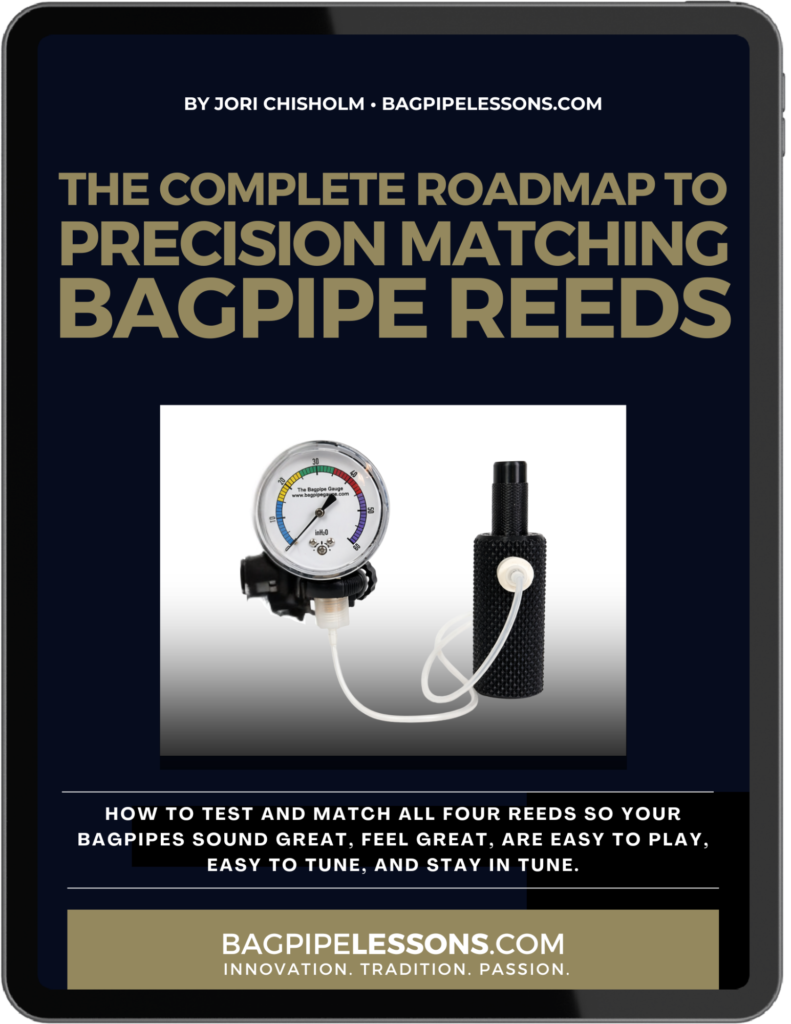
I’ve also put together a free downloadable guide that takes you through this step-by-step process. It walks you through exactly how to test each reed, what numbers to look for, how to compare them, and how to make the adjustments and verify that your adjustments are working to get all four reeds perfectly matched for ultimate efficiency, steadiness, and sound.
Remember, what’s your goal? Pipes that sound great, feel great, are easy to play, easy to tune, and stay in tune. The link for the download is in the description below.
Step number one: measure your pipe chanter reed. This is your starting point. Your chanter reed determines the target pressure for your entire setup.
Put it in the reed tester. Measure the pressure where the high A sounds best. You can also play your pipes and measure your pressure while playing where that high A sounds great. That’s your target pressure. Write it down.
Step two: test and measure every drone reed individually. Record three numbers:
- What’s the pressure you need to get that first tone?
- What’s the pressure you need to kick into the second tone?
- What’s the pressure where the reed shuts off completely?
Now you’ve got the full picture of your reed setup. Do that for all three reeds.
Step three is to identify any mismatches.
This is the most important thing you want to look at, which is the pressure where the drone kicks into the second tone. You want to make sure that that reed has kicked into that second tone.
You want that drone to kick in at the same pressure, or slightly lower than your chanter reed. You’re looking for all three drones to kick into that second tone at the pressure that your chanter reed kicks in—that’s the sweet spot.
If one drone is significantly higher, you want to bring the pressure down by moving the bridle to close down the tongue of the drone reed.
You also want to check the cutoff pressure for your drone reeds and make sure that your drones are not in danger of shutting off due to very slight fluctuations in your blowing pressure.
Step four: adjust and verify. This is where the magic happens.
Make a small adjustment to your reed—something like moving a reed bridle—and see what happens. Test it again. See if the numbers moved in the right direction.
Maybe you need to adjust it more. Maybe you went too far and you need to go back. Every adjustment is now an experiment that you can verify.
You’re not guessing. You make a change. You measure the result. You know what you’ve done. You know if you’re actually making progress. You can see it.
You can use the Bagpipe Gauge and the reed tester to adjust the tuning screws on your drones, too. Once you know the right pressure, use your tuner app to measure the pitch from your drone and make any adjustments you need to the tuning screw to get your tuning at exactly the right position on the drone and the right pitch.
Check out my YouTube video all about setting up drones and drone reeds for more on that topic.
Step five: install the adapter with your full set of pipes and enjoy practicing with your Bagpipe Gauge with all three drones going.
Full sound, full resonance, and the gauge is showing you your steadiness and your pressure. This is the ultimate practice setup for working on your steady blowing.
No silenced drones, no compromises. This is how you practice steady blowing. When your pipe chanter is the perfect strength for you and all three drones are matched, something amazing happens. Your pipes feel easier. The drones lock in, and they stay locked in. The sound is full and rich and stable. Your pipes are easy to tune, and they stay in tune. And you’re comfortable because you’re not fighting your instrument. Everything is dialed in. This is what it feels like, and now you know what it looks like.
Until you’ve felt it, you don’t know what you’ve been missing. Without this tool, you’re guessing at reed strength because you’re doing it by feel. You’re adjusting bridles and tuning screws using your ear and hoping for the best.
You’re spending hours setting up your pipes, but never quite sure that you got there. You’re left wondering whether the problems are your pipes or your playing. And maybe you’re just a little bit afraid to even touch your setup, because the last time you tried something, things got worse.
Now, with this tool, you know the precise strength of your pipe chanter reed. All three drones are perfectly matched at the same pressure. Every adjustment you make is verified with real numbers.
You can get your pipes set up and dialed in fast—something that used to take days or more. You know with certainty what your problems are, and you can fix them fast.
And you’re getting the full bagpipe practice experience, working on your steady blowing with all three drones sounding—the full sound—with the Bagpipe Gauge showing you everything.
That’s the difference between guessing and knowing, between fiddling around and mastering, between being scared to touch your pipes and having pipes that really sound and feel amazing.
So I know this is a lot of information, and I want you to be able to go through this with your own pipes step by step.
So download my free guide that walks you through this entire reed matching process. It shows exactly how to test your pipes, how to test each reed, what numbers to look for, how to compare them, how to make adjustments, and verify that your adjustments are working.
The goal is pipes that sound great, feel great, are easy to play, easy to tune, and stay in tune. You can do it. Download my free guide. It gives you the exact roadmap.
The Precision Reed Tester and Drone Adapter is available right now at BagpipeLessons.com/bagpipegauge. You can get it as a standalone if you already have the Bagpipe Gauge—just add it to your gauge and you’re ready to go.
And if you don’t have the Bagpipe Gauge, you can get them together as a bundle. It gives you the complete system: a precision reed testing tool to match your reeds perfectly, and the ability to do full three-drone bagpipe practice with real-time pressure monitoring on the Bagpipe Gauge. You can see your bag pressure in real time.
You can measure every reed on your pipes. You can match all four reeds to each other perfectly and objectively. You can diagnose and fix your problems in minutes instead of days. And you can practice with the full three-drone sound, with the Bagpipe Gauge right there guiding you visually.
The Bagpipe Gauge changed the way pipers think about steady blowing. The Precision Reed Tester and Drone Adapter will change the way you think about setting up your pipes. Together, they give you a level of understanding and control over your instrument that most pipers have never had.
I’ve got links below to more videos all about steady blowing and the Bagpipe Gauge. One of the videos was recorded during a live group class I did with members of my BagpipeLessons.com Inner Circle. The Inner Circle gives you full access to the very best of everything at BagpipeLessons.com, including weekly live Zoom classes with me and access to my exclusive lesson library with hundreds and hundreds of videos and lessons and tunes and exercises, product demos, and more on nearly every topic in piping—from music theory to technique, maintenance, setup, memorizing tunes, band playing, solo playing, competing, piobaireachd, and more. And you get personalized support from me to help you reach your piping goals. To learn more, check out my Inner Circle at BagpipeLessons.com/membership.
If you like this video, hit the subscribe button and hit the little bell so you don’t miss out on any of my new videos, and leave a comment below.
I want to hear about your experience with setting up your pipes, setting up drone reeds, setting up chanter reeds, using the Bagpipe Gauge, and once you get your Precision Reed Tester and Drone Adapter, I want to hear about it. How’s it working for you? What problems have you been dealing with? And how have these tools helped you? I would love to hear from you.
Let me know. Thanks again for watching. Happy piping. Mahalo.
Precision Reed Matching
Introducing a new tool to test and match all four bagpipe reeds to achieve harmony without guessing.
step-by-step
WATCH More Videos