
AS FEATURED IN

The Secret Blowing Technique Used By Top Pipers: The 80/20 Rule Revealed
by Jori Chisholm, Founder of BagpipeLessons.com
Last Updated: May 9, 2026
One of the biggest questions in piping is: how do the world’s best pipers get that bright, rich, steady, locked-in sound that stays in tune all the way to the end?
In this video, I share something I’ve never taught publicly before: a hidden breathing pattern I discovered after studying close-up videos of champion pipers and timing their inhale/exhale cycles.
I found that top pipers use a very consistent breathing cycle (roughly 2.5–3 seconds)
- 80–85% of time is used blowing into the bag
- 15–20% of time is spent inhaling
I call this the 80/20 Rule, and it’s a powerful way to build steadier bag pressure, better tuning stability, and more consistent tone.
Links to Products Mentioned in the Video:
Watch the video below.
Read the full video transcript below.
Video Transcript: Now, I want to tell you a story, because what I’m about to share with you is something that I have never discussed or taught publicly before. For years, I have been fascinated with this question.
Not only how do you blow your pipes steady, but something more specific: how can you blow your pipes to get that amazing, world-class sound that the world’s very best pipers get?
We know we need to keep a steady bag pressure. We know we can do that with a combination of blowing and squeezing the bag with the arm. We know that the exact right pressure for our pipes is determined by the high A. And we know we can get better at blowing steady by using the Bagpipe Gauge to see visually what’s going on with our pipes—not only the steadiness, but the strength of our pipes.
But is there some other secret technique or method to unlock that amazing, bright, rich, full, and steady sound that these world champion pipers can produce? Is there something that they are doing that is different from everybody else? How exactly should you blow into the bag? Should you take long, deep breaths or short, fast ones? How much of the time are you actually blowing, and how much of the time are you taking a breath? Does it matter? Are there many ways to do it, or is there one best way?
Well, the answer lies in observing the pros, in observing these champion pipers—the best of the best.
There’s an amazing video of a piping recital held in Cork, Ireland, in 1980. The piper is the late, great Donald MacPherson. He is widely considered to be one of the greatest solo pipers of all time. He was definitely the most successful solo competition piper of the 20th century. He won nine Clasps at Inverness and 50 Senior Piobaireachd titles at Oban. Nobody else even comes close to that amazing competitive track record.
Seumas MacNeill, the famous piper and writer, called Donald MacPherson a “prize-winning machine.” How did he do it? Great playing, great expression, great fingering—but his sound. More than any other piper in history, Donald MacPherson is credited with helping create the modern bagpipe sound. His tone was full, rich, perfectly steady, perfectly tuned, and the tuning stayed locked in even during these really, really long tunes—20 minutes or more.
Donald MacPherson achieved a level of quality and steadiness and perfection that was decades ahead of his peers. When watching the video of Donald MacPherson playing in that recital in Ireland, something caught my eye. It was his blowing—specifically, how he blew his pipes.
Long, steady exhales into the bag, followed by very quick inhales. It’s very dramatic. Once you notice it, you can’t not notice it. He’s obviously in great piping shape, and his pipes are set up to perfection, but the cadence of these really long blows with the quick inhale breaths was very noticeable.
So, I wanted to figure out: what was he doing here? What was this pattern? What was this technique? Did he do it consistently? And was this the secret to the Donald MacPherson sound?
So, I started watching videos of other top pipers—both pipers from today and from the past. YouTube is an amazing resource for this. You can get high-quality videos with close-up views of pipers. You can see their faces, and you can see their blowing patterns. You can see the rhythm of the inhale and the exhale. And piper after piper had similar blowing patterns.
So, this inspired me to do some real detailed research. I found videos of all the top pipers I could find from today and the past, and started watching and timing their blowing patterns. All the famous pipers you’ve heard of—Gold Medal winners, Clasp winners, famous Pipe Majors—even some of the great pipers who are no longer with us, like Donald MacPherson, John D. Burgess, and one of my teachers and mentors, Pipe Major Alasdair Gillies.
I timed the length of every breath—the inhale and exhale—down to the hundredth of a second and started building a wealth of data. What I found was remarkable.
There was consistency across performances and across players. The variability in blowing patterns was minimal. These top pipers all seemed to follow the same pattern. There was a very consistent ratio of blowing into the bag and breathing in, and how long it takes to complete one inhale-and-exhale cycle was also very similar across players.
There was a secret method, a technique, a pattern that was hiding right there in plain sight. After collecting and analyzing all this data, here’s what I discovered.
The length of time for completing a blowing cycle—meaning one inhale and one exhale—was very consistent, and right around two and a half to three seconds in length. Very consistent when looking at a player across the length of their performance and across multiple performances. And also surprising to me that it was consistent across different players.
And what about the time spent blowing into the bag versus the time spent taking a breath?
If you ask pipers and say, “How much of the time are you blowing into the bag versus taking a breath?” you will hear a wide range of numbers—all the way from 50/50 to 60/40 to other numbers.
Here’s what I found. These top pipers that I measured all had a very specific and consistent ratio.
They all spent approximately 80 to 85% of the time blowing air into the bag, and only about 15 to 20% of the time taking a breath.
Maybe the great pipers have been doing this for generations, or maybe Donald MacPherson did it first—we will never know. But the amazing thing to me is that all of the top pipers that I observed and measured blow their pipes in nearly exactly the same way. There is very little difference in the total length of time it takes to breathe in and blow into the bag, and the same proportion of time spent blowing versus taking a breath.
I was not expecting this, and I suspect most pipers don’t even know they’re doing it. I didn’t. I learned to blow my pipes over years of practice and adjustment and refinement, trying to get steadier, trying to achieve that great, steady, amazing bagpipe tone.
So what I’ve discovered, I’m calling the 80/20 rule. And I believe this is the key to achieving that kind of stability, tone quality, and tuning precision that defines the world’s greatest pipers.
Think about what this means. The world’s top pipers are all using a near-identical pattern of blowing their pipes—spending 80% of the time blowing into the bag, 20% of the time taking a breath, with a total blowing cycle of two and a half to three seconds.
Now, why is this so effective? I think there are four reasons.
First, your bag stays consistently full. A full bag is easier to keep at full pressure. The tightness of the bag material helps you keep your pressure up.
Second—and this is a big one—it maximizes the time that you’re using two muscle groups to keep your pressure up. You’re using your arm and your blowing muscles. The combination of arm and blowing together is more stable than relying on your arm alone. By keeping the inhales as short as possible, you’re minimizing the time that your arm has to maintain the pressure by itself.
When you watch top pipers play, you can hardly see the bag move. How is that possible? I remember watching Alasdair Gillies—how does he do that? His arm, his bag—nothing moves. It’s only possible if the bag barely deflates. And this is exactly what happens when you take these very quick, short inhales.
Third, it’s easy to take a quick breath in—there’s no resistance. You’re simply breathing in air. On the other hand, blowing into the bag requires more strength and control, because you’re working against the pressure already present in the bag that you’re applying with your arm. You need to blow in a way that matches the bag’s pressure so you don’t create a pressure spike. That’s why these long, slow, steady exhales are important—it allows you to regulate your blowing into the bag in a controlled, consistent way.
And this fourth one—this is crazy—this really surprised me. The total time of the breath cycle of two and a half to three seconds matches perfectly with the breathing rate of people when they’re doing moderate-intensity exercise. This is something you can do for 20 minutes if you’re not in very good shape, or between 30 minutes to an hour if you are in good shape.
So you’re aligning your blowing pattern with your body’s natural rhythm. You’re not only keeping your bagpipe steady, but you’re keeping yourself physically comfortable so you can sustain these longer performances.
And this last point really matters. If you’ve ever wondered why you get tired or out of breath after playing your pipes just for a few minutes, it might be that your pipes are too hard. It might be that your pipes are taking too much air. It might be that you’re out of shape. Or it might be that your blowing rhythm is fighting your body’s natural breathing rate instead of working with it.
The 80/20 rule solves that.
So how are you going to practice this? Let me give you some ideas for how you can integrate the 80/20 rule into your bagpipe practice today.
First off, you’re going to need the Piper’s Metronome.
You can set this to 100 beats per minute and use a 5/4 time signature. This creates a five-beat cycle. You blow for four beats, and then you take a breath for one. That gives you the 80/20 rule.
Set your accents on beats one and five. The “one” is when you start your blowing, and then you breathe in on five.
Blow in, blow in, blow—just like that. Four beats blowing, one beat breathing in. That’s 80/20.
By practicing with the Piper’s Metronome, you’re training this blowing cycle into your muscle memory. Over time, your body is going to learn to perform it automatically. You get used to these long, strong exhales and these quick inhales.
So you’ve got the pressure on the gauge, you’ve got the blowing cycle and the 80/20 rule on your Piper’s Metronome. The simplest exercise possible is just a single note. Just hold it—just one note.
Next, what I call the “super slow scale.” Just start on low G and work your way up to high A really slowly. I like three or four breaths or more on each note. You can stick a high A between every note of your scale—so high A, low G, high A, low A, high A, B, high A, and so on. Again, three, four, or five breaths per note. This is really good for controlling that tendency to change your pressure. The high A is going to let you know if you’re at the perfect pressure.
You’ve got your gauge, you’ve got your metronome—finally, you’re ready to try a simple slow tune.
Find the easiest, simplest tune you know and play it at an extra slow tempo. You’re increasing the complexity of what you’re playing, and the steadiness and the 80/20 rule will start to become more and more automatic.
You’re going to find that you’re going to get more tired sooner—that’s okay, and I would expect that. One of the first things you might notice is that your lips and your cheeks get tired, but this is because you’re blowing longer with a shorter time on those inhales. So your lips and your mouth get less time to rest. You also might find your arms and shoulder get tired as you get used to applying that stronger, more consistent pressure on the bag.
With all these exercises, the key is consistency.
Like any physical skill, steady blowing is going to become more natural with repetition—but you have to pay attention to what you’re doing. Focus on that. Keep what you’re playing simple.
Eventually, it will build into your muscle memory. And once you’ve got it and it’s more automatic, you can focus on your playing and your tunes and your expression, while your steady blowing is rock solid in the background.
Steady blowing is one of the most important skills you need to develop as a piper. And now you know the secret that the world’s best pipers have been using—the 80/20 rule. Long, steady blows for 80% of the time, quick inhales for 20% of the time. Two-and-a-half to three-second cycle. It’s going to make your pressure so much steadier.
Train with the metronome. Monitor your pressure with the Bagpipe Gauge, and watch your sound and your blowing transform.
So these are the tools you need. The Bagpipe Gauge gives you real-time visual feedback. It also shows you how hard your pipes are, so you can answer that question: is it my bagpipes, or is it me? You can get it at bagpipelessons.com/bagpipegauge.
The Piper’s Metronome—set it at 100 beats per minute, 5/4 time, with accents on beats one and five to train that 80/20 rule. You can get it at pipersmetronome.com. Available on the App Store for both Apple and Android.
I’ve also put together a brand-new free download for you.
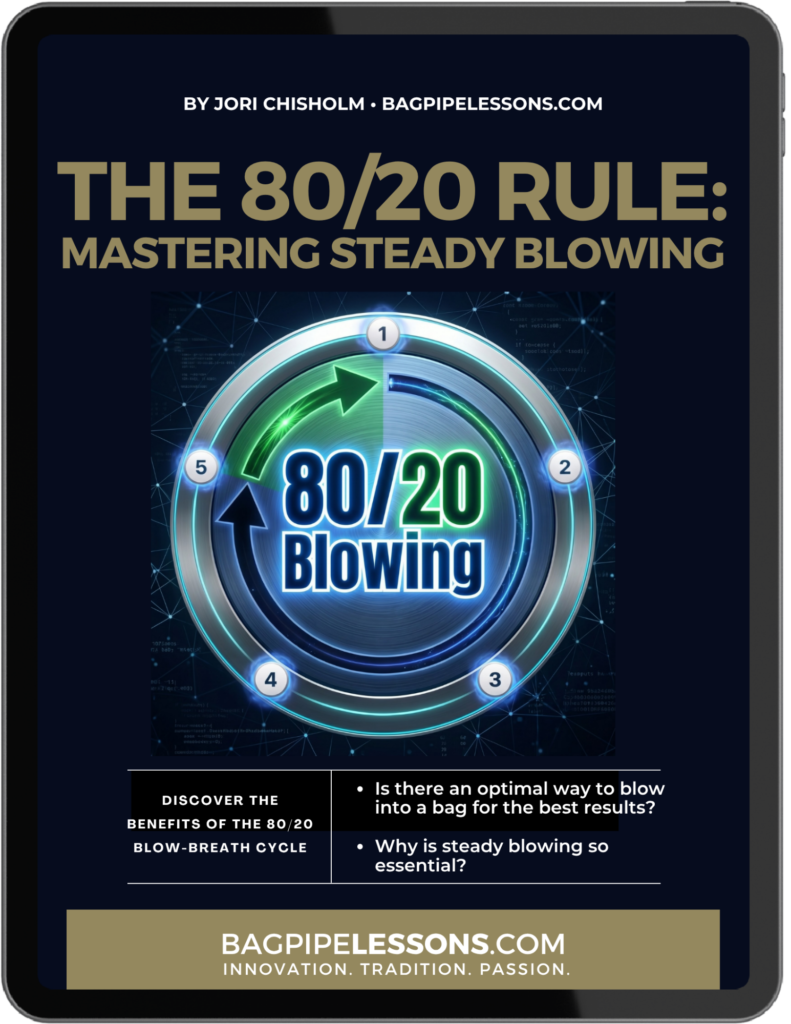
It’s called The Secret to Steady Blowing: Introducing the 80/20 Rule for Mastering Steady Blowing. It covers all of the key steps from today’s video in a written guide you can read and take home for your practice. Download it today at BagpipeLessons.com/8020blowing. The link is in the description below.
I have links below to more videos all about steady blowing and the Bagpipe Gauge. One of the videos is over one hour long, and it was recorded during a live Zoom class I did for members of my BagpipeLessons.com Inner Circle.
Membership gives you full access to all the best stuff at BagpipeLessons.com, including weekly live Zoom classes with me and other members, and access to my exclusive lesson library with hundreds and hundreds of videos, lessons, tunes, exercises, product demos, and more on nearly every piping topic. And you get personalized support from me to help you reach your piping goals.
To find out more and join my Inner Circle, please visit bagpipelessons.com/membership.
If you like this video, subscribe to my YouTube channel and hit the little bell so you don’t miss my next video. And I would love to hear from you—what is your biggest challenge with steady blowing? Have you tried the 80/20 method?
Let me know—I would love to hear from you. Thanks again for watching. Happy piping. Mahalo.
WATCH More Videos