

Free articleTechnique
How to Eliminate Crossing Noises For Good
A crossing noise isn’t a mystery: it means you dropped a finger before raising another. Here’s the rule that fixes it, and why it comes back under pressure.
The Short Version
A crossing noise is not a random blip. It is one specific extra note that sounds when the timing of raising and lowering your fingers is off between two notes. Once you know which two notes it sits between, you can work out exactly what caused it.
There are three kinds: switching (some fingers rise while others drop), rolling (fingers that should lift together come off one after another) and syncing (a gracenote that lands before or after the note change instead of between the notes).
The rule for switching: raise first, then drop. And because tension in your hands speeds up dropping fingers and slows down rising ones, relax your hands first, then adjust the timing only if you still need to.

Free guide (PDF)How to Get the Most Out of Your PracticePrefer a printable copy? Get the free guide, sent straight to your inbox.
Get the free guideCrossing noises are one of the most common things I hear in pipers’ playing, at every level, including the top players. The good news is that they are not mysterious. Each one has a specific cause, and once you can name it, you can fix it. This article comes from one of my live Inner Circle classes, where I spent a whole session on crossing noises.
 ▶Watch the videoBagpipe Essentials Masterclass Lesson #1: Master Top Hand Position for Clean Execution & ConfidenceJori Chisholm shows how to find the right top hand finger position on the practice chanter, starting with the ring finger and thumb and adjusting for…
What a Crossing Noise Actually Is
Here is my definition: a crossing noise is an unwanted sound caused by incorrect timing of raising and/or lowering fingers.
It is very quick, but it is not vague. A crossing noise is a particular note. If you go from low A to D and get a crossing noise, it is a low G, because the little finger dropped and closed the hole a split second before the three fingers above it came up.
Even a very quick one is audible. Years ago I was recording an album and heard a crossing noise while listening back in the control room. The engineer couldn’t hear it at all, but a piping judge would.
How it differs from a wrong note or a false fingering
A wrong note is playing C when the tune says D. A false fingering is playing the right note with a finger up or down that shouldn’t be, like lifting your pinky on C. You can hear a false fingering a little, more on the pipes than on the practice chanter, but if I had to pick the lesser of two evils, a false fingering is less of a problem than a crossing noise. A crossing noise adds an extra note that doesn’t belong in the tune.
The Three Kinds of Crossing Noise
1. Switching: some fingers rise while others drop
This is the first crossing noise most pipers discover, going up the scale from D to E. On the way to E, the bottom hand fingers come down and the top hand ring finger comes up. If the bottom hand lands first, you hear that low G.
When you play it correctly there is a tiny in-between stage. Going from low A to D, the three fingers come up and then the little finger drops. It happens very fast, but something has to move first, and it has to be the fingers that rise.
E to high A is another common one, and it can happen within one hand. To play it cleanly you lift the thumb and the two fingers just before the ring finger drops, so for a split second you are floating. Drop the ring finger first and you get a little low A in between.
The rule for switching: raise, then drop. Don’t close the chanter and then open it. Open it, then drop. This fixes every crossing noise caused by switching, including D to E.
2. Rolling: fingers that should lift together
Low G to B is a classic. Both the little finger and the ring finger have to come off together, and often they roll off one after the other, with the little finger leading. If you are already thinking “lift them together” and they still roll, give the ring finger a slight head start. Lead with the ring finger.
3. Syncing: the gracenote has to sit between the notes
Going from A to B is a single finger, so it can’t have a crossing noise on its own. Add a gracenote and that gracenote has to land exactly between the two notes. If the note change comes before or after the gracenote, you hear an extra sound.
Tachums are one of the worst for this. Take a B to G tachum without the dot cut. Players often slam the fingers down for the short B before the D gracenote has happened, so the gracenote comes in late and splits the low G into two notes. Now you have B, G and another G. An E doubling from F is another common spot. Make sure the gracenote between the two notes is played between the notes, not after the note change.
Some Transitions Can’t Have a Crossing Noise
There are nine notes on the chanter, so there are a lot of two-note combinations, but not all of them can produce a crossing noise. Low G to low A or A to B is a single finger, so there is nothing to mistime. Those you don’t need to worry about.
For the rest, the two notes tell you what to look for. When I hear a B to F crossing noise in a student’s tune, I know it is almost certainly rolling, not getting cleanly off to F. Find the two notes, and you have found the cause.
Why the Brief “False Fingering” Is Correct
One of the most common crossing noises I hear is in tunes with an A, C, E pattern. There is a D gracenote on the C, the C is very short, and players get a low A blip because the bottom hand moves to E before the top hand finger comes up. As far as the bottom hand is concerned you played a short C, but you never got to E.
The fix is to raise the top hand finger just before the bottom fingers drop. That means for an instant you are on a false fingering. Isn’t that wrong? It is technically a false fingering, but it is the correct way to do it. When some fingers lift and some drop, they have to pass each other somewhere. They can’t meet on the chanter, because that is the crossing noise. They have to pass in the air. At speed you can’t hear it or see it, unless you film it and slow it way down.
To train it, practice the in-between step and make it really long for a while. It feels strange, but you are building in a margin for error. If you get a crossing noise even once in a while, your margin is too small.
A Crossing Noise That Cost Me a Win
Years ago I was playing in the professional MSR at the Portland Highland Games, my hometown games. The judge was the great Alasdair Gillies, one of my piping heroes and one of the best pipers who ever lived. My pipes were sounding good and I thought I played really well.
The last part of my reel, Bessie McIntyre, is lively, with lots of movement up to high A, which means lots of crossing noise potential. I placed third. My sheet said great performance, great pipes, crossing noise in the fourth part. When I asked Alasdair about it (respectfully, because that matters when you ask a judge about a result), he said it was a big one.
I went back to the recording, and it was about the biggest crossing noise you could possibly play. I hadn’t even noticed it while playing. He was right, and I agreed with the result. That one crossing noise cost me 200 or 250 dollars, the difference in prize money between first and third. I still think about it.
Why Tension Causes Crossing Noises
So why does a crossing noise suddenly show up in a tune you can usually play cleanly? I think the answer is tension in your hands, from nerves, fatigue or habit.
Imagine a marionette, with strings pulling each finger down toward the chanter. You need a little downward pressure just to cover the holes. When your hands get tight, those strings pull harder. Any finger that is dropping comes down faster, and any finger that is rising comes up slower. On E to high A, the ring finger snaps down like a mousetrap while the thumb and other fingers are slow to lift. That shift in timing is all it takes.
That’s what I think happened to me in that MSR. It is also why crossing noises creep back when you start working on harder tunes. Harder tunes have more going on, and our natural response is to tighten up, which is the opposite of what helps.
How to Fix a Crossing Noise
- Find it. Crossing noises can be hard to hear while you play. Record yourself and listen back, or get feedback from your teacher, a judge or a piping friend.
- Name the two notes. The transition tells you what is going wrong.
- Work out which kind it is. Switching, rolling or syncing.
- Relax your hands first. Check whether you are gripping hard, slamming fingers down or pushing hard with your thumb.
- Then adjust the timing. Practice the transition slowly with an exaggerated in-between step, then bring it back up to speed.
Watch the full class. Inner Circle members can watch the complete 50-minute class replay, with chapters, key takeaways and the full transcript, in the Lesson Library.
Suggested Products
 Bagpipe Essentials MasterclassMy complete video course for the foundations of bagpipe technique.Learn more →
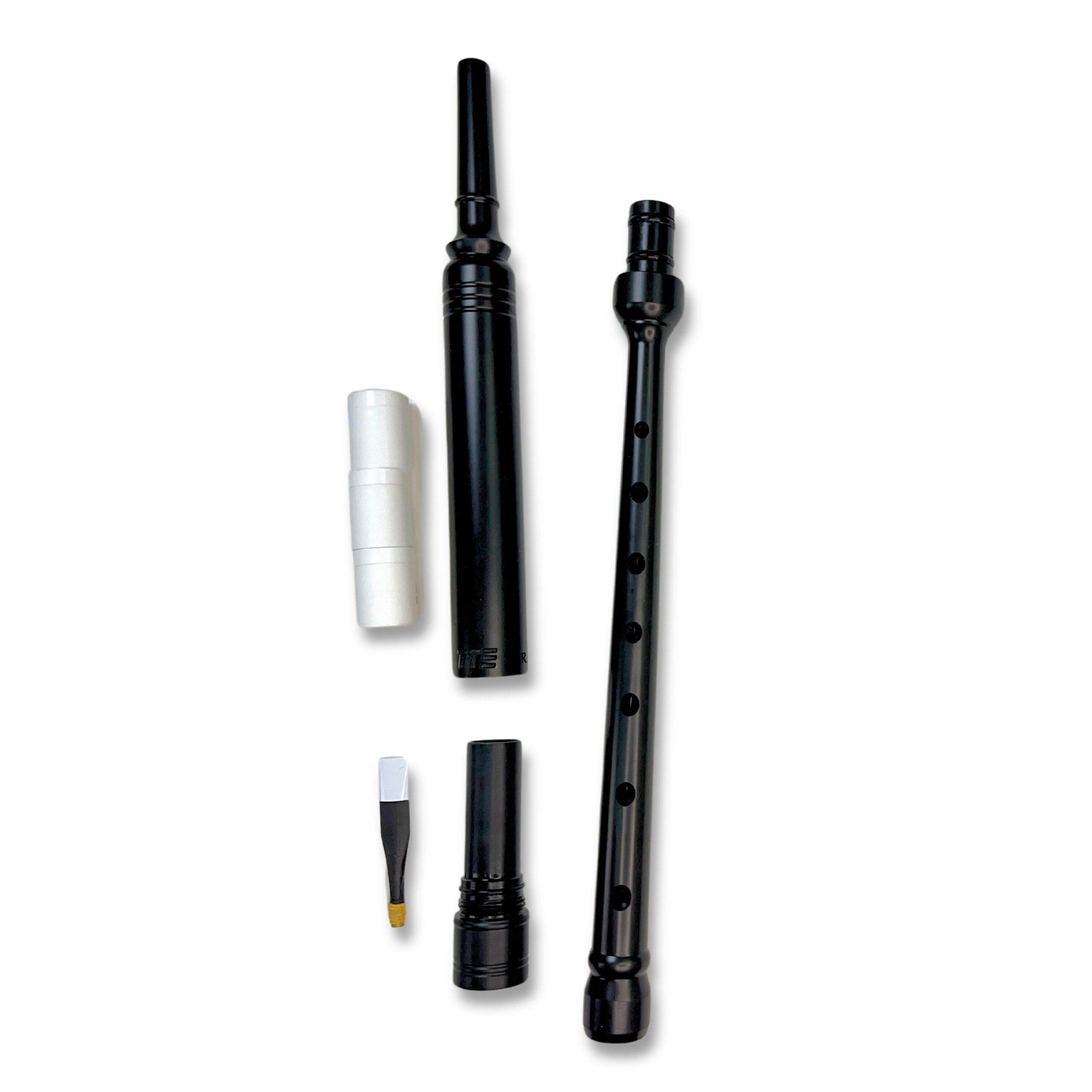 Endurance Practice ChanterThe only practice chanter with complete moisture control. I designed it, and R.G. Hardie & Co. makes it.Learn more →
 Practice Chanter Reed Variety Four PackFour premium practice chanter reeds, so you can find the one you like best.Learn more →
 Piper’s Advantage Phone MountKeeps your phone right where you play, for tuners, recordings and sheet music.Learn more →
More Free Guides
Pick any guide, enter your email, and I’ll send it straight to your inbox. See them all on the Free Resources page.
 Learn the Pipes Right
Start the right way, from your practice chanter to good finger position.
Get the free guide → Learn Tunes Fast
Avoid the common rhythm and timing mistakes.
Get the free guide → How to Get the Most Out of Your Practice
Clear goals and a simple routine for every practice session.
Get the free guide → Your First 100 Days as a Piper
What to expect in your first 100 days, from your first notes to your first tune.
Get the free guide → The Best Apps Every Piper Should Have
The tuner, metronome, recording and slow-down apps worth having.
Get the free guide → Bagpipes at Any Age
Answers to the questions people ask before they start, and what helps at any age.
Get the free guide →Frequently Asked Questions
What is a crossing noise on the bagpipes?
An unwanted extra note between two notes, caused by incorrect timing of raising and lowering fingers. It is a specific note you can identify, such as a low G between low A and D, not a random sound.
What causes crossing noises?
Three things: switching (fingers dropping before others have risen), rolling (fingers that should lift together coming off one after another) and syncing (a gracenote landing before or after the note change). Tension in your hands often makes all three worse.
How do I fix a crossing noise?
Find the two notes it sits between, work out which kind it is, relax your hands, and then practice the transition slowly with an exaggerated in-between step. For switching, raise first, then drop.
Which note transitions can’t have a crossing noise?
Transitions that move only one finger, like low G to low A or A to B. With no fingers passing each other, there is nothing to mistime. Adding a gracenote can still cause a syncing problem.
Why do crossing noises come back when I perform or play harder tunes?
Tension. Nerves, fatigue and harder music make your hands tighten, which speeds up fingers that drop and slows down fingers that rise. Relax your hands first and the timing often fixes itself.
Isn’t the momentary false fingering a problem?
No. When some fingers rise and others drop, they have to pass in the air, so a split second of false fingering is the correct way to play the transition. At speed no one can hear it, while a crossing noise is clearly audible.
Free guide (PDF)How to Get the Most Out of Your PracticePrefer a printable copy? Get the free guide, sent straight to your inbox.
Get the free guide
About the authorJori Chisholm
Bagpiper, bagpipe teacher and founder of BagpipeLessons.com. Teaching the bagpipes full time since 1999, now with live classes almost every week in the Inner Circle. Four-time U.S. Gold Medalist. Inventor of the Tone Protector, InTune Mic and Bagpipe Gauge.
More about Jori →